
Golfing hero Rory McIlroy shines a spotlight on the glens, beaches and fairways of his home

“Come with me,” says the man, with a knowing nod. “I think I know what you’re looking for.”
He’s spotted me wandering the perimeter of the clubhouse, conspicuous by my lack of golf bag and furtively clueless air. Locating stardust among a swath of neatly cut fairways and baize-like greens is harder than one might think.
The man leads me through a side door, down a corridor and we come out in a light-flooded foyer. In the centre stands a tall glass cabinet filled with trophies, signed tournament flags and personalised golf bags the size of wheelie bins. The curved wall is consumed by a photo montage of a curly haired child prodigy turned world beater. This is the shrine to Rory McIlroy at Holywood Golf Club, in the little County Down town of the same name, just outside Belfast.
In April, the town — make that, the entire nation — got its Hollywood ending. In a fingertip-gnawing finale and at the 17th attempt, McIlroy finally won the Masters, completing the elusive grand slam of golfing majors and thrusting the boy raised just a few streets from the club into sporting immortality.
McIlroy grew up honing his putting on a makeshift AstroTurf green outside the modest suburban home I’d passed on the way here. When he made a flying visit from his Florida base a few weeks back it was in a £75mn private jet (“I know what it cost because I checked the serial number,” the airport car rental employee tells me conspiratorially).
Cheering loudest at McIlroy’s Augusta triumph would have been anyone with a stake in Northern Ireland’s stutteringly resurgent tourism industry. Because, with impeccable timing, the Open is being staged here, at Royal Portrush Golf Club, this week — meaning the man of the moment contesting one of the sport’s most revered tournaments on home turf.
Interest has been unprecedented, particularly in the US, one of Northern Ireland’s biggest tourism markets; almost 300,000 spectators are expected for Open week and stirring footage of the County Antrim coastline will be beamed into an estimated 500mn homes worldwide. The longer-term benefits cannot be overestimated; like a misdirected putt on a championship-cut green, they have the power to just keep on rolling.
Portrush isn’t far away. In a country little bigger than North Yorkshire, not a lot is. Direct, if you were late for your tee time, it’s not much more than an hour’s drive from Belfast.
I’m taking the fabled coastal route, however — in golfing terms, a 142,000-yard (give or take) dog-leg left, lined by forested hills on one side and inviting sand traps on the other.
I join the single-lane coast road just north of the port town of Larne. Wind buffets the car and goads the sea into wavelets a little way offshore. On the gently sloping landward side, delicate crimson fox’s brush flowers are all that break the 50-shades-of-green.
The natural beauty is not always matched by the man-made. Covid hit hard in this detached corner of the UK, and most villages have a shuttered business or two, the murals decorating the boarded-up windows only adding to the pathos.
But just as decline can snowball, so can regeneration. It just needs a beacon and that’s exactly what master distiller Darryl McNally and hotelier Adrian McLaughlin are creating in the shorefront village of Carnlough.
Their £1.75mn transformation of what was the Londonderry Arms, now The Harbourview Hotel, is the biggest development in these parts since philanthropist and landowner Lady Frances Anne Vane-Tempest rebuilt the stone harbour in the 1850s and laid a railway from it to the limestone quarry on the hill behind the village.
This is now a 2.5 mile round-trip walking trail that I tackle in the lingering light of a late summer evening. A squall sends me scuttling back to The Harbourview where I sit with Darryl and Adrian by the fire in The Wee Bar and hear about their passion project.
Billed as Ireland’s first destination whiskey hotel, the offering spans tastings, themed dinners and even boat trips to distilleries on the Hebridean island of Islay. The whiskey collection numbers more than 300. Rory’s yet to visit, although the £11,000 bottle of 46-year-old Bushmills winking at me from a glass cabinet might be his sort of drop if he does.
The following morning, I drive into the slender glens that extend down to the shoreline like the imprint of fingers in putty. Glenariff is the pick: a glacier-smoothed valley with high basalt ridges from which waterfalls cascade, twisting in the wind as they plummet.
Cushendall, at the foot of the next glen around, proves the east-coast highlight. Perhaps it’s the soft onomatopoeic quality of the village’s name or the freshly painted pastel shades of the houses. Or maybe the lone, smooth-flanked peak behind, like a Monument Valley butte dunked in a vat of vivid green paint.
The sport of hurling sits at the centre of village life — literally so, in the case of the giant mural on the wall of the riverside Lurig Inn. But golf is a close second. Elitism tarnishes the sport in many parts of the world but not in Northern Ireland. Most children dabble when growing up; clubs are abundant and — hallowed links such as £420-a-round Royal Portrush aside — affordable.
Cushendall’s club, like many, is somewhere between community centre and café-restaurant. Wood-framed pictures of the male and female presidents and captains in the lobby stretch back to the 1940s. Elderly couples are playing bridge in a side room.
Through the open windows of the upstairs bar I can hear the waves raking the pebbles of the adjacent beach. I watch would-be McIlroys lining up their approach shots on fairways so green I can’t quite take my eyes off them. A pay-and-play round is £25.
Stripping some external paintwork at a locker room doorway is 85-year-old Niall. “I’m a serial volunteer,” he says, by way of explanation. He’s got a ready smile and dabs at his eyes constantly, like perpetually recovering from a punchline. He’s been a member for 62 years.
We talk weather. Green speeds. Rory. He’s a big fan — “of course!” — but won’t be going to this month’s Open. “Other commitments, sadly,” he says. Last time he visited Portrush for a major tournament, he went by boat round the coast. “It was quite the way to arrive,” he says proudly.
From Cushendall, the primary coastal road veers inland on a corner-cutting glide across patchwork fields and wide-open moorland.
If the east coast has the charm, then the north has the drama. The skeletal remains of castles cling to windswept headlands. Giant seas froth at the foot of cliffs that rear up like ancient fortress walls.
One of the finest examples of these is framed by the restaurant window of my hotel, the luxurious Salthouse on the southern fringes of Ballycastle. Over a late-night tipple, I resolve to hike it.
At dawn, I drive back on myself a short distance and cut towards the coast, following the signs for Fair Head. I park in the makeshift farmyard car park, drop the suggested £2 in the honesty box and set off on the blustery coastal path.
Sheep and cows close in, confusing me for their breakfast supplier. I cross a stile and suddenly I’m on the edge of the 200m-high dolerite cliffs, my clothes billowing out behind me like I’m shooting the video for a 1980s power ballad.
The dark stain on the horizon is the Mull of Kintyre, barely 20km away. Thirteen centuries ago, this corner wedge of Northern Ireland and the western seaboard of Scotland formed the thriving transmarine kingdom of Dál Riata. Seafarers and subsistence farmers spread language, faith and culture. It’s why the north Antrim accent can sometimes seem closer to lowlands Scots than Irish.
Golf isn’t everyone’s cup of tea but even Twainian-style sceptics would have to concede the aesthetic value of good links. And Royal Portrush Golf Club, a short drive west, is certainly that.
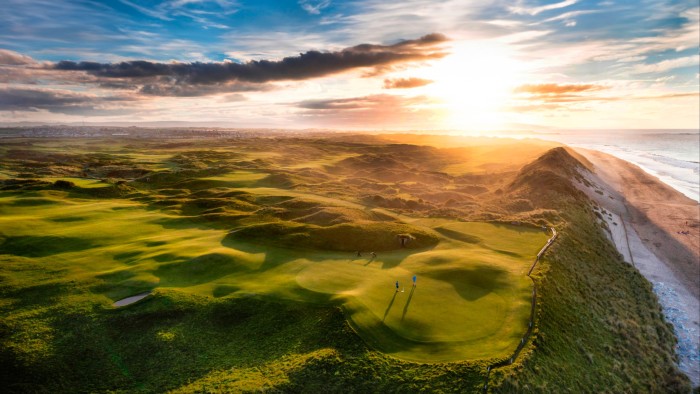
Approaching, it brings to mind a particularly well-manicured nature reserve — a subdued riot of gorse and fescue, ferns and wildflowers punctuated by creamy pockets of sand. One edge is defined by the coastal road, the other by towering dunes.
A temporary town of grandstands and marquees is being assembled ahead of the Open and the white pin flags are in place. They don’t so much flutter in the fabled Portrush breeze as convulse. I’m here for a lesson with club pro Charlene Reid, 37. She has bouncing red curly hair, and the healthy hue of a seasoned golfer. She’s known Rory since they went on a golf tour to Austria together, she as a 16-year-old, he exactly a year younger. “We share the same birthday — Star Wars Day, May the 4th,” she says, with a giggle.
The practice area is just behind the 18th green. So, before we start, Charlene sneaks me in through the tunnel beneath the temporary stands and I tiptoe tentatively on to the green. The Open scoreboard rises from behind navy blue stands. If Rory is top of this as the shadows start to creep across the fairways on Sunday, July 20, the moment may never be forgotten.
“What’s he really like?” I ask later, having finessed another approach shot into the thick rough beyond the practice green.
“Well put it this way, there aren’t many anti-Rorys,” she replies. “He wears his heart on his sleeve and he kind of tells us exactly what he’s thinking. He’s a very good ambassador for golf — but an even better one for the country.”
Portrush itself, a short walk from the course, is also prepping for Open week. Few places will be as busy as The Harbour Bar, which looks out over the waves advancing on West Strand.
It’s a spartan yet cosy spot made to feel even snugger by the golfing memorabilia carpeting the walls and ceiling. It’s popular with the players when Portrush is hosting big tournaments; assorted actors, too. There’s a picture of James Nesbitt. A picture of Jamie Dornan. A picture of Nesbitt holding the picture of Dornan. The echo of innumerable riotous nights is palpable.
If The Harbour Bar is Darren Clarke, the cigar-chomping local who won the Open in 2011 and to whom there’s a shrine in one corner, Rory is more Dunluce Lodge.
Whitewashed and pristine, like a pair of freshly pressed final-round golf trousers, Northern Ireland’s newest five-star enjoys an unrivalled setting alongside the fourth fairway of Royal Portrush. There are 35 luxury suites, entire walls of champagne bottles, a spa complex and a private-dining space crafted to resemble the inside of a bourbon barrel where I find a nine-litre Salmanazar of Bollinger.
In what we should probably call an Open secret, Rory will be basing himself here during tournament week — likely in the cavernous course-view suite to which I’m ushered. Will he also fill up the huge tub, open the shutters and — with a big, fat schadenfreudian grin on his face — watch through the room’s antique brass binoculars as golfers battle the elements in vain? I like to think so.
I have one final stop on my tour. It’s not golf related, although it would make one hell of a bunker. The sands of Benone Beach extend for 11km, from the cliff-edge 18th-century folly of Mussenden Temple to Lough Foyle, which defines the north-west border with Ireland. It would take an age to walk it, which is why some visitors drive, gliding gently along the flat, firm sands in SUVs or campervans and perhaps pulling up in a quiet spot for a few nights’ peace.
Operating here is the HotBox mobile sauna. It’s the brainchild of 30-something couple Carl Isaksson, a taciturn Swede, and his wife Anna, who’s from Limavady, just down the road. The former’s waiting to welcome me, with their wood-fired creation already towed into place and primed to 85°C.
“What’s the best technique?” I ask Carl. “Sea then sauna, or sauna then sea?”
“As you wish,” he says.
I opt for the former, plunging into the invigorating water then rushing back to baste myself while admiring the waves through the letterbox window, soundlessly pounding the shore. Then it’s rinse and repeat.
As I’m leaving, I ask Carl if he thinks this is the best beach in Northern Ireland.
“Well, look at it,” he says simply.
So we do, two outsiders transfixed by a golf-mad little country braced for what could be a defining moment.
Find out about our latest stories first — follow FT Weekend on Instagram, Bluesky and X, and sign up to receive the FT Weekend newsletter every Saturday morning
Read the full article here