

The author Lucy M Boston first glimpsed the Norman house known simply as The Manor from a punt on the River Great Ouse in 1915. Its somewhat neglected yet deeply romantic gabled Georgian brick façade quietly captivated her. “It was beautiful and right,” she remembered in her 1973 memoir of the hidden riverside dwelling, encased by elms, beyond whose boundaries she frequently disrobed for wild swims. Little more than two decades later, in 1939, it was hers.
Built in the early 1100s in the East Anglian village of Hemingford Grey – 15 miles north-west of the city of Cambridge – it is one of England’s oldest continuously inhabited homes. The rare untouched rooms were to become a transformative force in Boston’s life, forming the inspirational wellspring for the sextet of Green Knowe children’s books, the fourth of which won the Carnegie Medal. Boston compared her relationship with The Manor to an emotive, all-encompassing affair. “Like all old lovers, the house and I have grown alike,” she wrote.
Boston’s arrival, as a lone woman in her 40s, sparked villagers’ suspicion (they thought she was a spy). Having split from her husband, she had been learning to paint in Italy and Austria, and had a predilection for dirndls. Despite the backdrop of the second world war, she described The Manor’s two-year renovation – enacted together with her architect son, Peter, who also illustrated her books – as the happiest of her life. Together they uncovered the myriad secrets buried beneath the house’s 900-year-old walls, bringing its Norman features – windows, arches and fireplaces – to light.
Once home to nobles, merchants and landowners (including Oliver Cromwell’s great-grandfather and 18th-century celebrity siblings the Gunning Sisters), The Manor is now under the custodianship of Boston’s 85-year-old daughter-in-law Diana. “It was never my intention to live here,” says Diana, who took over the house with her late husband, Peter, and opened it to the public after the author’s death at the age of 97 in 1990. She has been hosting tours of the house and garden to visitors from around the world ever since. A former teacher, Diana is now The Manor’s historian-in-chief. “I was in awe of her,” she says of her mother-in-law. “Though I was better on a tennis court.” (When Diana suggested she might move in to help her mother-in-law, then in her 90s, Lucy quickly replied: “Lovely idea but I think you’d get in the way of my social life.”)
Encased by fragrant lawned gardens, with a secluded secret meadow, long, deep rows of borders rich with old roses, Cedric Morris irises and an avenue of yew topiary, it’s a place that remains very much alive. Once little more than a two-storey Norman hall, fortified by a moat with the first-floor living quarters accessed by a retractable ladder, the house was gradually enlarged and reworked in the 16th and 18th centuries (the property doubled in size in the latter). When Boston moved in, all the water was still drawn from a well under the kitchen floor (200 swings of the handle got you a bath) – which now replenishes the garden.
Surprisingly little has altered since Boston began writing her celebrated books, published from the 1950s to the ’70s, whose eerily imaginative pages are populated by The Manor’s army of former occupants. Today, the white walls are adorned with delicately enigmatic textiles and murals by Boston’s friend, the English painter Elisabeth Vellacott (whose work was acquired by the Tate when she was in her 90s), alongside Peter Boston’s colourful and wonderfully precise renderings of the Green Knowe children (including the protagonist, Tolly, based on him).
At the far end of the hallway corridor is the low-ceilinged kitchen, with Pompeian red walls and an Aga. Beyond it, after a twist and a turn, is Lucy Boston’s centre of operations – the oak-floored dining room. More of a sitting room, it is dominated by an expansive inglenook fireplace (for many years the sole source of heat) built in the 16th century, which Boston’s grandchildren referred to as “the window to the sky”. In the corner is a bust of Lucy’s grandfather, the first mayor of Southport, and a Norman arrow-shaped window, hidden behind a Regency cupboard. At the windows are patchwork quilts bought from Muriel Rose’s influential 1920s craft emporium, The Little Gallery in Chelsea.
It’s here, at the table set with Regency Trafalgar chairs, that Boston diligently wrote during the winter months (summers were reserved for creating the garden, which was non-existent before her arrival). Her motivation was both monetary and, as she put it, “to people the house with its own family”. The books found instant success – they were translated into myriad languages, including Afrikaans, Japanese and Korean, and adapted for the screen by writers including Julian Fellowes.
Upstairs, the first-floor bedroom walls are clad in tatami mats (fixed with batons and drawing pins). The space now serves as a makeshift museum for Boston’s surprising secondary talent as a seamstress. “Her hands were busy, and that left plenty of time for her brain,” says Diana, highlighting the globally important heritage collection of patchworks, renowned for their painstaking precision, which Boston stitched well into her 90s.
Elsewhere, much of the decoration is handmade. The wall lights are crafted from buckram, a type of woven, bleached and starched cotton, attached onto a wire frame. “You go through grand houses and look at grand things, but most things here could easily be part of your life – it’s graspable,” she says.
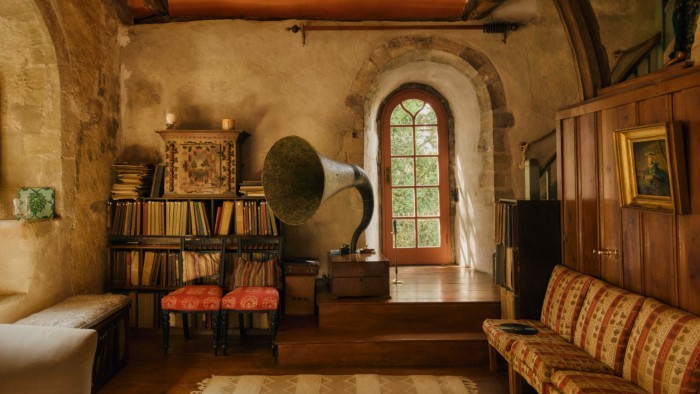
An elegant beamed bedroom with architectural details straddling six centuries gives way to a cavernous music room where Boston hosted twice-weekly war-time listening parties. Busloads of airmen were welcomed, making themselves comfortable beside the Norman fireplace on seating fashioned from mattresses covered in candlewick bedspreads. Visitors continue to enjoy records played on a 1920s gramophone, whose giant horn is made out of old telephone directories.
But it’s in the attic where The Children of Green Knowe really comes to life. Its simple interior is furnished with a rocking horse from Lucy’s childhood, an heirloom painted wooden toy box and a small wooden mouse – all of which are personified in the book’s pages. It’s a modest, if no less magnificent, early rendering of the Harry Potter experience; for Diana, it’s a gentle reminder to a cynical world “that magic still exists”, she says. “Visitors go away and tell me they’ve taken up painting or patchwork or writing. Lucy wasn’t published until she was 62 – she inspires people to try their hand.”
Details for tour bookings can be found at greenknowe.co.uk
Read the full article here