

Unlock the Editor’s Digest for free
Roula Khalaf, Editor of the FT, selects her favourite stories in this weekly newsletter.
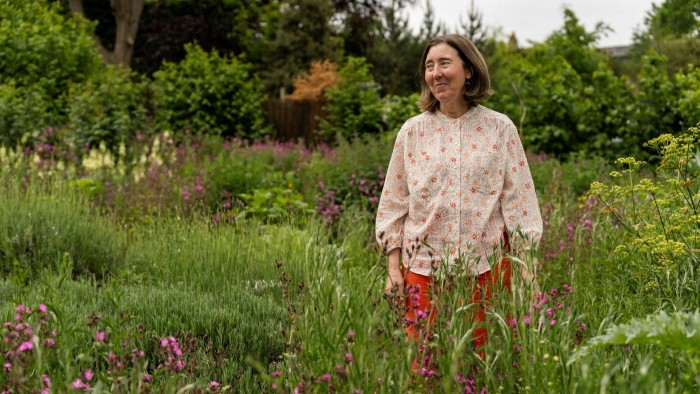
The traffic-laden Archway Road in north London is not where you’d expect to find one of the UK’s most fascinating gardens. But venture down a side alley off Highgate High Street and you’ll find a lush, curvaceous tangle where the air is heady from banks of rosemary and lavender, and sinuous paths skirt a pond overhung by willow and birch.
The somewhat secret spot is OmVed Gardens, first opened in 2017 by Karen Leason. Having been involved in educational and environmental initiatives as well as natural childbirth provision in India, she chose the name, OmVed, from two Sanskrit words relating to wisdom and the universe. When Leason bought the site it was a garden centre; its transformation involved digging up large areas of tarmac and concrete to create not only a beautiful retreat but also a community hub and event space. This month, the initiative, a Community Interest Company (CIC), is being relaunched as the “UK’s first centre for food, ecology and creativity”.
The project did not start with this as a predefined vision. Through conversations between Leason and landscape architect Paul Gazerwitz, winner of two medals for his work at the RHS Chelsea Flower Show, the idea emerged to focus on habitats. “That has been the foundation of all that we do,” says Leason.
In 2017, the first OmVed event was a dinner for the UN’s World Food Programme to discuss ways that a small north London garden could contribute to global efforts towards greater food security. Every June, the garden plays host to the Chef’s Manifesto, another UN initiative, which sets out to harness the power of the culinary industry to create fairer and more sustainable food systems.
OmVed may be forging its own path, but it is among a number of innovative urban ecological initiatives reconnecting people in imaginative ways with the food we grow and eat. Take Amy Franceschini’s Victory Garden in San Francisco, begun in 2007, which has grown into a city-supported network of urban farmers; or artist Annie Lord’s The Neighbouring Orchard in Edinburgh, commissioned by Art Walk Projects, which has planted over 160 apple trees in gardens along the coast.
OmVed aims to inspire conversations around food security and the need for major systemic change; it is a place to think. At the heart of this is the planting, says Leason. “People are so strict with their gardens, about how they should look and what they should be achieving with them,” she says. “But I don’t want to enter a garden and feel that I’m failing to live up to an ideal. I want to feel nourished and comforted and uplifted. I find that much more inspirational.”
Gazerwitz has been a driving force. “A landscape architect has to listen — to the natural world, to the site, to its location — and then respond,” he says. “If you push against nature, it pushes back harder.” He has employed the Miyawaki technique, a strategy developed by the late Japanese botanist Akira Miyawaki that clusters different native trees very close together to encourage the rapid generation of biodiverse mini-forests.
The two-acre site is flourishing. Influenced by permaculture principles, edibles and ornamentals jostle along merrily together: sweet peas and calendula grow up alongside squash and corn, while nasturtiums spill from circular raised beds.
OmVed has been updated with a cluster of new buildings. An old greenhouse that reached the end of its life has had its wooden frames converted into exhibition plinths and platforms. In its place comes a new double-height greenhouse built on passive design principles. It joins three further additions: a new seed library, a multipurpose “barn” to host events and a new kitchen with accessible green roof for an expanded programme of activities. All were designed by Smerin Architects, known for its minimalist aesthetic and innovative use of natural materials.
The new spaces will enable a year-round programme of events. This June there will be workshops on low-cost food growing and healthy, affordable cooking. The seed storage and research will be shared with school groups and other local communities. OmVed is also working with local green spaces such as Highgate Cemetery to encourage more pollinator-friendly approaches to planting and management.
OmVed’s approach to cultural programming mirrors that of its planting: open-minded and generous. For the past year, Vivienne Schadinsky has been artist in residence, immersing herself in the life of the gardens. Inspired by conversations with scientists and researchers, the London-based environmental artist and educator, known for her Japanese Sumi-e (monochrome ink painting), has focused on the world-changing potential of beans. It’s a subject that relates to OmVed’s ongoing work with Chef’s Manifesto, which is campaigning to double global consumption of beans (as well as peas, lentils and other pulses) by 2028.
Beans are nutrient dense and easy to store, as well as easy to grow; they are drought resilient and fix nitrogen in the soil — a superfood for the age of climate change. In conversation with institutions such as Kew Gardens and the Millennium Seed Bank in Wakehurst, Schadinsky has worked with OmVed’s gardeners to grow beans on-site and test the positive impact they can have on soil health. The result is a suite of new artworks, which will be on view this summer.
“I hope that people will leave with the sense that something small can carry a lot of weight,” says Schadinsky. She is talking about beans. She could just as well be talking about this green and dynamic corner of north London.
omvedgardens.com; OmVed Gardens reopens to the public on May 31
Find out about our latest stories first — follow @ft_houseandhome on Instagram
Read the full article here