

Stay informed with free updates
Simply sign up to the Arts myFT Digest — delivered directly to your inbox.
When the Welsh novelist Joe Dunthorne began reading his German-Jewish great-grandfather Siegfried Merzbacher’s memoir, he had been hoping to discover the story of his late grandmother’s (Siegfried’s daughter’s) flight from Nazi Germany. Few members of his family had read this unpublished manuscript which was 2,000 pages long and awash with dreary details about distant ancestors and Siegfried’s childhood holidays. But Dunthorne pressed on and, in the final chapter, encountered a brief yet shocking confession. In the early 1930s, Siegfried, who was a scientist, had betrayed his “most sacred principles” and worked at a secret chemical weapons laboratory on the outskirts of Berlin.
In the podcast series Half-Life, Dunthorne — best known for his 2008 book Submarine, which was later made into a film — tries to get to the bottom of what happened: what did Siegfried do at this laboratory? What did he know of the Nazis’ plans to eliminate the Jewish population? How did he justify his activities to himself and others?
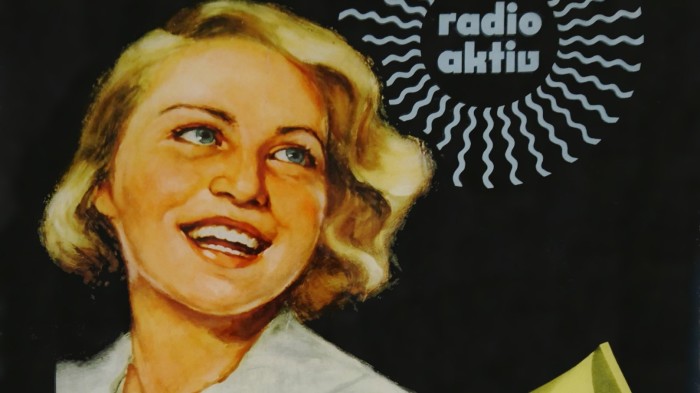
Dunthorne has a clear ear for melodrama, opening the series with the line, “My grandmother grew up brushing her teeth with radioactive toothpaste.” Siegfried, we learn, in the 1920s had helped invent Doramad, a toothpaste containing a radioactive metal that, according to the adverts, yielded “sparkling, brilliant” teeth, and brought home samples for his wife and children. When they left Germany for Turkey in 1935, they took a job lot of Doramad with them, “their suitcases gently emitting alpha particles as they travelled a thousand miles east”.
Half-Life tells a sprawling story of wartime Germany and the Merzbachers, who were assumed to have fled as Jewish refugees — except that Siegfried continued to be employed by the German company Auer, which manufactured gas masks; also the family returned to Germany to collect belongings. Dunthorne visits Oranienburg, where Siegfried and his family lived in the early 1930s and which had thousands of bombs dropped on it in the war, many of which remain undetonated and buried in the earth. He also embarks on an emotional journey to Ankara where he learns about the Dersim massacre, in which thousands of Kurds were murdered, possibly using a gas created under Siegfried’s supervision.
Multiple narratives unfurl in this moving, meditative and, at times, improbably comic series (Dunthorne does a winning line in dry self-deprecation). The storytelling is first class, as is the darkly atmospheric sound design by Eleanor McDowall of Falling Tree Productions who accompanies Dunthorne on his travels, propping him up during painful bouts of sciatica. There is also a wonderful score by the musician and composer Jeremy Warmsley.
There are some startling twists in Half-Life that I won’t ruin here. But, along with pondering the life and career of a lone German scientist, it reveals much about inherited guilt and trauma, the subjective nature of truth and how the stories passed down through family generations are not always to be trusted.
bbc.co.uk/programmes
Read the full article here