

Stay informed with free updates
Simply sign up to the US companies myFT Digest — delivered directly to your inbox.
Despite the Trump administration’s . . . negative views, solar power is rapidly becoming a very big deal. Far bigger than many people realise.
Here’s a cool Goldman Sachs chart showing how the rise in solar energy generation is the fastest in the history of electricity.
The chart is lifted from a recent report on what the investment bank’s energy analysts argue is “a structural solar surge”. In the decade since it started taking off, solar power generation has reached 2,129TWh, and has made up 8 per cent of global power generation over the past 12 months.
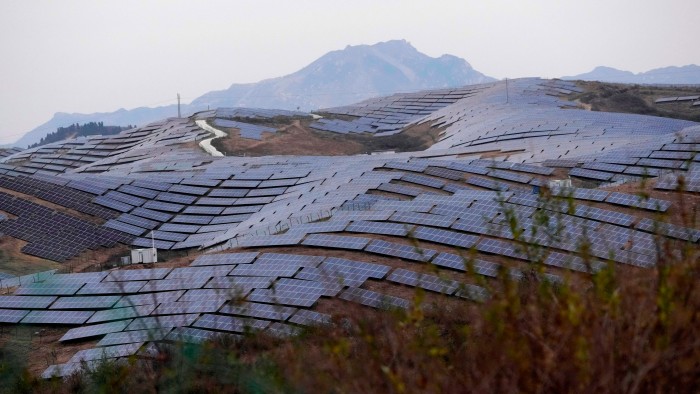
For this we can largely thank a truly stupendous build-up of capacity in China:
The Goldman team — led by Daan Struyven, its co-head of global commodities research — point out that solar energy “has consistently beaten expectations” and argue that it will probably fill a “high share of long-run global energy demand” thanks to three drivers:
First, learning-by-doing has sharply reduced the cost of solar panels. Specifically, we estimate that costs tend to drop 20% if cumulative output doubles, with a positive feedback loop from lower costs to higher demand, higher supply, and again lower costs. The investment costs have fallen faster for panels than for any other investment good in modern history, including computers and communication equipment.
Second, solar’s marginal fuel costs are zero.
Third, solar panels are modular as they come in small sizes available at constant fixed prices, making it easier to create a decentralized grid. In contrast, thermal or nuclear power stations are usually large with high fixed costs.
This combination of zero marginal fuel costs and decentralized production and their favorable potential impact on energy security and carbon emissions likely help explain solid support from the public for solar energy, including in the US and the UK.
There are obviously challenges, such as solar energy being in the US doghouse at the moment, and China paring back its support for the industry recently.
Goldman’s analysts also highlight perennial solar power issues such as demand-supply mismatches — the sun might not be shining when you actually need electricity, and storage remains an issue — and reliability (viz, the recent blackouts in Spain and Portugal). However, they reckon that these problems are becoming less problematic.
Goldman Sachs has kindly made the full report public for Alphaville readers here.
Read the full article here