

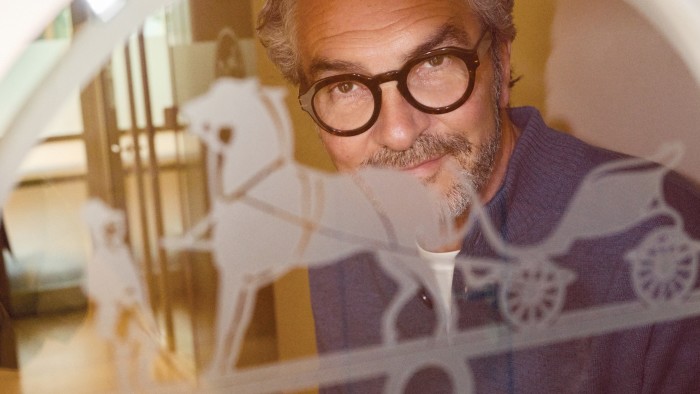
Over the past decade, Hermès, the French house known as the maker of luxury goods including the coveted Birkin bag, has quietly become a serious force in watchmaking. Once focused on selling quartz watches in high volumes, the brand now crafts intricate mechanical timepieces that command six-figure price tags.
At the heart of this success is Philippe Delhotal, the creative director of the brand’s in-house watch division Hermès Horloger since 2008. Under his tenure, the watch division has grown its revenue from €163mn in 2015 to €577mn last year. Hermès now ranks number 13 in the Morgan Stanley list of the top 20 watchmakers by sales, surpassing Chanel, Bvlgari and Jaeger-LeCoultre.
Delhotal pursued a dual education that would later inform his unique approach to the trade — studying watchmaking in Besançon, then immersing himself in fine arts at the École des Beaux-Arts in Paris. “I was passionate about drawing, and I was from a family that worked in watchmaking,” he says. “I told myself that learning watchmaking and drawing could result in something interesting.”
He began his career working at Vacheron Constantin in the late 1980s. Later he moved to Piaget and Patek Philippe. When Delhotal made the move to Hermès, many in the industry were baffled. “I was told, ‘You’re crazy,’” he recounts with a smile of amusement. “They said to me, ‘You are up there,’” — he raises his hand high to indicate the prestige of Patek — “and you go to a house that sells handbags and scarves.’” But Delhotal felt he was venturing into a world of watchmaking that was largely uncreated and that he could shape.
Hermès entered the timekeeping market almost 100 years ago, putting its name on watches made by the likes of Movado and Tavannes. During the 1970s it scored a bullseye with the Kelly, a watch inspired by the lock of the eponymous handbag, which demonstrated that Hermès fashion iconography could be adapted to watchmaking. In 1978 Hermès took watchmaking in-house, launching timepieces such as the Arceau (1978) and the Cape Cod (1991) that rapidly became popular with the fashion‑aware market.
Despite these successes, when Delhotal joined the house, its watches were regarded as little more than an accessory — equipped with nondescript quartz movements, it was the design and appearance that counted. Under his stewardship, the brand has pursued a narrative approach that views the whimsicality of the world of Hermès through the lens of bespoke calibres, dials and cases and inventive methods of time display. It’s a form of haute horlogerie that is wholly sui generis — distinctly Hermès, and suited to no other brand — appealing to a watch-literate, style-conscious mid-market buyer.
Other strategic changes, such as reducing production volumes — from roughly 250,000 pieces a year to 70,000 — cutting wholesale accounts and, more recently, increasing the average selling price to SFr8,300 ($10,000), have shaped an “ambitious but logical strategy” that has paid off, according to Oliver Müller, founder of watch industry consultancy LuxeConsult, and co-author of the Morgan Stanley report. But the brand has not been immune to broader economic conditions: watch sales in 2024 dipped 4.2 per cent year-on-year, which was mainly due to a “tough market environment more than anything specific to Hermès”, according to HSBC analyst Anne-Laure Bismuth.
The brand has a playful yet profound vision of time that is both liberating and amusing. “We do things with lightness, but seriously,” Delhotal reflects. “We have fantasy and there is freedom. We like to laugh, we like to bring wonder, we like to bring emotion.” This is the essence of Hermès watchmaking: technically accomplished yet imbued with a distinctly Parisian joie de vivre.
The brand’s signature complication, Le Temps Suspendu (suspended time), is a watch that does exactly what it says and allows the wearer to temporarily halt time. Press a button and the hands go to 12 o’clock, press another button and the hands move to show the time. The story goes that Pierre-Alexis Dumas, artistic director of Hermès, was having such a good lunch one day that he wanted to stop the passage of time for an hour or two.
Another complication, the Arceau Le Temps Voyageur, offers a unique approach to displaying time across multiple zones. Home time is shown through an aperture located at the 12 o’clock position. Local time is indicated by a moving subdial that circumnavigates the dial, showing the time in different cities on the outer ring.
Alongside such mechanical jeux d’esprit, Delhotal’s most significant contribution to Hermès watchmaking has been his championing of the house métiers d’art (craftsmanship). “When I arrived, I told them, ‘Listen, it’s a house above all of craftsmanship, and working with the crafts seems obvious to me,’” he recalls.
Chief among the artisans with whom Delhotal has collaborated is Anita Porchet, widely regarded as the finest watch enamellist of her generation. Her exquisite work on the Cape Cod Rocabar series was inspired by Hermès scarves and features stylised horses. Then there are Jean-Vincent Huguenin, whose meticulous hand-engraving transforms metal surfaces into miniature bas-relief sculptures, and Nelly Saunier, a celebrated plumassière (feather artist) who last year created miniature feather marquetry for the Slim d’Hermès Zebra Pegasus watch.
Chez Hermès, elaborate techniques are often put at the service of witty visual puns. Particularly amusing was the flamboyant flourish of last year’s Slim d’Hermès Flagship watch that reimagined the brand’s store in Rue du Faubourg Saint-Honoré as a seafaring galleon. The soufflé-light motif, borrowed from a silk scarf, masks the painstaking process behind the dial’s creation — a miniature painting on aventurine glass, finished with delicate gold appliqué.
But more than for its silks, Hermès is renowned for its leatherwork — and the technique that best reflects this, championed by Delhotal, is the pioneering use of leather marquetry on watch dials. For the Arceau Cavales, artisans worked with calfskin trimmed to just 0.5mm thickness, cutting and assembling pieces to create equine motifs.
In an industry that is steeped in heritage and tradition, Delhotal has done something rare. Drawing on techniques, motifs and materials from across Hermès diverse métiers he has forged a distinctive horological identity for a house more often associated with leather goods and silk than with watchmaking.
Read the full article here