

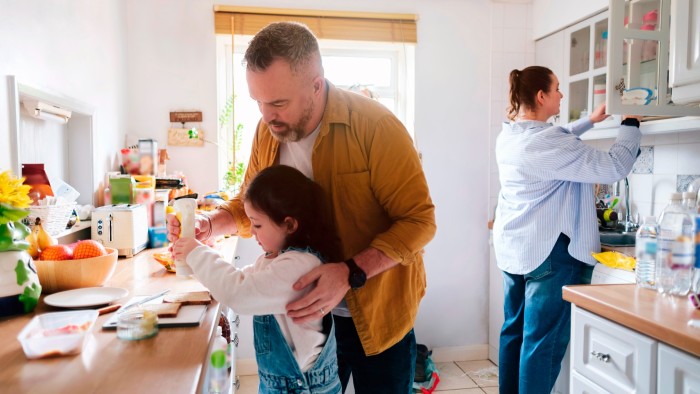
Forced by the pandemic to work from home, many households began to rethink the interaction between domestic and work lives. Now parents in particular have grasped the new opportunities that help them balance domestic duties and keeping careers on track.
Could that also sow the seeds for greater equality in the workplace for the next generation?
Experts such as Professor Heejung Chung, head of the King’s Global Institute for Women’s Leadership, a research institution, are blunt on the subject. “If working parents don’t or can’t role model to their children that it is possible for mothers to combine a fulfilling career with family life, then there is no chance of obtaining gender equality,” she says.
Without such change, Chung argues, the gender pay and pension gaps will not close, and senior positions will remain out of reach to women.
Greater equity at home between women, traditionally bearing the brunt of the domestic workload, and men, often the main breadwinner and working further from home, is crucial to working mothers being able to develop a career.
“It’s time for men to be ‘parenting out loud’,” says Elliott Rae, who has turned that phrase into a campaign group and lobbies for employers to help normalise men taking time off for family life. More parental leave for fathers would be one way, for instance, to help boost gender equality in the workplace he says.
Around 100 organisations in the UK have introduced it so far, he adds, including insurer Aviva and telecoms group Vodafone. In the US, Goldman Sachs bank began offering 20 weeks of paid paternity leave in 2020.
We asked three sets of working mothers and fathers how they try to be equal partners at home while also developing their careers. The answer is planning, tech and investing any spare money in help.
Joanna and Eric Ridgway
The couple both work full-time and live in Dallas, Texas, with a four-year-old and a two-year-old. Joanna is senior vice-president of global sales at Cien.ai, an artificial intelligence data analytics company. She has made a significant career transition and upskilled in a new and fast-growing industry over the past year since being made redundant from a role as managing director at a bank. Eric was recently promoted to managing director in a risk department at another bank.
Joanna works from home but often attends in-person meetings and evening events, and is sometimes travelling. Eric goes to the office three days a week and otherwise works from home. They take turns to walk their daughter to pre-school, and Eric often collects her before resuming work. They have a nanny who works 7.45am to 5.30pm on weekdays.
They outsource as much of the domestic load as possible, for instance using a weekly meal service called The Chef’s Cuisine, whose $25 meals need only to be heated up. “I also use the Instacart grocery delivery service and our nanny helps with laundry and other food shopping. She often preps and feeds the children dinner,” says Joanna.
Since Joanna’s career change, Eric has become the main breadwinner but remains “very hands on”, she says. “He was a huge support in enabling me to pursue a new career,” she adds. The couple have navigated the challenge of managing costs by changing pre-school, cutting holiday spending and eliminating unnecessary bills such as unwatched streaming services. “Taking on more financial responsibility for our family is something Eric’s really proud of,” Joanna says. Eric says there is “a clear understanding” that everything is for the benefit of the family. “Joanna continuously progressed in her career by building on her experiences and deserves to take this risk to try something new,” he adds.
Crystal and Mark Whitcroft
Crystal is co-founder of an Italian wine import and export business, D&P Selezioni. She works full-time from home in Bath, England, but also travels to the US and Europe. Mark is co-founder and chief executive of an AI software business, PlannerPal, aimed at financial advisers, and also works from home full-time. As business founders, both work late into the night and at weekends. They have a five-year-old and a three-year old.
Recently a childcare booking service app, Bubble, came to the rescue when the five-year-old fell ill at school while Crystal was away on a work trip and Mark was out of town for a meeting.
“School always calls me first,” says Crystal — mothers tend to top the list of contacts by default. Next, they called Mark, who had just got off a train two hours away. His parents, who live nearby, were away too, “so . . . I knew I had to get the next train home”. From his train seat, he logged into Bubble to access some of the 40 free hours of childcare cover funded by an investor in his business. By 12.30pm, he was back home, checking on his son until a childminder arrived at 2pm. “I could carry on with work,” he says.
As Crystal observes, balancing family life and professional development “requires more patience and discipline”.
Laura and Chris Lear
Laura works full-time as deputy managing director of strategic communications agency Ambitious, in her office in Bristol, England, three or four days a week, and the rest at home.
Chris is a family physician, also working full-time, between his practice surgery, a hospital accident and emergency department, and from home one day a week. They have a six-year-old and a four-year-old.
Since the pandemic, Laura has worked a couple of days a week from home. She has moved employer twice specifically because of remote-working opportunities that enable her to take on bigger roles. Ambitious is a female-founded business and champions flexible working.
“Chris and I are really intentional about splitting childcare [evenly],” she says. For four days a week they take it in turns to drop the children off at their school’s breakfast club at 8am and collect them at 5.30pm. They have a nanny for the fifth day, who also makes the children’s dinner.
“It’s enabled us to fit in work, the children and some exercise. We get up early, we go to bed early and we plan everything,” says Laura.
Chris adds: “We’re both quite organised people, but we’ve had to up our game.” They use Google calendars and a “slightly more old-school” calendar on the fridge door.
“We’ve both got careers that are important and we want to progress, but our family comes first, so we have to make the rest work,” says Laura. Chris adds: “Recognising that and being able to talk about it in a supportive, non-judgmental, non-competitive way makes all the difference.”
Sacrificing personal time is also part of the work/life equation. “Socialising in the week adds more strain,” says Laura. “So we accept that we need to keep things simple . . . certainly a change from pre-kids.”
Read the full article here