

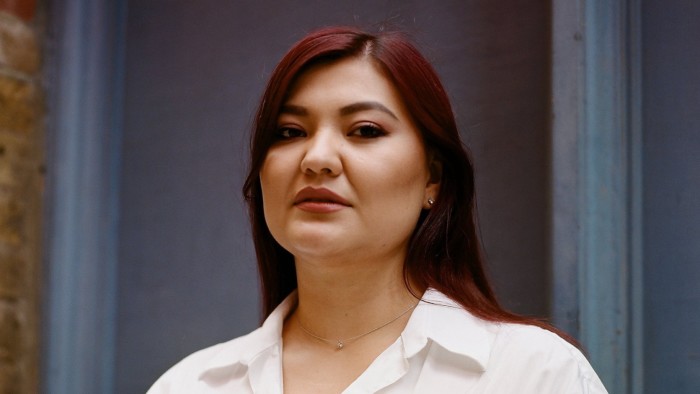
Aigul Akhmetshina bursts into the room, dragging a suitcase and a bouquet of flowers behind her. She has just landed in London from New York, where she sang in The Barber of Seville and at Carnegie Hall, and is on her way to recording sessions for her second album.
This fast-paced existence, living out of suitcases and hotel rooms, is precisely how she likes it. “There will be a time for me to ground myself,” she says firmly, but now “it’s time for me to work”. Besides, artists “love drama”, she says. “Our life is like a soap opera. We live so fast that sometimes you don’t notice what’s happening.”
It’s no exaggeration. Akhmetshina’s biography reads like a movie plot. One of the world’s most sought-after mezzo-sopranos, she was born in 1996 in a rural village near the Ural Mountains in the Russian republic of Bashkortostan, where she was brought up by her mother. “My family is like a police dynasty,” she says. Her grandmother was a captain, and both her mother and sister worked in local police administration.
She is keen to dispel the widely circulated myth that she grew up milking cows. “But I would admit I can work with a chainsaw,” she grins. “I love physical work.” She was a tomboy, “running, fighting, I was covered in bruises”.
Akhmetshina decided early on that music was her calling. Everyone in her family sang, but never professionally. “My grandfather thought that musician is not a good profession,” she explains, because it was so financially unstable, especially in a small village. She would become the exception because she was the youngest granddaughter, so “was allowed to do whatever I want”.
When she was six she pushed to go to music school — even though it meant playing her grandfather’s button accordion, because that was the instrument her family could afford. “I hated that instrument!”
Akhmetshina didn’t come to classical music until she was a teenager. She grew up singing folk songs, and had initially wanted to be a pop singer — the musical influences of her youth cover a broad range, from Christina Aguilera, Celine Dion, Whitney Houston and Shakira to Linkin Park, Slipknot, Depeche Mode and Ella Fitzgerald. (She still loves pop: in New York recently she went to see Beyoncé on her Cowboy Carter tour, and as she’s telling me about her forthcoming album full of love songs, she breaks into Foreigner’s “I Want to Know What Love Is”.)
But Akhmetshina describes seeing opera at the Bashkir State Opera and Ballet Theatre in the city of Ufa as like “seeing your purpose”. It was the theatricality of the performance that captivated her. “I love to transform into different characters,” she says, and this is apparent in her live performances. Akhmetshina is distinctive not just for her voice, but for her acting — she has that rare gift of being able to inhabit a role completely.
The years following her realisation were disheartening, with rejection following rejection on the local competition circuit. “There were lots of moments when I would think that I’m totally useless and I need to quit,” she says, and when she was turned down by Moscow’s Gnesin Russian Academy of Music at 18 she decided to put singing behind her.
In the car on the way home, Akhmetshina called her teacher, telling her she was quitting and would apply to universities. “That moment, when I was on the phone, we had a car accident.” Afterwards, “I couldn’t sing. There was so much tension.” She packed her few awards away in the garage in a box she labelled “Aigul’s Bullshit”. “It’s still there!” she says.
Providence, however, moves in mysterious ways. The accident also meant that Akhmetshina missed the university application deadlines, giving her a year to rebuild her voice — and to audition for the Royal Opera House’s Jette Parker Young Artists scheme. Her audition was the first time she had been abroad alone. “It was incredibly scary,” she admits, not least because she spoke little English and the only person she knew was her manager. Nonetheless, the gamble paid off. She became the youngest artist ever accepted on to the programme, and made her Royal Opera House debut as Carmen in 2017, aged just 21.
Since making London her home, Akhmetshina (who has a Russian passport but has identified as “half Tatar, half Bashkir” and is applying for British citizenship) has had a swift and dazzling rise. Carmen is the role with which she’s most associated. She has sung Bizet’s heroine in productions around the world, including at New York’s Metropolitan Opera, Glyndebourne, the Deutsche Oper Berlin, the Bavarian State Opera in Munich and the Vienna State Opera. It’s a role she adores and has thought about deeply. On stage, “I live as Carmen”, she says — and “after Carmen, I always crave a steak and a glass of red wine!”
Akhmetshina speaks enthusiastically and passionately about Carmen’s motivations, although sometimes it’s not clear whether she’s talking about Carmen or herself. Carmen “freaks out every time when somebody is trying to control her, she becomes an animal”, she explains. Then, minutes later, “I definitely don’t like control. I don’t like when people say to me what I should and shouldn’t do.”
Perhaps this sympathy is one of the reasons her Carmen is so powerful. Akhmetshina seems to instinctively understand the character. “There’s always a reason why she behaves a certain way,” she says, complaining that Carmen is sometimes portrayed as “just a sexy lady who is playing with everyone without a reason”. But “nobody becomes like that without a reason”.
Should she direct Carmen herself, it would be full of colours. “It’s not supposed to be grey,” she says. “I believe people come to opera to see beauty.” As for Carmen herself, “she is very intimidating. She’s intimidating for women and for men. And at the same time, she’s so attractive for women and men. It’s like a magnet pulling back and forth. I want to dive into that.”
No wonder Akhmetshina has been hailed as “the Carmen of our time”. This is a label she’s cautious about, though. “It adds extra pressure, and you have to constantly be more than you are,” she says. Nor does she want to be pigeonholed. “As an artist, you don’t want to become labelled with just one role, even such an iconic role as Carmen.”
So this year alone she’s singing Fenena in Nabucco, Adalgisa in Norma, Charlotte in Massenet’s Werther, and in 2026, Dalila in Samson et Dalila at the Royal Opera House. At the Proms next month, she will perform Ravel’s sensuous song-cycle Shéhérazade with the London Philharmonic Orchestra.
I get the feeling that whatever Akhmetshina wants to perform, she will make it happen. She exudes determination. “If you want to have some change in your life, you need to take action into your hands,” she tells me. “I always was stubborn.” She shrugs off having been bullied at school. “You fight to prove that you are not what they say, or you just become bullied and you feel sorry and you become a victim — and I’m not that.”
Akhmetshina describes herself as a dreamer, and encourages all aspiring artists “to dream, to develop, to work on themselves”. Just as important, though, is learning how to work with others. “Theatre is teamwork. These people who are around you, they allow you to become a star . . . you will not achieve that alone.”
Opera singers need their supporters, friends and advocates, because it is a tough, rollercoaster career, with a great deal of luck determining who becomes a global sensation and who does not. “If you come for fame and money, it’s not the right place”, Akhmetshina says.
“If you come because you have a great belief that you can bring people together through art, you can change something, you can influence, you can do something good through the art — then it’s the place.”
August 10, bbc.co.uk/proms
Find out about our latest stories first — follow FT Weekend on Instagram, Bluesky and X, and sign up to receive the FT Weekend newsletter every Saturday morning
Read the full article here