

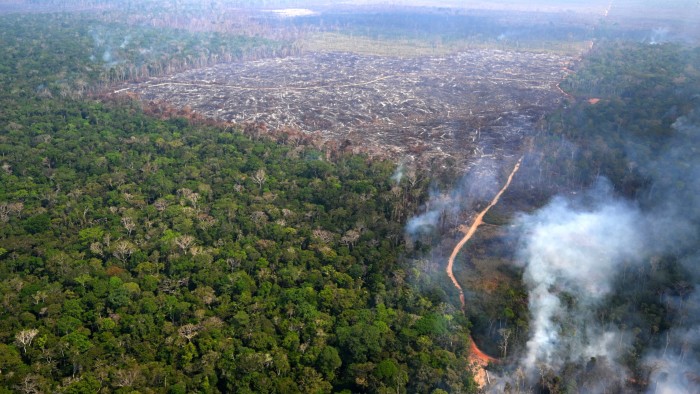
Ranchers can earn an average $50 a year from raising cattle on a hectare of land in the Brazilian Amazon, according to government agricultural census data. It may not sound much, but for a farm covering thousands of hectares it is an incentive to clear virgin forest that produces no income.
Experts say law enforcement can only go so far in trying to preserve the Amazon. The world’s largest rainforest absorbs and stores huge amounts of carbon dioxide, making it crucial in the fight against climate change. But it has faced continuous destruction from cattle ranching, illegal logging and gold mining.
Ultimately, the rainforest will only survive if it is more profitable to keep it standing than to cut it down. As guardian of most of the rainforest and host of this year’s COP30 summit in the city of Belém, known as the gateway to the Amazon, Brazil has an ambitious strategy to make conservation pay.
A $125bn fund to protect the forest
Brazil launched a global plan ahead of the UN climate conference to raise a fund worth as much as $125bn to pay a regular income to countries that preserve their rainforests.
The idea is to persuade donor countries and philanthropists to seed the fund, the Tropical Forest Forever Facility (TFFF), with a target of $25bn of capital lent on favourable terms, which would be leveraged by issuing $100bn of senior debt to private sector investors. The capital raised would be invested in higher-yielding bonds, including emerging market debt. Provided the fund performs as expected, the extra yield obtained over the cost of capital would be available to pay to countries that conserve their forest. Payments could amount to $4 per hectare per year to nations with low deforestation rates and 74 developing nations could qualify.
Brazil has committed $1bn to the fund, as has Indonesia. Norway will contribute $3bn. The COP hosts now hope that enough other nations step up in Belém.
Garo Batmanian, head of Brazil’s forestry service (SFB), says the design is intended to capture more of the rainforest’s value than other schemes, which make one-off payments. “With the TFFF, the emphasis is on standing rainforest,” he says. “The more standing forest you have, the more you receive. And when you reach zero deforestation, you continue to get paid.”
Payments would be made to national governments, with at least 20 per cent reserved for local communities and indigenous people.
“This is the biggest climate initiative ever launched worldwide by a country from the global south,” says João Paulo de Resende, under-secretary for economic and fiscal affairs at Brazil’s ministry of finance.
Bioeconomy
Brazil’s bioeconomy strategy is an effort to develop profitable and sustainable ways of exploiting natural wealth by supporting innovation.
Among the most promising ideas so far are new medicines, such as natural antidepressants or appetite suppressants, and products such as biofibres from plant species, says Carina Pimenta, the environment ministry official in charge of the bioeconomy.
She says the number of innovation start-ups in the Amazon has grown from a handful 15 years ago to more than 1,000 today. To fund initiatives, the government is setting up a blended finance mechanism called Eco Invest, which uses money lent by the Brazilian treasury at low rates and leverages it with credit from the private sector.
The strategy aims to develop new products while also getting more out of existing ones, such as the superfood açaí. These dark purple berries from the açaí palm are pressed to make pulp for smoothies or smoothie bowls that are popular as a health snack.
“It’s very important that we use all of the açaí,” Pimenta explains. “The residues [from the pressing of the fruit] can help generate energy through the production of biogas.”
The bioeconomy strategy also aims to provide a better living for the estimated 9mn people working in Brazil’s bioeconomy, including indigenous peoples.
Pimenta is particularly proud of two natural medicines adopted by Brazil’s government-run health service, as “a great example of how you can use something from a traditional community, which will receive part of the profits”.
Carbon trading
Brazil passed a law last year to set up a mandatory carbon trading market, which rewards the reforesting of large areas that have already been cleared. At this year’s COP, Brazilian President Luiz Inácio Lula da Silva hopes to encourage blocs such as the EU and China to join a voluntary coalition to co-ordinate domestic carbon markets.
As much as two-thirds of Brazil’s grazing land — 100mn hectares — has suffered some degradation of soil quality, according to agriculture minister Carlos Fávaro. The government estimates that as much as 40mn ha could be recovered by restoring soil nutrients, allowing farmers to boost production without destroying more native forest.
José Alexandre Scheinkman, a finance economist at Columbia University in New York, says 6mn ha of degraded pasture has been abandoned completely for over six years and is ripe for reforestation.
“The typical hectare in the Amazon has 500 tonnes of CO₂ equivalent” captured in it, he explains. “On the European carbon market that would sell for about $40,000.” Even though carbon in Brazil would not be priced at that level, Scheinkman believes a local carbon market will make it profitable to reforest degraded pasture, a process that takes between 15 and 30 years.
The wheels, though, are turning slowly: Brazil’s carbon market is not due to be fully operational for another five years and the reputation of an existing voluntary market has been tainted by scandal.
“Unfortunately, in Brazil a lot of forest was cleared,” says Scheinkman. “But that means we have a lot of potential for reforestation.”
Read the full article here