

The opera house in Vilnius is hard to miss — a colossal concrete monolith in a fairytale town. The theatre defies architectural style as well as civic scale. From a distance it resembles Soviet-era brutalism. The nearer you get, the more the glass facade reveals flamboyance within: staircases of African teak; curvaceous leather banquettes; 72 intricate chandeliers in brass and yellow glass.
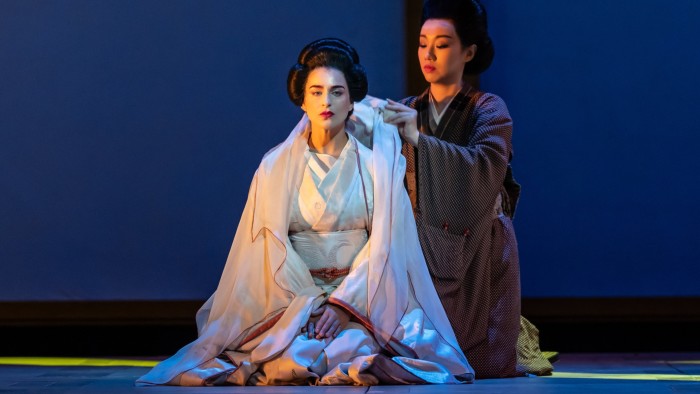
Never since the Lithuanian National Opera opened in 1974 has the nation enjoyed more prowess on the world opera stage. The effect, ironically, is that its top tier of operatic talent hardly ever performs here. By a rough calculation, more than 20 Lithuanian opera singers now ply their trade internationally. Half of them regularly grace the artform’s most prestigious stages, all from a country with fewer inhabitants than the US state of Kansas. Last year, the title roles in Tosca, Elektra and Madama Butterfly at the Royal Opera in London were all taken by Lithuanians.
One of them was Asmik Grigorian, the soprano who has become the darling of the world’s most ambitious opera houses and festivals. She is emblematic of a generation of Lithuanian singers whose vocal versatility comes coupled to an extra theatrical gear, making for performances of visceral power. Less well known than Grigorian, but with similar ferocity on stage and arguably a more lustrous voice, is soprano Vida Miknevičiūtė, who sings the title role in the Hamburg Staatsoper’s production of Strauss’s Salome (June 7-18; October 5-12). Miknevičiūtė electrified as Sieglinde in the Berlin Staatsoper’s landmark 2022 staging of the Ring Cycle but her voice is equally at home in operetta as in Wagner.
“We are a singing folk,” Miknevičiūtė says of Lithuanians, on a phone call from her home outside Frankfurt. “[In Soviet times] we worked in groups and singing made that easier. If you were cooking, gardening or labouring together you would sing, sometimes just as a method for staying alive.” After song spontaneously erupted during collective acts of defiance against Soviet occupation in the Baltic states from 1987-91, the protests were labelled The Singing Revolution. Miknevičiūtė’s grandparents had long since been shot by the Soviets as partisans.
Even before the wall came down, talented Lithuanians benefited from their country’s strong music education and democratic talent-screening, both residues of Soviet cultural policy. Miknevičiūtė was spotted, auditioned, and sent to a specialist music high school. “They asked me what I wanted to be. I said singer, thinking maybe a pop singer. I ended up in opera.” Plenty in opera talk of Miknevičiūtė’s strong work ethic and humble family background in Kaunas, Lithuania’s second-largest city. “Anyone can do it in Lithuania,” she tells me, “you just need potential.”
As it struggles to shake off its aristocratic roots elsewhere, opera has had unusual reach in Lithuania. A popular live television show once promised to find the nation’s next opera star. The country has three full-time music theatres (impressive given its population size).
“We don’t see opera as elitist,” says Edgaras Montvidas, a Lithuanian tenor who started his career on the Jette Parker Young Artists programme at the Royal Opera in London and is currently singing in a production of Carmen in Lausanne (until May 27). “Somehow classical music is closer to our culture, whatever class you are from,” he tells me on a call from Switzerland. “Every opera performance [in Lithuania] sells out. People are investing in their souls.” Does being Lithuanian come with a certain cachet in the opera world these days? “I certainly don’t need to explain where Lithuania is on the map any more.”
Montvidas also came to opera from relative poverty. He was raised in the south-western town of Kybartai, on the border with the Russian exclave of Kaliningrad. It was his dream to become an actor, but he enrolled in music school as a pianist and soon fell under the tutelage of Virgilijus Noreika, the tenor and pedagogue who had a transformative effect on generations of Lithuanian opera singers. If Noreika’s name crops up in almost every conversation about the strength of singing teaching in Lithuania, so does that of Irena Milkevičiūtė — Asmik Grigorian’s mother. “She was the only opera singer who really touched me when I was a student,” says Ausrine Stundyte, a Lithuanian soprano who is set to appear at this summer’s Salzburg Festival with a performance of Schoenberg’s monodrama Erwartung (July 27-August 18).
Stundyte, like Montvidas, was drawn to the stage via acting more than music. “Acting is the real joy for me,” she says, adding with a laugh, “Unfortunately, it has to go with singing.” Speaking on the phone the day after opening a new production of Strauss’s Die Frau ohne Schatten in Amsterdam, Stundyte talks of the “phenomenal” theatre scene in Vilnius when she was growing up. “I was always going to the theatre and found it so powerful, so magical. I wanted to bring that to opera.”
She was not alone. In 2006, a start-up opera company presented its first show, directly across the road from the Lithuanian National Opera, at the Vilnius Congress Hall — a drab concert venue in which the audience sits in shallow terraces unusually close to a wide stage. The group called itself The Bohemians — after the first work it staged, Puccini’s La bohème — later rebranding as Vilnius City Opera. Grigorian and Montvidas sang in that first production. In the children’s chorus was Giedrė Šlekytė, now a fast-rising conductor who will lead performances at the Berlin Staatsoper next month.
The dynamo behind Vilnius City Opera is the opera director and film producer Dalia Ibelhauptaitė. She started the company, she tells me on a call from London, to prepare young Lithuanian singing talent for the needs of international opera, offering title roles to eager artists when well-known companies would only employ them as walk-ons. On the wide, close stage of the Congress Hall, she cultivated a cinematic style with an emphasis on high drama and an eye for emotional detail. “My aim was to show [Lithuanian performers] that singing was not enough, so we made opera like the movies,” says Ibelhauptaitė, who recently produced The Offer, a TV series about the making of The Godfather.
Miknevičiūtė and Stundyte have both performed with VCO but the company is still most associated with the likes of Grigorian, Montvidas and the renowned bass Kostas Smoriginas, who continue to sing with it. “What those three learned is that you never stop with what you have,” says Ibelhauptaitė. “They still study and they still get coaching. And they have inspired a new generation.” Among them is Aistė Pilibavičiūtė, a promising Lithuanian soprano who has sung with VCO and will appear this summer as Micaëla in a new production of Carmen at the Immling Festival, Germany (June 28-August 8).
Something else unites the Lithuanian singers most in demand right now. Montvidas, Miknevičiūtė, Stundyte, Grigorian and Smoriginas were all born between 1975 and 1981. “We lived through this extraordinary time,” says Stundyte. “We were adolescents when Lithuania became independent, so we got freedom of expression just as we were personally starting to believe that anything was possible.” The effect, she says, turbocharged their sense of self-belief. “There are so many fantastic singers in this profession; you have to have something intangible to climb over in order to reach the top. It’s not about technique any more or even about your voice. It’s about who you are.”
Find out about our latest stories first — follow FT Weekend on Instagram and X, and sign up to receive the FT Weekend newsletter every Saturday morning
Read the full article here