

Unlock the Editor’s Digest for free
Roula Khalaf, Editor of the FT, selects her favourite stories in this weekly newsletter.
The task of sorting out the “cupboard of doom” had been on my to-do list for a few years until a house move this summer forced me into action. Two decades of my family’s old paperwork lay slowly dying inside. I did not want it to move with us, but dreaded the thought of dealing with it.
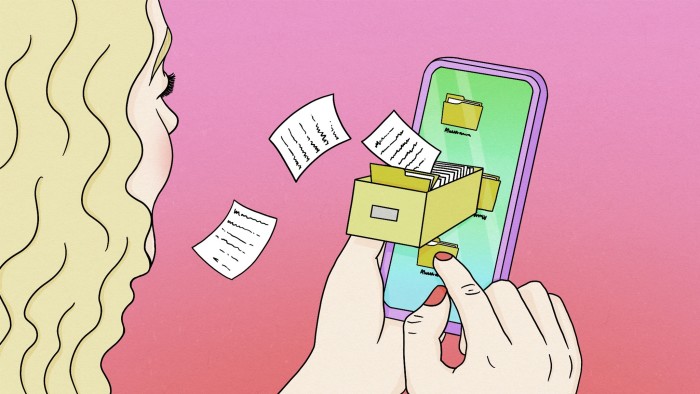
Nowadays, we store paperwork inside clouds, not closets. Yet the digital world presents a different organisational challenge — the dispersed and hidden nature of virtual documents.
My payslips and health records turned digital during the pandemic. Most bank accounts, credit cards and financial products like pensions and insurance have a standalone app where statements appear. Other information is emailed. Cost-conscious providers have been bouncing customers into paperless billing for some time, and the utter uselessness of the UK’s postal service has weakened the barriers to resistance.
But unless you have a system for keeping on top of all of this, you risk losing control — and that could cost you money. The financial industry profits from human inertia. Letters through the post about late payments, contract renewals or deals ending are hard to ignore; emails are easier to miss (especially if you need to find a password to view the contents).
Plus, there’s a looming inheritance angle. If all your paperwork is in the cloud, when you ascend to the pearly gates, your descendants on Earth may be unable to unpick your financial affairs.
Thankfully, there are digital solutions. When I shared my paper-free journey on Instagram I was staggered by the number of people who said they wanted to do the same. So here is my four-step guide.
1. Nail your digital filing system
Most people I know have a sprawling digital patchwork of phone notes, starred emails and downloaded documents. If you struggle to stay on top of this, two organisational apps that plenty of my UK followers recommend are DoqIt and FYIO (for your information only).
Both allow you to store, categorise and search your digital documents and, crucially, set up reminders and nudges in advance of when things need renewing.
Catherine Ann Reid, founder and chief executive of DoqIt, says people often subscribe after a “near miss”, such as failing to realise their passport had expired, or that they’d been driving around for months without an MOT, invalidating their car insurance. For less than £3.50 a month, DoqIt gives an overview of upcoming tasks within sections including family, work, property, health, travel and subscriptions.
Sarah Wrixon, co-founder and chief executive of rival app FYIO, says most users are female. Ingeniously, FYIO offers the ability to share access easily to documents and reminders with other registered users, and spread the mental load of keeping on top of it. Wrixon says her own husband was definitely “a piler rather than a filer” of paperwork in the past, but is now more proactive. The first gigabyte of digital document storage on FYIO is free, then a subscription costs £3.99 a month.
Don’t think life admin is worth spending money on? An estimated £50bn lies in lost or dormant accounts, including old workplace pensions. It pays to keep track.
2. Start as you mean to go on
“Just start today” was the advice both Wrixon and Reid gave me about embracing my digital filing system. Don’t feel you have to spend hours scanning and uploading your previous life. Just start from now. As most contracts renew over the course of a year, so long as you nail step one, in 12 months, you’ll be largely sorted.
I have gone paperless on everything apart from my council tax bill. There are still instances where you need to prove your ID by showing a physical bill with your name on it (buying a house is one of them). I personally like to schedule a monthly check-in where I ensure key digital documents have been downloaded, checked and filed with any actions or reminders set. Slowly, my list of financial to-dos will turn into “ta-das”.
3. Tackle the paper mountain
If you can, get all of your paperwork in one room, and slowly begin to decant it into three boxes — destroy, recycle and keep. Then, sort through all of your various files and folders. Ironically, I found that ticking these off on a paper list was a great psychological aid. I also gave all the mishmash of digital documents on my hard drive a much-needed declutter too.
A very wise person advised me only to do two hours at a time, otherwise your brain starts to melt. Finally, I used a shredding company who securely destroyed and recycled an incredible 120kg of our old paperwork. A liberating feeling.
4. Think about legacy planning
Tax records should be kept for seven years, but HMRC advises you can keep these on paper, digitally or as part of a software programme (eg book-keeping software).
I also keep my bank statements for seven years. Too many FT readers have told me of difficulties obtaining historic ones after a relative has died to evidence inheritance tax records. Keep records of any kind of gifts, including those made from excess income. You can complete the relevant parts of an IHT403 form at the end of every tax year to help your executors in future.
We now have one filing cabinet of paperwork (importantly, our adult children know where this is) containing a simple asset register and list of who we have accounts with; the aforementioned IHT form; plus a copy of our wills and power of attorneys. I had previously filled out a very useful text book called “I’m Dead, Now What?” with details of life and health insurance policies, funeral preferences and the names of all of our household providers. If like me, you are the “money person” at home, it’s crucial that your other half knows about this stuff.
There is no cupboard of doom in our new home. But we are finding there is much joy to be had in a properly organised digital system.
Claer Barrett is the FT’s consumer editor; [email protected]
Read the full article here