

Unlock the Editor’s Digest for free
Roula Khalaf, Editor of the FT, selects her favourite stories in this weekly newsletter.
Footsteps from the freezing cold top of a Northumberland hillside, a small, tin-roofed “lunch hut” is glowing. It’s late in the afternoon, an hour when the plain wooden shelter for grouse shooters is usually empty and dark. But on this late November day, it is hosting a rousing, improbable feast to mark the border crossing into winter.
The hut lies within Hepple Estate, the 4,000-acre rewilding project and gin distillery run by Walter and Lucy Riddell, who have lived since 2012 in the handsome hall at the foot of the hill. The land is rapidly being muffled by snow, the first to fall this winter. Thriving populations of red squirrel, merlin and nightjars are hunting or bedding down.
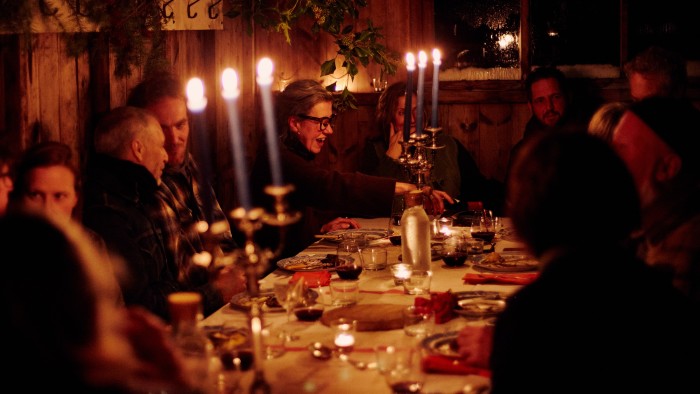
Inside, a candlelit canteen table primed with red-wine bottles is warmed by a three-bar gas heater. Oak logs and charcoal burn in the grill outside and a dozen guests in hats and wool coats – among them Fiona Beckett, a food and drink writer, and artists Charming Baker and Charlotte Hopkins Hall – huddle around cigarettes and hot drinks. It’s only 4.30pm, but the weather and the hillside socket of the hut make it feel more like midnight. There’s barely enough light for Adam Riley, of Riley’s Fish Shack in Tynemouth, to start shucking a crate of Lindisfarne oysters, or for Valentine Warner, chef and co-founder of the distillery, to make the buttered cabbage and venison shoulder on the grill, or for Nick Strangeway, cocktail druid, to mix smooth toddies of medlar and sloe gin.
But the feast is underway and the semi-alpine, somewhat makeshift conditions don’t seem much of a bother. “Olive or with a twist?” Strangeway starts asking of the assembly, by now shuffling their feet for warmth. Minutes later, he reappears out of the blizzard with thimble-sized Martinis that taste like clean, cold stream water, with a glorious juniper nose from the Hepple Spirits gin. (Warner, Strangeway and the Riddells are all co-founders.) Warner passes around finger toasts of brown crab and caper berries, while Riley proffers a tray of the creamy oysters.
“One shouldn’t have to think too long about a menu,” Warner had said earlier in the hall’s family kitchen, where the estate-shot venison shoulder (the best and juiciest cut, he says) was baking on a gentle heat. Warner grew up in Dorset but is a lifelong friend of Walter’s, a legacy of their parents’ respective involvements in diplomatic circles in Japan. He has “spent his life around ingredients”, globetrotting as a chef, presenter and food writer, and as he looks out of the kitchen windows to a garden of bare wintry scrub, he sees culinary invitations where I can see none. “Porcini grow everywhere, there’s roe deer, blackcurrant leaves and sage in the kitchen garden – why not make the most of them? There are more plants in the hills than we’d ever be able to use in the gin.”
The plants that matter most are juniper and Douglas fir trees, whose needles have a lemony tang, alongside twists of bog myrtle and other botanicals that make Hepple stand out as a product of meticulous land management and distilling skill. It’s the only distillery in the world that uses young green juniper, and guided by distiller and Hepple co-founder Chris Garden, it borrows techniques from the perfume industry for extracting the purest flavour.
The finicky juniper plants, which can take 16 years to produce berries, are cultivated by hand. Lucy has planted hundreds of seedlings so tiny that she marks each one on what3words, a navigation app. Walter says the estate now has the “largest stand of juniper in Northumberland”.
When Walter inherited Hepple from his father, he left the air-conditioned offices of Canary Wharf, where he worked in banking, and made the decision to move the estate away from upland sheep, grouse shooting and timber. “A lot of fences came down,” he says, and they committed to focusing on a wilder side of nature. Hepple now has a conservation manager, Mary Gough, and full-time ecologist, Richard Thompson, who grew up on the other side of the hill. He hopes to reintroduce Northumberland black grouse soon.
Back in the lunch hut, it is unequivocally nighttime, and platters of gorgeously scented meat and a tureen of piping-hot polenta are steaming up the hut windows. Warner has sautéed porcini with black olives dropped in at the end, painting the cabbage with butter and stirring the polenta with orange peel, sage and “loads of butter – breaking all the Italian rules”. In the fuggy bonhomie of the hut, where wine flows, it tastes like a rich antidote to the wilds outdoors. A sensational mincemeat pie with wedges of locally made Darling Blue cheese and fresh figs finishes things off.
As with many parties, it’s not exactly clear how this one will end – the hut might have to become an emergency bunkhouse. But the estate’s four-wheel drives do manage to go back up and down the hillside, and the party continues by the fire at the hall with squares of dark chocolate and a smattering of cigarettes. Strangeway materialises to offer drinks with the subtlety of a poacher punting pheasants from an overcoat – and where he began the feast with Martinis, he toasts its end with champagne cocktails and sly Negronis. There is black ice in the morning, but the passage to winter has been made in style.
Read the full article here