

Unlock the Editor’s Digest for free
Roula Khalaf, Editor of the FT, selects her favourite stories in this weekly newsletter.
Ambitious Labour MPs hoping for a first ministerial job sometime soon, or incumbent ministers hoping to turn around the government, should read one book above all: Reforming Lessons (Routledge £18.99). Written by Nick Gibb, the long-serving schools minister of a series of Conservative administrations, and headteacher Robert Peal, the book is an excellent account of the standout success, as the authors see it, of the Conservative governments of 2010 to 2024: the improvement in teaching in England.
It’s ultimately a story of how the Tories put rocket boosters under the academies and free schools programme and how, in Gibb’s telling, those new schools defeated “progressivist” educational ideology and led to the success of England’s schools.
Although there are specific lessons and arguments about school reform and the importance of “trad” teaching methods, along the way anyone reading Gibb and Peal’s book will pick up plenty of useful general principles for how to drive reform within government departments. (An indication, perhaps, of the wisdom of one of the book’s big arguments about the importance of “knowledge-rich” learning.) For those of us not dreaming of ministerial office, Reforming Lessons is a refreshing insight into something the last government did that worked, which deserves to be widely emulated.
It’s not, by Gibb’s own admission, a political memoir that will live on because of his skills as a writer (though, for a policy-heavy book, it is a pretty easy read), but it will, hopefully, live on as one of the important books about policy.
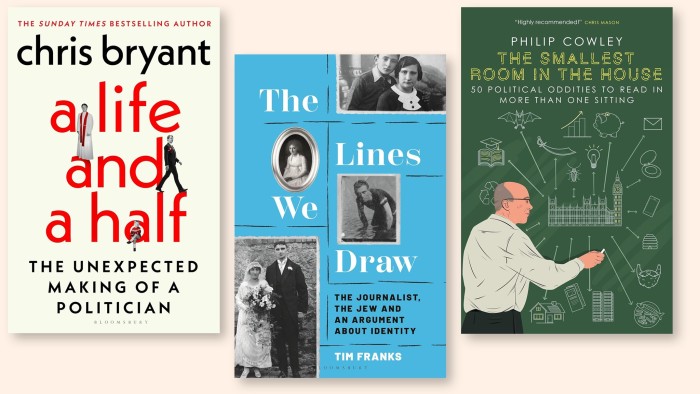
On the other side of the aisle, Chris Bryant’s A Life and a Half: The Unexpected Making of a Politician (Bloomsbury £25) is a memoir of his life before becoming an MP in 2001, and the unorthodox route he took to get there, from ordained priest to BBC executive to Labour politico (having been a Conservative while a student at Oxford). Bryant is one of the handful of sitting MPs who can genuinely write — his two-volume Parliament: The Biography is delightful — and as you’d expect, A Life and a Half is a terrific book, funny, frank and moving in equal measure.
It is not just a story of changing careers: in many ways it is a story of coming to terms with yourself. “I didn’t know what to say, so I said nothing, which was pretty much the standard way of dealing with emotions in the Bryant household,” he reflects on the death of his grandmother when he was a child. That will come as a shock to anyone who has seen Bryant in the House of Commons. Although this is not a political memoir, it is in many ways the story of how he went from a boy unable to speak to one of Parliament’s most eloquent MPs. We can only hope that we might one day get an account of everything that has happened to Bryant in the 21st century that is half as good as this book.
Tim Franks’s The Lines We Draw: The Journalist, the Jew and an Argument About Identity (Bloomsbury £20) is another memoir. Franks, a British Jew who spent years as the BBC’s Middle East correspondent, explores his own family history, and the question of what it means to be Jewish. As you would expect, it is a globetrotting memoir that takes the reader across his family story, taking in Portugal, London and his time at the BBC’s Middle East bureau, but what makes this brilliant, considered book worthwhile is not its breadth but how thoughtful it is.
For lighter relief, perhaps when the above becomes a little too much for the reader, Philip Cowley’s The Smallest Room in the House: 50 Political Oddities to Read in More Than One Sitting (Biteback Publishing £14.99) is a compendium of musings on political facts and trivia. As the title suggests, this is a book to be enjoyed during bathroom breaks, ranging from everything to which political party represents the most seats with service stations to the art of managing parliamentary rebellions, told with engaging good humour. The gags, too, range widely, with an enjoyable combination of scriptural references and swearing, plus the odd world-weary aside: “Every election, the optimist in me hopes that it will be a contest in which opinion polls are properly reported; the pessimist in me knows that pollsters and journalists need the cash and clicks that come with over-hyping poll findings.”
It’s almost good enough to make you wish for a stomach bug.
Stephen Bush is an associate editor and columnist at the Financial Times
Join our online book group on Facebook at FT Books Café and follow FT Weekend on Instagram, Bluesky and X
Read the full article here