

Some stage directions are headaches created by a playwright for others to solve. “Exit, pursued by a bear” is one example. Another turned up in an early draft of the script for David Adjmi’s Broadway hit Stereophonic — a note requiring a group of rock musicians to start playing “transcendent” music.
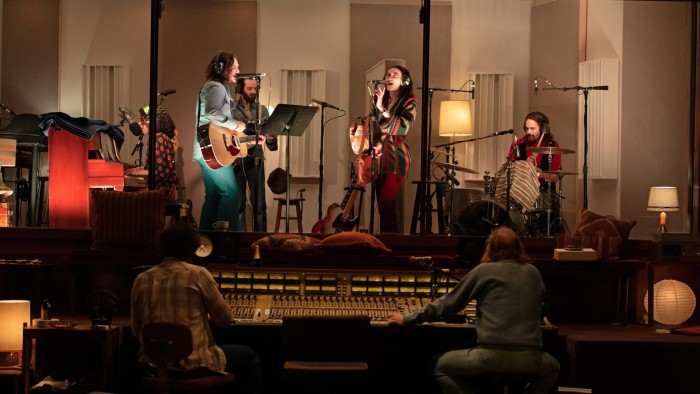
Now transferring to London’s West End, Adjmi’s play is about a fictional band recording an album in California between 1976 and 1977. On the cusp of superstardom, the two women and three men toil in their Sausalito studio, trying to create winning harmonies despite personal disharmony. The New York production received the most Tony nominations in Broadway history. But it couldn’t have happened without someone figuring out how to deliver that challenging stage instruction.
The person who did so sits opposite me at a long meeting table in the offices of the play’s London production company. Will Butler, 42, used to be a member of Arcade Fire, one of indie rock’s biggest acts in the 2000s. He wrote the songs that the unnamed band in Stereophonic are making; two of the play’s 13 Tony nominations last year were for his musical work.
“The first task was to make something that could plausibly be a hit in the 1970s,” he says. Only one song is played in full during the play’s three-hour duration, a driving rocker called “Masquerade”, which we see the actors perform live as the band record it. Other pieces of music are fragments of songs that Butler and the play’s music director Justin Craig fleshed into completed tracks for an album performed by the original cast.
“Music is very strange and very primal,” he says. “I was shocked at how much character work the harmonies do, and also the instrumentation. When people sing in harmony, it’s like, ‘Oh, you’re made for each other. It makes total sense why you’re together, even if you’re fighting.’”
He joined the project at its inception just over a decade ago, when he was still in Arcade Fire. With its blend of groove, emotion, rootsiness and sophistication, his score manages to sound fresh yet also very much like something one might hear in California in 1976: a feat not of pastiche but verisimilitude.
“I tried to avoid on-the-nose listening, but I was happy to copy from before and after,” Butler says of his preparations. He wanted to write songs that might have emerged from the consciousness of a songwriter weaned on 1960s bands such as The Byrds, and might have then gone on to influence 1980s bands such as REM.
“I can steal from The Byrds, I can steal from REM, I just don’t want to steal from Tom Petty,” he explains, laughing. “But when we went to record, then it was, sonically: ‘Let’s try to get it right’. Like, how did Fleetwood Mac mike these drums, how did Tom Petty mike these drums, how did they mix this, what’s the snare sound?”
Good-humoured and open, Butler tosses Fleetwood Mac’s name into the mix casually. But that storied band seems to shadow Stereophonic much as Macbeth does theatre lore: the bringer of bad luck, an ill wind that blows no good.
The play’s Anglo-American, mixed-sex, multiple-songwriter band clearly bears a close resemblance to the Mac. The album they are making has affinities with 1977’s Rumours, a huge bestseller recorded under conditions of debilitating intra-band tension, aggravated by romantic links between bandmates. The West End transfer comes after a copyright lawsuit was settled out of court last December. It was brought by Rumours’ sound engineer and co-producer Ken Caillat, who alleged that the play made unauthorised use of his memoir.
“It was never, like, secretly about that,” Butler says of the play’s Fleetwood Mac references. “It was just the mythos of the play. And there is something so mythic about it. The blend of Americans and Brits, men and women, it just felt silly not to use that because it’s so powerful. And a lot of that stuff belongs to the ages. The Mamas & the Papas had the same story, and it’s so dark. They’re cheating on each other and breaking up, and writing songs about him cheating on her and making her sing the song in the studio.”
Adjmi’s script chimes with Butler’s experiences in Arcade Fire. “It starts to smell like humans,” he says of the strangely suffocating space of the recording studio, with its boundless opportunities for procrastination and perfectionism. “We weren’t stinky teenagers, but it still starts to smell like breath and humans, and you’ve just got to get out of there.”
Butler is currently in a band called Will Butler and Sister Squares with his wife Jenny Shore and her sister Julie Shore. Arcade Fire were also a family band for him, led by his older brother Win Butler and the latter’s wife Régine Chassagne. In 2022, after Will’s departure, Win faced allegations of sexual misconduct from several former fans. He has denied their claims and no charges were brought. The band have kept going, releasing a new album, Pink Elephant, earlier this month. In a sign of the damage to their reputation, it hasn’t charted in the US Billboard top 200.
We meet five days after the album’s release; Will hasn’t yet heard it. Stereophonic’s depiction of a band being torn apart echoes some of the tumult that his former band faced.
“There aren’t literal parallels. But it’s very real,” Butler says. “The play is very observational. It’s not saying, this is a bad person because he wants to make a record so bad. It’s just: this is a person who wants to make a record so bad. And it’s a little bit his dad’s fault, and it’s a little bit his own fault, and a little bit he’s a jerk. I see that in myself, I see that in Win, I see that in every band I’ve been in. So it feels very real.”
Stereophonic shows a brilliant album being alchemised from unhappiness and discord. “My own view, which isn’t necessarily that of the play, is that I would rather have broken people making art than only hurting other people,” Butler says. “If they’re going to hurt other people, they might as well make as good art as they can as well. I would rather they didn’t hurt people. I would rather that. But you don’t always get a choice in this world, when people are broken, and how those pieces fit together.”
‘Stereophonic’ opens at the Duke of York’s Theatre in London on Saturday 24 May
Find out about our latest stories first — follow FT Weekend on Instagram, Bluesky and X, and sign up to receive the FT Weekend newsletter every Saturday morning
Read the full article here