

Unlock the Editor’s Digest for free
Roula Khalaf, Editor of the FT, selects her favourite stories in this weekly newsletter.
Homo sapiens: we’ve been through a lot these past 300,000 or so years. Now we have our own TV show.
The BBC-PBS documentary series Human follows our evolutionary and geographical journeys from primordial desert dwellers to planet-exploring civilisation builders. It is a sweeping tale of survival and struggle; fortune and adaptation; wandering and wondering. Playing out across hundreds of millennia, it is also something of a slow-burn saga. But thanks to groundbreaking research and DNA-reading technology, the remote past has never felt so within reach.
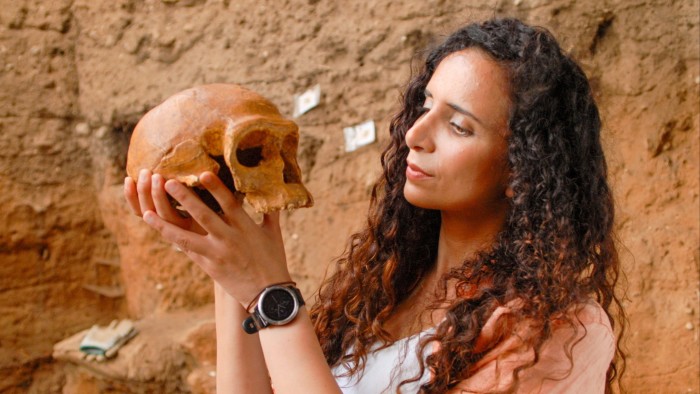
Guiding us over five episodes is Ella Al-Shamahi, a palaeoanthropologist who not only displays articulate expertise and an infectious enthusiasm as she offers us a “peek behind the curtain of evolution”. On location at various excavation sites across the world, she talks us through the archeological discoveries that have reshaped theories of how, where and when homo sapiens lived, bred, spread and developed. A skull unearthed in Morocco, for instance, suggests that we’re some 100,000 years older than previously assumed.
While such digs are undoubtedly fascinating, Al-Shamahi contends that it’s possible to lose sight of the human element when handling ancient remains. Accordingly, she goes beyond science and data to consider the more abstract, existential questions of what our distant ancestors experienced, thought and felt as they settled in caves and later ventured into the unknown.
If this psychological, even emotional, approach gives life to the long-dead, the show is slightly cheapened by the inclusion of naff dramatised sequences of people in loincloths. Similarly, scenes that find Al-Shamahi narrating atop a cliff, sand dune or other dramatic landscape can veer a little too close to Philomena Cunk territory.
But there are also several genuinely awe-inspiring and unexpectedly moving moments. Findings such as a ritualistic snake carving in a cave from 70,000 years ago and an early phonetic alphabet etched into the walls of a turquoise mine in Egypt in about 1700 BCE are moving reminders of humans’ inherent ingenuity, artistry and spirituality.
The final episode, which focuses on the emergence of early cities and nation states, reflects on the irony that, as humans become more civilised, they become more violent, competitive and tribal. And yet the series ends on a more upbeat note as Al-Shamahi visits a research centre in London where scientists are not only revealing more about our ancestors, but also demonstrating the very thing that makes us human: “Our almost limitless capacity to learn.”
★★★★☆
On BBC2 from July 14 at 9pm and on iPlayer in the UK now. On PBS in the US from September 17
Read the full article here