

Unlock the Editor’s Digest for free
Roula Khalaf, Editor of the FT, selects her favourite stories in this weekly newsletter.
Sleep, it seems, may whisk even Nobel laureates into the same sort of fantasy realm as ordinary folk. In one of several soccer-related items here, Egypt’s greatest novelist, Naguib Mahfouz, dreams of himself as a youthful star on the national team, renowned for “dribbling and scoring skills”. Hostile opponents threaten tackles, but the ball carries him with it into the air until both “disappeared . . . into the clouds”.
Celebrated not just as Egypt’s literary champion, but the godfather of modern Arabic fiction, Mahfouz had undergone an apotheosis of his own by the time of his death, aged 94, in 2006. However, enemies, political and religious, resented this acclaim. In 1994, a militant Islamist stabbed him frenziedly in the neck while he walked in his beloved Cairo alleyways. As Hisham Matar writes in his introduction, the assault “violently advanced” Mahfouz’s old age.
The supremely versatile author of The Cairo Trilogy, whose work spanned great realist frescoes of Egyptian life along with parables, satires and historical fiction, now found writing an ordeal. During his final decade, however, Mahfouz did manage to compose two collections of his dreams.
The 100 fragments of I Found Myself . . . , the second of these miscellanies, represent the fragile coda to a vastly prolific career that numbered around 40 novels and more than 300 stories. Matar, the Libyan-British novelist and memoirist who spent much of his youth in Cairo, has translated and introduced the pieces.
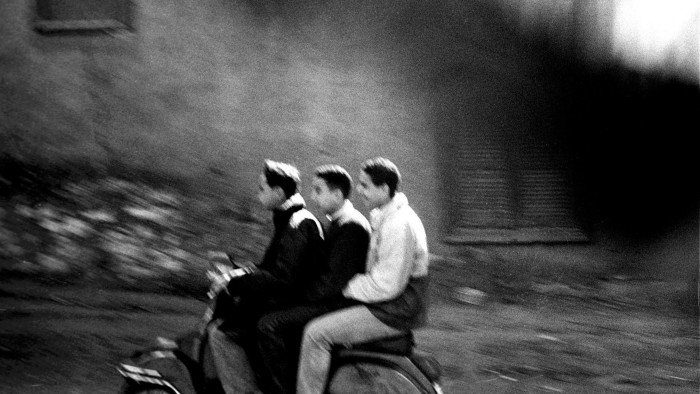
He met Mahfouz in the post-attack years and reports that the writer told him: “You belong to the language you write in.” Matar’s English — cool, spare, elliptical — serves these enigmatic nuggets well. Diana Matar, his wife and an award-winning photographer, partners the miniatures with equally haunting images of the city’s frayed and dusty streets.
Recounted dreams often baffle and bore. Mahfouz, a prose artist to the end, cuts and compresses. Sad, strange, comic (often all at once), these mosaic shards build into an elusive pattern. Lost lovers often return, notably the much-missed “B”. When she tells the dreamer she’s “happy with my husband and children”, it feels that “the very last candle had gone out”. If “the stupor of first love” recurs, so does regret at squandered chances. In fleeting glimpses of old flames, the dreamer seeks proof “that my love was not an illusion but real”.
Romantic elegy drives one set of nocturnal adventures. Dashed hopes of political freedom fuel another. Mahfouz repeatedly meets nationalist leader Saad Zaghloul, who resisted Britain’s quasi-colonial power in Egypt. On one occasion, his statue comes to life to banish a troublesome ghost. Or a silent protest demo turns “loud and hostile” when dead, fearless friends arrive.
In dreams, the thwarted longings of youth — erotic and democratic — revisit. But beware nostalgia. Granted a rub of Aladdin’s lamp, the dreamer brings his beloved “A” back from the dead. Yet that means a time-shift to the era when pro-Nazi crowds chant “Rommel, advance”, with their “fascist banners waving”.
These tantalising scraps stir and move. They never quite fuse into a single story. Something in them resists translation from night into day, just as Diana Matar’s intriguingly shaded, cropped and angled photos tempt us with the promise of a narrative — and deny it. We learn that private experience, asleep or awake, will always escape its interpretations. Both words and images guard their mystery.
Meanwhile, as the dreamer says in front of an etched portrait of himself with “B”, “We have turned into a legend, one to be depicted and retold.”
I Found Myself . . . The Last Dreams by Naguib Mahfouz, translated and introduced by Hisham Matar, with photographs by Diana Matar Viking £12.99/New Directions $16.95, 160 pages
Join our online book group on Facebook at FT Books Café and follow FT Weekend on Instagram, Bluesky and X
Read the full article here