

This February, Tate Britain closed its most popular show since Covid, and most successful ever of a female artist. For three weeks until its ending, the galleries were open until 10pm on Friday, Saturday and Sunday, as visitor numbers finally reached nearly 270,000. The exhibition was of Lee Miller, the photographer whose extraordinary career took in modelling, Man Ray, the destruction of the second world war and Vogue.
But it wasn’t just the biographical content that was pulling people in. “It is amazing work, full of audacity and intelligence, humanity, sensuality, compassion,” says the exhibition’s curator Hilary Floe. “And also, my intuition is that photography itself has a particular resonance at the moment. On the one hand it’s relatable — we all take hundreds of images on our phones — but the difference between the evanescence of a digital image and the power and beauty of a historical print is enormous.”
In an age of short-form video, the photograph represents something categorically stable and physically present. This is perhaps why photography exhibitions seem once again to be emerging in significant numbers, as the medium is reassessed for contemporary times, and tastes.
Among multiple institutional offerings is a show focused on photography’s earliest days as an art form at Tate Modern later this year, while the work of Robert Mapplethorpe is currently being celebrated at the Palazzo Reale in Milan. The Nederlands Fotomuseum, with a collection of some 6.5mn items, opened in Rotterdam last month. An exhibition of Catherine Opie’s high-colour portraits will open at the National Portrait Gallery in London on March 5.
According to a Morgan Stanley report published in 2025, the photography market reached its peak in 2014. But dealers are unperturbed. At Tefaf several booths will be showing photography either exclusively or in dialogue with other media. “I feel there is a comeback for photography,” says gallerist André Buchmann. “We’ve had so much painting and sculpture, and suddenly you put up photographs and it’s interesting again. It’s outside of expectation.”
“We are in the middle of a generational shift,” says Darius Himes, international head of photographs at Christie’s, “from the collectors, curators and dealers who built the market to a new set of younger collectors who are learning about the nuance of historical printing techniques, or loving the dynamism of a peer like [30-year-old US photographer] Tyler Mitchell.”
Buchmann’s namesake gallery will be bringing work by Anna and Bernhard Blume from their series Im Wald (“In the forest”) to Tefaf. For the Blumes, photography was a medium to convey what was in essence a performance practice. Less interested in perfection than evocation, they allowed blurring and bursts of light to shower across the images to embellish their constructed scenarios.
The four-panel piece, made in 1987, depicts the Blumes as a bourgeois couple — him in a hat and coat, her in a floral dress — enjoying the countryside, though perhaps in a less than conventional way. Bernhard’s interactions are dramatic and quasi-religious, as he throws himself at the trunks of trees.
“This was the mid-1980s, and acid rain was on everyone’s mind,” says Buchmann of a time when the impact of industrialisation on the environment had become a major issue. “But also, from the German perspective, the forest is a powerful symbol, a place of fairy tales and imagination.”
Thomas Schulte, like Buchmann, is returning to Tefaf after an absence of a decade or so. “We’re a conceptually led gallery,” says Schulte, who is based in Berlin. “Our focus is on art which goes back to the 1960s — Gordon Matta-Clark, Alice Aycock. Robert Mapplethorpe also fits into the programme, as an artist who completely changed the discussion around photography.”
Beginning exclusively with Polaroids, Mapplethorpe moved to a dramatic reframing of male physicality and desire. Schulte, however, is focusing on his flower pictures, which demonstrate an equal search for perfection and erotic charge. “Where his idea of the body is connected to drawings of the 17th-century, the tulips are akin to a modern vanitas, another art historical strand,” says Schulte. “That makes his work relevant at this fair that was previously known for its focus on Old Masters and still lifes. He represents the contemporary take.”
Mapplethorpe’s work is among the higher priced photography that comes to auction. “Self-Portrait” (1988) sold for £548,750 (with fees) at Christie’s in 2017, for example. Flower works are lower in price, but can still reach the €200,000 mark, depending on quality and composition. In the context of the fair, explains Schulte, it is the Mapplethorpe Foundation that sets the price.
“When you’re faced with a choice between a painting and a photograph that could possibly come in multiples, it can create a sense of insecurity for a collector,” says Gagosian’s director of photography, Joshua Chuang. “But we’re actively engaged in foregrounding it.” At the beginning of this year, Gagosian chose to show photography in four galleries simultaneously: Richard Avedon and Nan Goldin in London, Roe Ethridge in Athens and Irving Penn in Gstaad, with plans to show Deana Lawson and Francesca Woodman later in the year. “The gallery doesn’t have a photography programme per se. Larry [Gagosian] just wants to promote great artists,” says Chuang. “We think this work conforms to that.”
Back at Tefaf, Michael Hoppen will be showing the work of Sohei Nishino, a Japanese artist who creates diorama maps using photography, collage, cartography and psychogeography. Taking inspiration from the 18th-century Japanese mapmaker Inō Tadataka, his latest is of Venice.
Meanwhile Ron Mandos gallery from Amsterdam is showing work related to, rather than by, Mapplethorpe. The late Erwin Olaf, a gay photographer and activist, was inspired by the American, and worked with the same medium-format Hasselblad camera to produce images of erotic masculinity. Olaf, who died in 2023, is currently the subject of a major retrospective at the Stedelijk in Amsterdam. Mandos’s booth in Maastricht will be an homage to both him and the choreographer Hans van Manen, with whom Olaf collaborated closely. Van Manen died in December last year.
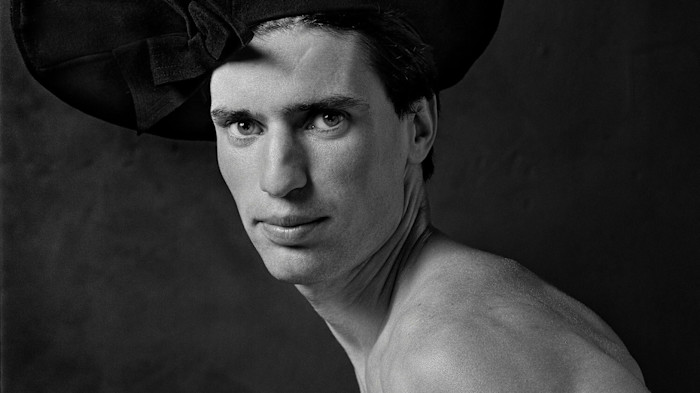
“We’re showing some of Olaf’s Ladies Hats series, which he began in 1985,” says Lars Been, the gallery’s in-house curator who has organised the booth. “The pictures are a comment on toxic masculinity and a fight against macho behaviour. He would give a guy a hat and their behaviour and their face would immediately change, maybe soften, or become humorous.” With inspiration taken from the chiaroscuro of Rembrandt and Caravaggio, the work again connects to the core art historical concerns of the fair.
Photography aficionados, though, may well be attracted by Olaf’s handmade carbon prints — a complex 19th-century technique where a print can take a day to make as the carbon is worked into the paper. “This is where photography gets technical and crafted,” says Been. “The carbon prints are unique and very special.” In the heady context of Tefaf, though, they will not feel unreachable at €35,000.
March 14-19, tefaf.com
Find out about our latest stories first — follow FT Weekend on Instagram, Bluesky and X, and sign up to receive the FT Weekend newsletter every Saturday morning
Read the full article here