

This article is part of FT Globetrotter’s guide to Paris
Finding artisanal coffee is not difficult in today’s Paris. Joachim Morceau, who founded Substance Café — the city’s sole reservation-only coffee-tasting bar — takes it a step further. He says that the French capital’s top five coffee venues could form one of the best top-five lists in the world.
This posture would have seemed impossible even just a decade ago. In her first book, Serve It Forth (1937), American food writer MFK Fisher wrote: “France today possesses what is probably the most intelligent collective palate.” Yet for the next half century, coffee remained a glaring exception to this rule — a blind spot in an otherwise discerning food culture. In a nation renowned for sophisticated tastes, the acerbic, harsh espresso served in many bistros was not just surprising, but seemingly inexplicable. Contributing factors included France’s colonial past and the influence of industrial-scale coffee companies like Lavazza and Cafés Richard, leading espressos to often contain 25 per cent or more bitter robusta.
In 2010, The New York Times published an article questioning why coffee was so bad in Paris. But by 2019, the FT’s Simon Kuper was celebrating a Parisian coffee revolution — a transformation marked by independent roasters, many founded by immigrants familiar with high-quality coffee from Australia or the US, who introduced a focus on artisanal roasting methods and espresso drinks like the cortado or flat white.
Today, the city’s coffee culture has again entered an exciting new phase, which is less centred on shaking off a bad reputation, and more on micro-roasteries pushing for higher degrees of coffee nerdery and distinctiveness. In most neighbourhoods across Paris, you can find coffee shops championing single‑origin beans and state-of-the-art brewing techniques. It doesn’t come cheap, but it means consumers enjoy coffees that are layered and lingering — more akin to a €15 glass of wine than a €1.50 shot of espresso.
To situate this shift, it helps to understand broader global changes in coffee production and distribution. Coffee enthusiasts often speak in “waves”. The first wave, in the late 19th century, coincided with colonisation and the mass production of coffee. The second, initially driven by postwar Italian immigration and espresso culture, and later by the global spread of chains like Starbucks, dominated until the third wave emerged at the turn of the millennium, introducing a focus on provenance, roast profiles and manual brewing techniques. Speciality coffee was treated like wine, with terroir, varietals and tasting notes shaping the vocabulary.
Paris is seeing a fourth wave that is largely characterised by scientific brewing techniques and more ethical, transparent sourcing. “It is hard to define,” says Alexis Gagnaire, founder of Tanat coffee shop, but one key principle is that “innovation is at the centre of everything”. Tanat is known for its experimental approach, using methods like carbonic maceration (fermenting whole coffee cherries in a sealed, oxygen-free environments) and co‑fermentation (fermenting coffee with other fruits like apples and berries) to produce funkier, tropical-flavoured coffees. Gagnaire says that doing this has “also attract[ed] a new kind of clientele that speciality coffee has never reached before”.
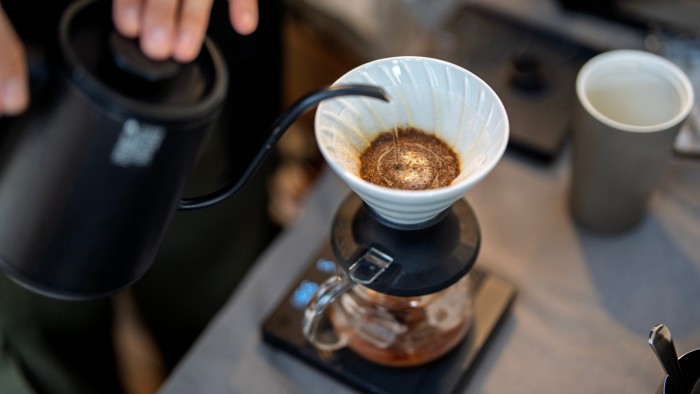
There is also a growing focus on the importance of terroir, which has resulted in the rise of lighter-roasted, tea-like serves with flowery notes. These coffees have emerged from the search for purer expressions of the beans — what Morceau believes is the new signature of the Paris coffee scene. At Substance Café, he brews me an Ethiopian Geisha, a highly aromatic, floral varietal that has been fermented with the coffee cherry intact to enhance fruitiness and complexity. He explains that he uses minimal extraction, traditionally frowned upon as it means too few flavour compounds have dissolved from the coffee grounds into the water, the latter of which in this case is calibrated with calcium, magnesium and bicarbonate. The result is subtle and elegant but complex, with persistent notes of delicate berries and rose.
This meticulous focus on origin, processing and brewing precision isn’t unique — it’s part of a larger trend shaping Paris’s speciality coffee scene. Kévin David of Moklair, a Reims roastery stocked across Paris, says the future lies in varietal diversity, refined drying techniques, and “processes that make coffee both clearer and deeper”.
So while David chases clarity, Morceau pursues purity and Gagnaire values innovation, it somehow all adds up to a coffee scene that feels unmistakably Parisian. The fourth wave might be hard to define, but as coffee becomes more poetic, opinionated, and refined, the only surprising thing is that it took Paris so long to catch up.
L’Arbre à Café
10 Rue du Nil, 75002 Paris and five other locations
Featuring minimalist design with light-wood accents and sleek copper- or stone-toned counters — all enhanced by natural greenery — the decor of L’Arbre à Café’s six shops deliberately aligns with its 100 per cent organic and biodynamic ethos.
Biodynamic farming (chemical-free practices that emphasise soil health through compost, crop and grazing rotation) “increases the fermentation effects and intensity”, says founder Hippolyte Courty. “You increase the taste of terroir.”
L’Arbre à Café has been a local pioneer in biodynamic speciality coffee since 2009, with beans sourced from its own biodynamic farms in Peru and Ethiopia, and those of five other biodynamic growers. Its range of beans are rotated around its locations, with espressos starting at €3, milk-based coffees at €5 and V60 and Chemex pourovers at €6. The roasting methods applied to the beans involve a variety of ultramodern techniques, and include groundbreaking work with water — all of it aimed at creating a certain style. “Some want to increase intensity,” he says. “We definitely prefer complexity and authenticity.” Opening times (Rue du Nil branch): Sunday-Monday, 9am-1pm and 1.30pm-6pm; Tuesday-Wednesday, 9am-1pm and 1.30pm-7.30pm; Thursday-Saturday, 9am-7.30pm. Website; Directions
Substance Café
30 rue Dussoubs, 75002 Paris
It’s a one-man show at this 13-seat tasting room, as Morceau schmoozes in French and English while preparing coffees on a cherry-red espresso machine and V60 filter pots. It is reservations-only, with no music, takeaway options, food or pastries. “I try to avoid every negative bias,” says Morceau of elements that can distract from the actual coffee. The sugar ban is paramount, as it takes 30 minutes for the palate to recalibrate, he claims.
His preference is for coffee beans that express floral and fruit flavours, mostly from Panama or Ethiopia, with the elegant Geisha varietal — rediscovered in 2004 — very prominent. A filter begins at €9, with the specials whiteboard menu going up to €21. Most of his coffees are roasted according to the washed method: removing the cherry’s fruit before the beans are dried, to highlight clarity and acidity. “I don’t want the taste of fermentation,” he says. “I want purity.” The same applies to the €7 double espresso, which he calls a “filter concentrate” (treating espresso as a concentrated filter coffee), brewing to achieve citrusy notes and a longer finish.
Morceau might be serious about coffee but he wants the experience to be relaxed. “I don’t want people to think it’s elitist or chichi,” he says. “This place is not a temple. It’s just a place where I try and make you a good coffee.” Opening times: Monday-Friday, 12.30pm-7pm. Website; Directions
Tanat
96 Rue des Archives, 75003 Paris, and two other locations
Tanat’s three shops each have the same minimalist aesthetic, with glossy stainless-steel bars and dedicated retail sections. Tanat cares about terroir (it is one of the categories customers can choose from) and specialises in “funky and fruity” coffees that are created by natural, anaerobic, and 30-hour fermentation processes.
The focus on innovation as such may seem like a stylistic choice, but it’s related to Tanat’s sourcing experiences. “Altitude plays an increasingly important role in producing high-quality coffee, as we can clearly see in Panama,” Gagnaire explains. “Co-fermentation offers a solution for lower-altitude farms.”
Currently, they’re working with coffea liberica — a rare, low-yielding species with a famously unconventional, woody, jackfruit-like flavour — including a yeast-fermented version they competed with at the World Barista Championships this year. The shops offer a sizeable menu of espresso and filter options ranging from €4 to €20, but also cater to those who are less experimental, with a cortado at €4.50 and €5.50 for a flat white (the standard price in Paris’s speciality coffee shops).
For fermentation sceptics, Gagnaire argues that while Tanat pushes coffee’s boundaries, it’s always about discovering the coffee’s essence. “So where is the balance?” he explains. “We want to know that and discover a bit more.” Opening times (Rue des Archives branch): Monday-Friday, 8.30am-7pm; Saturday-Sunday, 9pm-7pm. Website; Directions
Terres de Café
36 Rue des Blancs Manteaux, 75004 Paris, and nine other locations
If Tanat is, say, experimental Loire Valley natural wine, Terres de Café would be Burgundy, where terroir is everything. Founded in 2009, it now has 10 Paris shops plus locations in Brussels, Lille, Versailles, and Seoul. It offers more than 30 exclusive coffees across five permanent ranges, including whole beans, ground varieties, single-origin coffees and blends. Natural coffees — where beans are dried inside the cherry, creating fruitier, more complex flavours — remain central to the offering, representing 60 per cent of retail sales.
After experimenting with a variety of fermentation methods, Terres de Café concluded that innovation is only “interesting when it enhances the terroir”, says Servell, which has led him to ban additives external to a coffee farm, such yeast, fruits, aroma extracts and lactic acids. Customers, he adds, are “looking for purity and bright acidities, understanding that an exceptional coffee is refined and powerful at the same time”.
Its Marais location at 36 Rue des Blancs Manteaux offers the full experience, with wicker chairs and Polaroids from farm visits. All the shops have fairly standard-priced staples (espresso starting from €2.90), alongside a more adventurous menu that includes coffee-plant infusions such cascara (the dried coffee-cherry husk) — plus a full line-up of Geishas and other grands crus starting around €15. Opening times (Rue des Blancs Marteaux branch): Tuesday-Friday, 9am-7pm; Saturday-Sunday, 9.30am-7pm. Website; Directions
Have you sampled Paris’s fourth-wave coffee scene — or do you prefer the city’s traditional cafés? Tell us in the comments below. And follow us on Instagram at @ftglobetrotter
Read the full article here