

Unlock the Editor’s Digest for free
Roula Khalaf, Editor of the FT, selects her favourite stories in this weekly newsletter.
“One has to tell the truth,” declares 20-year-old Joey towards the end of Terence Rattigan’s In Praise of Love, with all the certainty of youth. It’s an assertion that draws a wry smile, as by then we have seen just how tangled the truth of his own situation is.
Both his parents are lying — to him, to each other, to themselves — but their reasons are complex and the revelation of those reasons will prove unexpectedly moving. Even the play itself practises deception: it starts out as a brusque domestic comedy — waspish words traded over the whisky — but shifts into an elegiac, poignant piece about love, loss and the long shadow of war.
This 1973 chamber drama doesn’t match Rattigan’s finest works, with some clunky bits of plotting and exposition. But Amelia Sears’s delicate revival gently fathoms its depths and demonstrates how the playwright brought his acute understanding of emotional reticence to bear on a rapidly changing society. That he had leukaemia himself when he wrote it adds to its charge. And some of the lines find a new sting today, particularly Lydia’s lament that her native country, Estonia, has been swallowed up by Russia. Who belongs in a country and to whom a country belongs are also questions that leap out afresh.
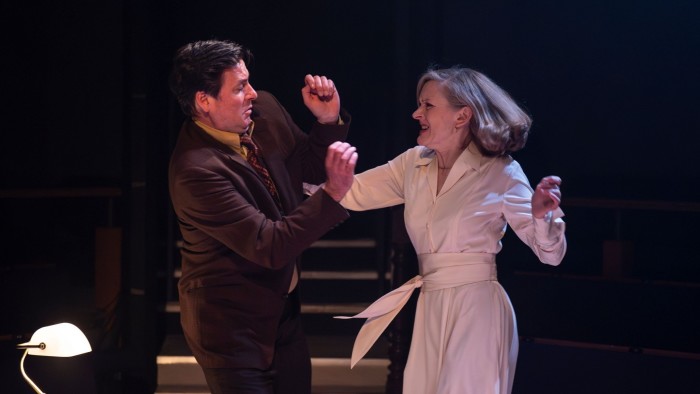
Lydia is suffering from a terminal condition that she is assiduously hiding from her abrasive husband, Sebastian, a bombastic literary critic whose avowed Marxism doesn’t preclude accepting an OBE. A man of loud opinions and endless grievances, he treats Lydia as his unpaid secretary, getting her to file his books, fix his lamp and fetch his whisky (he noticeably never pours his own drink, let alone that of anyone else).
He’s written with venom by Rattigan and played here with epic bluster by Dominic Rowan. But beneath the armour there’s clearly something softer — he may pour scorn on Shakespeare as “bourgeois”, but it is to him that he turns to express the fear of death. Lydia, meanwhile, conceals steel beneath her gentle exterior. How much husband and wife really know and why they hide their knowledge from each other will emerge over the course of the play. Both worked in wartime intelligence, which makes them practised in pretence, but Lydia’s terrible experience of brutality and starvation also explains much about their mutual, if misguided, urge to protect.
Stuck between the two of them is their friend Mark (Daniel Abelson), a successful American novelist who is devoted to Lydia. He acts as a useful dramatic device — both spouses confide in him — but also brings another twist to the play’s study of love, as does Joey (Joe Edgar), scornful of his father’s views but desperate for his affection. Both are played with watchful care.
But it is Claire Price’s excellent, subtly layered Lydia who holds the stage. A refugee still trying to belong, a survivor who has seen horrors, she counters her son’s assertion about truth with her own, hard-won, creed: “Honestly, Joey — in the end you’ll find it’s only people who matter at all.”
★★★★☆
To July 5, orangetreetheatre.co.uk
Read the full article here