

Unlock the Editor’s Digest for free
Roula Khalaf, Editor of the FT, selects her favourite stories in this weekly newsletter.
I have recently been rereading Cecil Beaton’s endlessly entertaining diaries, along with Ashcombe: The Story of a Fifteen-Year Lease, surely the most evocative account of finding and falling in love with a house and garden to be put to paper.
It has all been in preparation for an exhibition I have been asked to design: Cecil Beaton’s Garden Party, the first to explore the role flowers played in developing the photographer, artist, designer and writer’s creative practice. It opens at London’s Garden Museum on May 14 and much is rooted in two of his beloved gardens.
Ashcombe tells the tale of Beaton’s love affair with a house that was, when Beaton first set eyes on it in 1930, a dilapidated building in a fold of Wiltshire downland. Beaton fell under its spell instantly, describing the effect as if being “touched on the head by some magic wand”. Beaton dedicated himself to a complete overhaul of the house and its garden. It became an obsession.
The artist Rex Whistler, Beaton’s much-loved friend and a regular visitor to Ashcombe, designed a new stone doorway, windows were made larger, and urns were added to its parapet, transforming this once humble building into a much grander affair. Outside, cartloads of manure were imported from neighbouring farms. Although Beaton effused enthusiasm for his new idyll and a huge deal of effort went into the garden on his behalf, at this stage of his life he wasn’t troubling with getting his hands too dirty: in Ashcombe he confesses to enjoying doing “a little superficial weeding”.
Beaton was impatient to get his cutting garden at Ashcombe off the ground, but complains that “the show of colour that appeared in my plots was rather disappointing”. This was a considerable setback considering the flower arrangements were a “major item in the curriculum [of weekend house parties] and took several hours to erect”. He was therefore forced to spend all his money on flowers at Covent Garden Market.
Beaton’s studio, housed in a former orangery opposite the main house, was given an all-white decorative scheme. White walls, white furniture, white sofas. Flowers were integral to Beaton’s vision — a large cutting garden, entirely of white flowers, was planned.
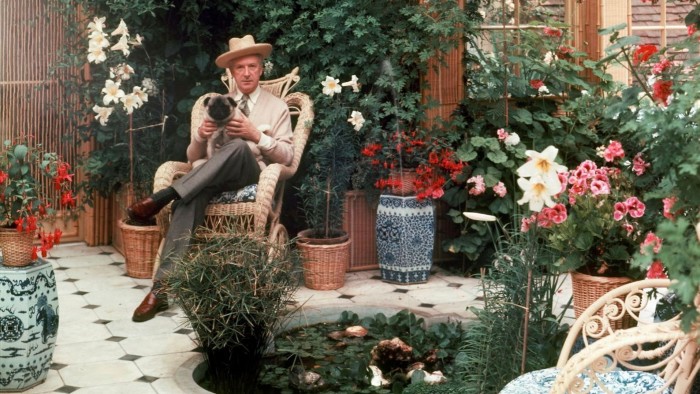
After 15 years, Beaton was forced to leave. It was a dagger to the heart. Some sort of relief, however, came through another house, another garden. Beaton moved to nearby Reddish House, an early 18th-century manor, in 1947. It is at Reddish that Beaton truly fell in love with gardening, creating during his time there an impossibly romantic garden in the classic English style. He planted rose and peony gardens, and the water garden he created in 1971 in the meadow in front of the house, with its meandering walks and lake with an island, is still there. It is at Reddish, too, that Beaton made his famous Winter Garden, leading off the drawing room, with its glass roof, bamboo trellising and small pool set into a black and white marble floor.
Visiting Reddish for the first time in May 1967, the art historian Sir Roy Strong described his impression of the house, noting its theatricality — “like a series of stage sets” — but “overlaid with cascades of flowers, not only real ones which were in vases everywhere but across the Aubusson carpet, the fabric of the loose covers and the curtains. Flowers were the key to this house. No room was without them, nor dining table devoid of a bouquet.”
Beaton did not cultivate gardens for the sole purposes of pleasure and decorating his homes, however. Flowers were a central part of his projects, from his photography to his costume and theatre design. The poet and patron Edith Sitwell was styled as a medieval effigy and photographed clutching a handful of lilies against a checkerboard floor in 1927. In the same year, Beaton captured his new friend Stephen Tennant and a cohort of other shiny young things dressed as faux rustics in floral smocks and brandishing baskets of flowers on the lawn in front of Tennant’s home, Wilsford Manor. Beaton worked with Constance Spry’s company for the supply and arrangement of flowers at times, but being a skilled florist himself, he mostly concocted his own creations.
Writing in his diary about his preparations for photographing the Queen Mother in 1953, Beaton muses on the idea of “making some pictures in the [German court portraitist] Winterhalter manner, with real country flowers on a side table instead of the usual Palace display of hydrangeas and gladioli”. He drove baskets of roses and clematis from Reddish to London for the photo shoot. In fact, one gathers from his diaries that Beaton was hardly ever without some selection of fabulous blooms, picked from his garden and about to be put to some creative use or another. The porters at Waterloo station came to recognise Beaton as the “eccentric traveller to Salisbury, wearing outsize hats, who is always late and laden with baskets”.
As Beaton’s career progressed, the ways in which flowers worked their way into his designs deepened. March 15 1956 was the opening night of My Fair Lady on Broadway. Beaton had been commissioned to design the costumes; the play was a success and the greatest triumph of his working life so far. Garden Museum curator Emma House writes in the Garden Party exhibition catalogue: “Flowers flow throughout the musical from the opening scenes of the busy flower market to embellishments on individual costumes to Eliza Doolittle’s sheer chiffon dress from the final act, its fabric twisted into a flower.”
The garden at Reddish House continued to be added to well into the 1960s (two large wooden greenhouses were installed in 1969), and throughout the 1970s Beaton welcomed a stream of artists, actors and models. Jean Shrimpton and David Hockney were both photographed in the Winter Garden; Bianca Jagger and Greta Garbo (with Beaton’s adored cat Timothy held aloft) can be found relaxed and smiling and surrounded by roses on the terrace.
Beaton worked tirelessly on creative commissions for decades, and yet Marion Taylor, wife of Beaton’s last gardener Stephen Taylor, remembered how he still waited with joyful anticipation for the arrival of snowdrops at Reddish each spring. The quiet blooming of a spring flower in his Wiltshire garden would have provided as much pleasure (if not rather a lot more) for Beaton than a packed and shrieking opening night in New York, I am sure of it.
“Cecil Beaton’s Garden Party”, May 14-September 21; Gardenmuseum.org
Find out about our latest stories first — follow @ft_houseandhome on Instagram
Read the full article here