

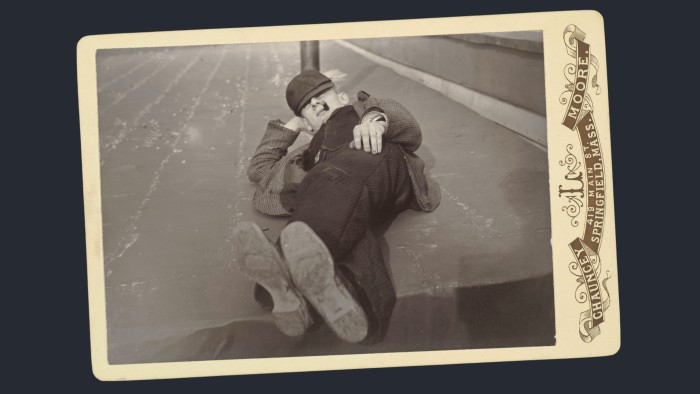
The title of the Metropolitan Museum of Art’s delectable exhibition The New Art: American Photography, 1839-1910 asserts an iffy point as if it were settled truth. It implies that photography, a radical tool for recording the modern world when it was introduced in 1839, instantly attained the status of art.
Fortunately, the show itself doesn’t even try to make that case, leaving the curator, Jeff Rosenheim, free to include images that were never intended for a museum’s walls and were never considered works of the creative imagination. Instead, this preview of a promised gift from the William L Schaeffer Collection finds beauty in workaday oddments.
Photography’s first moments produced pieces of evidence, illustrations, memory aids for painters, reports on war and technical showpieces. Much of this material is inert, but what makes the Met’s selection so absorbing is the panorama of unrealised possibilities and intimations of a visually supercharged future. These are the earliest stirrings of a technology that nearly two centuries later continues to dominate — and complicate — our lives.
A vista of empty whiskey bottles, arranged in a sculptural heap, hangs in a gateway gallery. Squinch in close enough to the blue-tinted cyanotype from 1896 and you can read a few labels: Monogram, Old Crow, Old Gold, Miller’s Gamecock Rye. But it’s really a stage-managed crowd shot. A phalanx of dark-tinted bottles stands guard over their clear-glass brethren, which lie fallen on the field. Someone has arranged these objects in a tight gyre, to fit in the frame and create the impression of drama. The maker is unknown, but the aesthetic intention can’t be doubted.
That alcoholic still life belongs to a decade-long series of pictures commissioned by the city of Boston. They documented urban scenes that were about to vanish as a pedestrian core grew tentacles in all directions, reaching out towards the age of the automobile. A wall label invokes Eugène Atget, who spent those same years roaming Paris and documenting the receding past. Our anonymous Bostonian shared Atget’s preservationist spirit and austere lyricism.
The New Art celebrates hundreds of nameless photographers who built up a collective account of a rapidly expanding nation. They turned their cameras on pets, storefronts, forests, babies, patients, dead bodies and gatherings of teammates, classmates and workmates. Momentous occasions and ordinary routines received the same treatment — so long as everyone could hold perfectly still for the three or four seconds it took the shutter to open and close.
Today’s universal habit of photographing everything everywhere, anytime, might seem like a uniquely contemporary phenomenon, but ours is hardly the first generation to flood the world with images of the ordinary. It was the 19th century that first democratised the visual imagination. Professionals (or affluent enthusiasts) had a shortlived monopoly on an expensive and cumbersome technology, but their services were much cheaper and easier to engage than those of portrait painters, and so millions did.
Even the most basic pictures from the mid 19th century are at once evocative and current. In them, you see ordinary Americans discovering the pose, learning how to wear a costume, bare a limb, or hold a tool so that strangers will see them at their theatrical best. You also witness the awe that led men to haul their bulky apparatuses deep into the nation’s back-country, where they photographed waterfalls, storms, rivers and cliffs.
The show is at its best in the portraits. A daguerreotype from the mid- 1840s catches an anonymous couple in a moment of quiet intimacy. The woman tilts her face down in a melancholy expression that speaks of a vibrant inner life. The man looks straight at the viewer, one finger resting at his temple and the other hand holding a book. It’s hard to pin down what magic transmutes these faces into an incarnation of tenderness and warmth. Not spontaneity, surely, since they had to hold that pose for an endless minute. Perhaps it’s in the way her sloping shoulder leans into his chest and two bodies form a single unit.
For a dose of noble sorrow, look at “Aunt Susan” (c1850), who reclines on a daybed and cradles her head in a pillow. The lens sits low and close, confronting her granitic face. That’s the only zone of stillness in a riot of patterns: the criss-cross print of her dress, the crocheted Afghan behind her shoulders, the topography of creases on the pillowcase, the perfect parallels and flawless part of her hair.
All we know about this woman is that she’s dying; a handwritten annotation asserts that consumption killed her six months after the picture was taken. Photographers everywhere advertised their services with the slogan “secure the shadow ere the substances fades”, an admonition Susan’s family took literally.
There’s nothing shadowy about three hand-coloured portraits from the 1840s, whose sitters appear so vivid they might just have ordered vanilla soy lattes. A mature lady with deep furrows and an attitude of rippling vitality turns towards the camera, cocking her head. In her dark glasses and lace shawl, she could be Lou Reed in drag, possessed of a formidable life force.
Above her on the wall, a self-assured young man with a prominent jaw and an even more prominent cravat gives the camera a smug smile. The hand-tinting gives him a slightly ruddy look, as if he had just staggered into the studio from the pub. Perhaps it’s a comment on his personality that the photographer seems to have been more interested in inanimate objects — the swath of yellow curtain behind his head, the floral pattern of the tablecloth — than the rather blank-looking gent himself.
The eye is drawn to interesting people, and the one who caught my attention is a young girl with large dark eyes brimming with alertness. She looks physically fragile, with a gold chain hanging from her slender neck and resting on a protruding clavicle. But the gaze is steadfast and strong, reaching across the decades to demand a conversation.
By the middle of the century, photographs were ubiquitous. Celebrities, socialites and working stiffs all carried cartes de visite. These calling cards bore the visitor’s likeness, and pictures of theatre stars and circus performers were collected, sold and swapped like Pokémon cards. Cartomania, as the fad was called, ensured that photography permeated the culture. It reassured the public that the nuances of being human could endure even in a form of mechanical reproduction. Photography didn’t replace painting; it evolved into a separate art.
To July 20, metmuseum.org
Read the full article here