

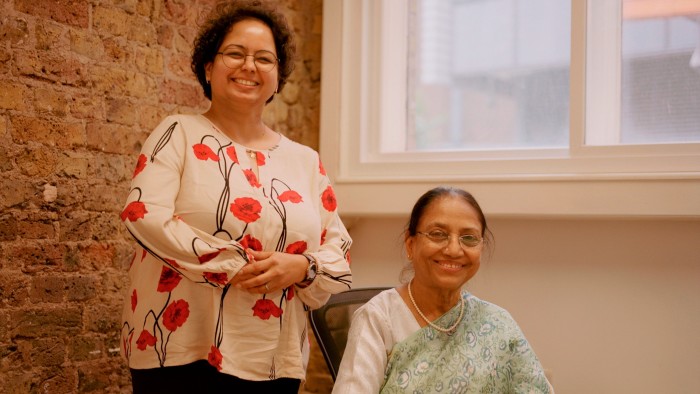
The Indian writer Banu Mushtaq’s fiction is unknown to most English-language readers and there was surprise and jubilation when the 77-year-old and her translator Deepa Bhasthi won the International Booker Prize this week. But perhaps nobody was more shocked than Mushtaq.
“I never dreamt it could happen. I don’t know how to express my emotions, except to say it is the greatest experience of my life,” she says, still looking somewhat stunned in the morning-after surroundings of a PR agency’s central London office.
For Bhasthi, 41, the honour lies in becoming, she says, “the first translator of colour” to win the annual award, which goes to the best work of fiction translated into English and splits the £50,000 prize money equally between author and translator.
The pair won for Heart Lamp, a collection of 12 stories which Mushtaq wrote in Kannada, a language spoken by an estimated 65mn people, between 1990 and 2023. The book fizzes with verbal energy, teeming with voices and plunging the reader into the lives of women in patriarchal communities of southern India.
The translated stories retain words from Urdu, Arabic and Kannada, which enrich their music and send the reader googling terms such as amma and mahamari. This might sound like a chore but it deepens the sense of immersion and discovery that comes with reading Mushtaq’s stories. Max Porter, chair of the International Booker Prize 2025 judges, called Heart Lamp a “radical translation which ruffles language, to create new textures in a plurality of Englishes”.
Bhasthi, who is also a writer and has translated other authors’ works from Kannada, says: “This is our lived experience. We have different languages in southern India. Even though we speak a certain language at home, the language of the streets is different and we work our professional lives in English. Banu and I engage with different languages on a daily basis.”
The book is a true collaboration: it was Bhasthi’s job to select the stories for Heart Lamp from Mushtaq’s six published collections.
“I wanted it to be a career-spanning collection of Banu’s stories that I personally liked,” says Bhasthi. “No translator would want to work with something they didn’t enjoy as a reader.”
Bhasthi lives in Madikeri, about 100km from Mushtaq’s home in Hassan, but the two women speak different versions of Kannada — something the translator was conscious of when working on Heart Lamp.
“I was very aware that I do not come from the same community as Banu. There were layers to her stories, nuances, that I might not understand entirely,” she explains. “I did not want to stereotype or flatten her culture. I spent a lot of time reading around the texts, watching TV and film and listening to music, to get into the mood of her community.”
There was also a political element to the collaboration.
“There is an attempt in India to other minorities and put all communities in boxes even though [in reality] everyone bleeds into each other,” says Bhasthi, referring to Narendra Modi’s Hindu nationalist government. “Authoritarian politicians do not want harmony between communities so they try to bracket them in certain ways.”
On a more local level, Heart Lamp has been a source of pride in Mushtaq’s home region. “Where I live, irrespective of caste and creed, people are happy that Karnataka has won global attention,” she says.
Mushtaq was born into a Muslim family in 1948 but her parents sent her to a convent school where she started writing in Kannada. She became a lawyer, a feminist activist and member of the Bandaya Sahitya movement which, in the 1970s and ’80s, protested against upper-caste and male-dominated literature.
“When I started writing, I was challenging the patriarchy,” she says. “I wrote about dowry debt, which meant a newly-wed bride would be burned to get more dowry from her parents, and domestic violence . . . My subjects have changed because the social situation has changed. I have started to write about communalism, solidarity, neighbourhood life in Karnataka.”
She is currently writing her seventh collection of stories, and has published only one novel. Why does she prefer the short story over other literary forms?
“In a story, you have to be stingy with your words [and] use them diligently,” she says, lighting up at the opportunity to talk craft. “You need a route map, otherwise it will become a novel . . . If an issue is haunting the people, I don’t want to write a report or an essay, I want to write a story. The short story is intimate and has the power to remain in readers’ minds.”
The women protagonists in Heart Lamp contend with stultifying social expectations and religious rules, almost perpetual pregnancy or husbands who are either useless or bullying or both. The title story concerns a young woman who confides in her parents when her husband starts seeing another woman, only to be told to accept her lot. Mushtaq conveys the woman’s unhappiness with characteristic economy of language: “The feeling of being a stranger in her own house nagged at her, and the fire of insults ground her down . . . ”
What was the inspiration for the story?
“I saw many women who were told by their parents and brothers: ‘Once you are married you must live at your husband’s home or die there. You live peacefully or with fighting but if you cannot survive you die. Don’t come back to us.’”
These narratives are not based on her own experiences of family life. “I was lucky,” she says. “My parents provided me with education, freedom, and allowed me to make decisions for myself . . . My husband is very loving and I have a harmonious family . . . But women like the ones in my stories still come to me and I counsel them as an activist. They describe experiences that are worse than those in my stories . . . The violence is still there today.”
The International Booker Prize judges called Mushtaq’s women characters “astonishing portraits of survival and resilience”. A case in point is her funny, incendiary story “The High-Heeled Shoe”, about a woman whose unstable husband forces her to wear ill-fitting, three-inch stilettos even though she is five months pregnant and unwell.
Mushtaq’s treatment of the story epitomises the mission of her fiction: “The husband should have worn the high-heeled shoes,” she laughs. “These roles that say how women should be are very dominant. The woman in the story defies her husband but he doesn’t understand, so she breaks the shoe, thereby breaking the stereotype. It is what I have done throughout my life, breaking the stereotypes one by one. How artfully you break it is the important thing.”
‘Heart Lamp: Selected Stories’ by Banu Mushtaq, translated by Deepa Bhasthi, is published by And Other Stories, £14.99
Join our online book group on Facebook at FT Books Café and follow FT Weekend on Instagram, Bluesky and X
Read the full article here