

Stay informed with free updates
Simply sign up to the House & Home myFT Digest — delivered directly to your inbox.
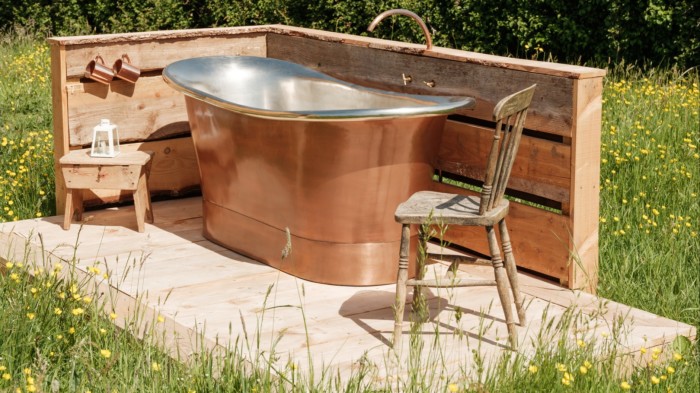
In a walled garden in West Sussex, Mark Rogers is trying something new. The co-founder of landscape design practice Hortus Collective is adding stepping stones to loose planting of erigeron, geraniums, foxgloves and pulmonaria in a “lovely white Sissinghurst variety”, creating a meandering pathway to a leafy and secluded corner of the garden. And there he is installing a copper bathtub.
Rogers’s clients, Victoria and Edward Bonham-Carter, wanted to create “rooms within the garden”. Outdoor living rooms and kitchens have become commonplace features. Could the bathroom be next in line? “It could be somewhere to put the bottles for a summer party,” says Rogers, “and somewhere to bathe the next day.”
Hospitality is leading the way: places like Nymetwood Treehouses in Devon and Thornfalcon Winery & Press in Somerset have installed outdoor baths among nature for guests. At artists’ residency Salmon Creek Farm in California, the romantically ramshackle cabins have outdoor baths set among the redwood trees.
“It’s to do with immersing yourself in a landscape,” says Rhiannon Batten, who runs The Scrumpling, a vintage caravan retreat in Somerset where, in a glade among two acres of meadow, she has just added a wood-fired bathtub for her guests. It takes forest bathing to a new level. Lying back and looking up at the swaying leaves is “very soothing”, she says. “We know that being among trees reduces the stress hormone, cortisol and boosts the immune system.” Adding in the relaxing benefits of a warm bath makes sense.
But it’s outdoor ice baths that have been making headlines; at-home versions can be a pricey business. There’s the $11,150 Goodland Cold Tub, which features a concealed chiller unit that can take the water down to three degrees, and the £6,000 Monk bath that links to an app for guided breathwork. At last year’s Camp Kerala, the upscale glamping area at Glastonbury Festival, there were outdoor baths by the design company Splinterworks; cold plunges in the hammock-like King Hamaca tubs were so popular that the team had to keep fetching more ice. This year, the baths will be back on site, for both cold and hot dips.
Bathing for health benefits is, of course, not a new concept. Think of the Romans with their caldarium and frigidarium, or the spa towns that flourished in the 18th and 19th centuries. In France at that time, companies like Rogeat in Lyon and Niederbronn in Alsace styled their baths to mimic the popularity of hydrotherapy and spas. Zinc was used from 1750, copper from 1780 and cast iron baths from 1860.
The look was short and deep, “to recreate that spa feel at home”, says specialist Marcus Frisby, who runs Antique French Baths. He sources examples from châteaux and maisons bourgeoises across the country for clients all over the world, from Scotland to Australia to LA, and has experienced a 30 per cent increase in customers using them outdoors.
“The copper baths are becoming really rare,” he says. They cost about £3,500 after restoration and work particularly well outdoors where the aged patina is all part of the desired aesthetic — a far cry from a plastic hot tub.
Fired Earth’s freestanding versions also fit the bill for elegant outdoor bathing. The brand has experienced a rise in enquiries for outdoor baths — such as the Babylon, Canterbury and Florence styles — and decided to tap into the trend. Its new collaboration with artist Frances Costelloe features paintings of bearded irises on the double-ended Florence bath; the marketing images were shot in a Northamptonshire country garden surrounded by alliums, peonies and cherry blossoms.
Other brands are channelling a modern aesthetic. Canadian company Goodland creates smart rectangular wood-fired bath tubs in aluminium and red cedar wood. Assembly is DIY and takes 15 minutes — so is popular is remoter locations anywhere from off-grid Alaska to the Californian Hills. In the UK, Omnitubs are handmade in Somerset using Omnigel — a blend of resin and protective agents — that feels warm to the touch and is UV, scratch and stain resistant.
Plumbing in an outdoor bath is straightforward when it’s close to a house and can connect to an existing plumbing system. Fired Earth recommends keeping within 15 metres to retain good pressure and temperature; beyond this you might need to install a pump. Drainage also needs to be considered — waste water can either go back into the main system or be used to water the garden provided no chemicals or harsh soaps are added.
At Batten’s electricity-free Somerset sanctuary, the set-up is deliberately low-key. An upcycled roll-top bath connects to a specially designed — read improvised — water system. “We just figured it out ourselves,” she says. It cost around £2,000 in total — they ran a very long hose out from an outdoor tap, and then created a loop system flowing the water through a pipe into the back of the wood burner and into the bath. It’s not a quick fix, though; the bath takes two hours to heat up.
It plays into the romantic notion of outdoor bathing. “When you’re outside you lose the functionality of the bathroom,” says design gallerist Alex Tieghi-Walker. The bath in the garden of his former LA home was a courtyard haven created with bells hanging from the guava tree. “There’s something amniotic about being in water,” he says. “It’s womblike.”
Such relaxation lets the subconscious get to work. One of Frisby’s customers — a writer based in Wiltshire — wanted a cast-iron bath fitted “indoor-outdoor-style” in the garden treehouse work space she built with sliding glass doors opening on to the countryside. “It’s all plumbed in with underfloor heating, the whole shebang,” she says of the new addition that has become an integral part of her work-life routine. “I have my best ideas in the bath.”
Find out about our latest stories first — follow @ft_houseandhome on Instagram
Read the full article here