
Jesse Armstrong on his tech bro takedown Mountainhead: ‘It’s where clever and stupid meet’

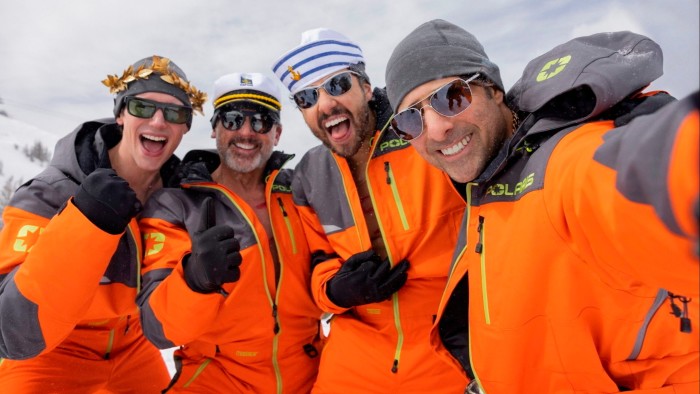
It is a bright, cold March day in Utah and sunlight is pouring through the enormous windows of the $59mn cliffside mansion where Jesse Armstrong is shooting Mountainhead, his debut feature. This is the British writer-director’s first project since his zeitgeisty, award-winning show Succession ended in 2023, but if he is feeling the pressure of high expectations, it doesn’t show.
Wearing a cosy jumper and closed-toe Birkenstocks, Armstrong sips peppermint tea and chats casually in between takes. “This is the most relaxed set I’ve ever worked on,” says a crew member.
Which is remarkable, given the insane timetable for the film. Armstrong didn’t start writing the script until January, and the shoot was a brisk five weeks. The film, which stars Jason Schwartzman, Steve Carell, Cory Michael Smith and Ramy Youssef, will be released next week. “I had never even heard of this film two months ago,” Carell says, during a break between scenes. The quick pace was exciting, he adds, comparing the script to Stanley Kubrick’s Dr Strangelove, one of his favourites.
With Mountainhead, Armstrong is moving from Succession’s cut-throat media moguls to the world of tech oligarchs. The film revolves around four wealthy CEOs who have gathered at the mansion for their annual poker weekend, which is going ahead despite an AI-induced global crisis sparked by the company owned by the richest of the friends.
The idea of taking on tech had been floating around in Armstrong’s brain for a while. He had been reading obsessively about the industry’s titans — Elon Musk, Peter Thiel and Mark Zuckerberg among them — and listening to them on the All-In and Lex Fridman podcasts. Then, late last year, he felt the urgent compulsion to write a script.
“I was just not able to get their voices out of my head,” he says. “It was like an itch that I wanted to scratch. And maybe this is something writers don’t always admit to, but there was a little bit of professional pre-jealousy — I thought if somebody else did the [tech] space in this way, I might be a bit jealous.”
Early in December, he flew from his home in London to Los Angeles to pitch the idea to Casey Bloys, head of HBO. “I said I wanted to do it fast, and he was keen to do it probably slightly even faster than I was,” Armstrong recalls. Working in a rented room in south London, Armstrong wrote the first draft of the script in two weeks and quickly assembled the cast.
The urgency was in part because Armstrong wanted to capture the “cultural, political and social” moment when tech executives — Musk in particular, via his and President Trump’s so-called Department of Government Efficiency — were amassing even more power. And he wanted to present the story while the audience was still living through it.
He acknowledges that real-world events have moved incredibly quickly since then. “Doge has almost come and gone in between, but I think we are roughly speaking in the same tech moment,” he says.
He also had a more personal reason for hurrying: the fear of directing his first film. “I wanted to just run at it rather than what I could have done, which is worry about it for a year and try to watch every tutorial on YouTube about how to direct a movie,” he says.
On the day I visit the set, Armstrong is shooting a comic scene involving a coup in Argentina. When Schwartzman arrives, Armstrong strides over and gives him a big hug.
The actor plays Hugo Van Yalk, aka Souper, a tech bro struggling to launch a new lifestyle app who has somehow taken a role as the main interlocutor between the IMF and a post-coup Argentine government. (“Souper” is a shortening of “soup kitchen”, which the others call him because he’s not a billionaire.) It is here that Armstrong’s gift for absurd, jargon-laced bullshit — one of the great joys of Succession — meets Schwartzman’s improv skills.
As Souper gets on a glitchy video call with members of Argentina’s new cabinet, Armstrong begins shouting out suggestions for dialogue. “Throw in some stuff about the currency, the labour market and the deficit,” he says. Schwartzman starts riffing. Blaming the technical issues on the Argentines, he says it can’t be a problem with the screening room in his mansion. “It’s very fibre optic here,” he says. “It’s very reverberant.” Armstrong is delighted. “Great jargon!” he enthuses. “You can’t go wrong with that stuff.”
Armstrong proved his genius for acerbic dialogue and elevated profanity years ago in The Thick of It, a satire of British politics created in 2005 by Armando Iannucci, and later in Succession. The modern tech industry provides him with another linguistic trough of nonsense: in Mountainhead, characters are willing to “eat the chaos” but don’t want the situation to “go paper clips”.
The idea of an overconfident, under-informed tech executive meddling in the affairs of another country feels as if it has been pulled from the headlines — witness Musk’s attempts to influence recent elections in Germany. This extreme topicality has become something of a trademark for Armstrong: by the end of Succession’s four-season run, the show seemed to be anticipating — prompting, even — the actions of the Murdoch family, who were among the inspirations for the show’s powerful media clan.
The movie was almost entirely shot in the 21,000 sq ft mountain house, which gives off the chilly vibe of tech billionaire’s rarely used retreat. There is an underground basketball gym, a rock climbing wall, a two-lane bowling alley and a couple of bars spread across seven vertigo-inducing floors. It also has the best view in the area, according to the person who cares for the house and dozens more around Park City.
By using a small cast and confining the action to the weekend house — much as Mike White did during his peak-Covid shoot for the first season of HBO’s hit series The White Lotus — Armstrong was able to work quickly. He was speed-writing updates to his script on set while Musk was shutting down swaths of the US government, providing more techno-apocalyptic grist to his story by the hour. “I admire the intellect of these people — I don’t think Elon is just somebody who’s taken other people’s good ideas and monetised them or developed them. I think he evidently has a kind of genius in his field.”
But it is when these powerful executives begin to stray from tech and into politics or culture that the alarm bells ring — and the comedy potential emerges. “There’s a level of self-confidence about their pronouncements and actions in other areas which start to become quite interesting,” Armstrong says of Musk and other current tech executives. “Where clever and stupid meet is quite an interesting place for comedy.”
As much as he lampoons the tech executives in his new movie, Armstrong says he has some sympathy for them. “The Sam Altmans and sometimes the Musks seem to feel as anxious about the possibilities of AI as other people,” he says.
“They feel if they can maintain control, things will be OK, and that’s a consolation that’s not available to the rest of us. It’s not much comfort for us to be told to trust them.”
‘Mountainhead’ will be on HBO and Max in the US from May 31 and on Sky and NOW in the UK from June 1
Find out about our latest stories first — follow FT Weekend on Instagram, Bluesky and X, and sign up to receive the FT Weekend newsletter every Saturday morning
Read the full article here