

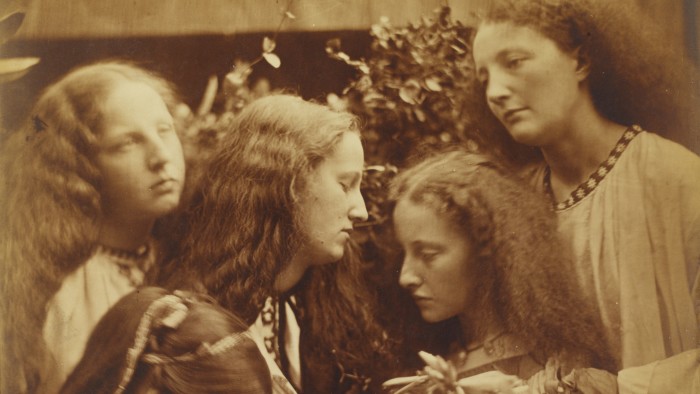
Julia Margaret Cameron has been dead for nearly 150 years, yet her photographs keep swinging in and out of fashion. She’s a sentimental relic — no, a brave proto-feminist, a technological pioneer, or a dabbler with a wobbly command of the medium. Drawing on the extensive collection of London’s Victoria and Albert Museum, the Morgan Library in New York has mounted a reverent exhibition that stimulates but doesn’t settle the debate. Visitors will have to decide whether they’re more seduced by her gifts than annoyed by all those chaste maidens, bearded luminaries and staged tableaux.
Born in Kolkata in 1815 to a French mother and an English father, Cameron moved to England in 1845. Her brief but momentous career began in 1863, when she received a camera as a Christmas gift from her adult daughter. At 48, she fell instantly in love.
“From the first moment I handled my lens with a tender ardour,” she wrote, “and it has become to me as a living thing, with voice and memory and creative vigour.”
An upper-class matron living next door to Alfred Tennyson on the Isle of Wight, she was well positioned to cajole Victorian cultural figures into posing. Her sister Sara Prinsep also hosted a lofty salon in London at Little Holland House, where Julia recruited a host of superstar sitters.
For 11 years, she immortalised the craggy faces that fronted some of the age’s most supple minds. She shot white-haired geniuses such as Thomas Carlyle (who disparaged the result as “terrifically ugly and woebegone”), Charles Darwin, Henry Wadsworth Longfellow, George Frederic Watts and, of course, Tennyson.
Then there were the countless young women who in lieu of celebrity offered a wistful, ethereal beauty. Many of those friends, relatives and servants are shorn of their identities but blessed with voluminous locks. Parlourmaids hid their street clothes under free-flowing robes and saw themselves reinvented as Madonnas and Guineveres. Cameron clothed them in feminine self-sacrifice, instructing them to lower their eyes in sorrowful longing or adopt attitudes of redemptive resignation.
Photography was still a relatively recent innovation, but already it had scattered in various aesthetic directions. Some of Cameron’s colleagues prized the medium’s ability to reproduce the intricacy of plant life and architecture in astringent precision. Others used it to report on dramatic events like hangings, mount elaborate theatrical fictions, or emulate the atmospherics of painting.
Cameron settled on portraiture, but first she had to master some delicate and cumbersome procedures. At the beginning, she recalled, “I did not know where to place my dark box, how to focus my sitter, and my first picture I effaced to my consternation by rubbing my hand over the filmy side of the glass.” The set-up demanded endless stretches of total stillness. One model recalled the ordeal: “Mrs Cameron put a crown on my head and posed me as the heroic queen . . . The exposure began. A minute went over and I felt as if I must scream, another minute and the sensation was as if my eyes were coming out of my head; a third, and the back of my neck appeared to be afflicted with palsy; a fourth, and the crown, which was too large, began to slip down my forehead; a fifth — but here I utterly broke down . . . ”
The whole process was such slow going that her first success, an 1864 portrait of an extravagantly patient young girl named Annie Philpot, triggered “a transport of delight. I ran all over the house to search for gifts for the child. I felt as if she entirely had made the picture.”
“Annie” has the qualities that infused the rest of Cameron’s work. It’s deliberately unfocused, giving it an otherworldly air. The girl doesn’t look at the camera, but gazes off, lost in reverie. Cameron balanced light with murk, using the camera to inject uncertainty that could pass for romance.
Trooping past dozens of these smeary pictures, I started to wish she had varied that approach. It’s difficult to distinguish one female model from another, since Cameron gravitated so predictably to a type: oval face, full lips, thick, cascading hair and melancholy mien.
The men are less wispy but not much more distinct. Here’s Darwin in three-quarters profile, with far-seeing eyes and a prophet’s beard; Henry Taylor, the same; Longfellow in full profile, with similar stoniness and facial hair; the violinist Joseph Joachim, minus beard, plus fiddle.
The partial exception to this roster of burdened seers is an 1865 portrait of Tennyson. With his eyes puffy, hair in mid-flight and beard unkempt, the poet laureate looks as though he has just woken up, still gripping the book he was reading the previous night. He had a sense of humour about that image, which he approvingly captioned the “Dirty Monk”.
Cameron grasped photography’s potential as art, and she looked both to Renaissance painters and her Bohemian contemporaries for inspiration. Mary Hiller, housemaid and muse, could have been one of Dante Gabriel Rossetti’s “stunners”, with long hair streaming like a waterfall, catching the dappled light.
Cameron described some of her more self-consciously literary scenes as “Fancy Subjects for Pictorial Effect”, and those remain compellingly silly. Saints, mythological figures and characters from plays all suggest souvenirs from dress-up games. A bored bacchante has stars in her mane and something else on her mind. Whether he’s impersonating Ahasuerus or King David, Henry Taylor gives the impression that he’s fortified himself for the session with a hearty fry-up and perhaps dripped a bit of egg on the sleeve of his biblical robe.
Cameron’s improvisational technique drew barbs from the start. The prints were “smudged, torn, dirty, undefined”, one critic harrumphed. Another suggested that these faults were mitigated, but not eliminated, by the innate deficiencies of her sex. “For Mrs Cameron’s heads there must be some excuse made for their being the work of a woman; but even this does not necessitate such fearlessly bad manipulation as the majority of these heads and figures show. Fog and dirty plates, and bad development, and unnecessary feebleness” were the result.
But Cameron commanded blur and chiaroscuro with intention. The long exposures that bedevilled sitters also allowed the camera to register slight movements, letting pictures breathe. She considered imperfection a stylistic virtue, the product of whatever spontaneity the infant technology would permit. “When focusing and coming to something which, to my eye, was very beautiful, I stopped there instead of screwing on the lens to the more definite focus which all other photographers insist upon,” she explained.
She was hardly alone in that philosophy. The romantics excoriated flawlessness. Passion, coupled with vibrancy, was a higher aim. The critic John Ruskin distilled that preference into an ideology. “Of human work, none but what is bad can be perfect, in its own bad way.” Perfection, in Ruskin’s eyes, yielded only vacuous obsession.
And yet the Morgan’s generous supply of Cameron’s work winds up making sloppiness feel like a justification for timidity. All that misty pining and haunted glances, those bushy beards and furrowed brows, add up to a narrow, sedate view of a time and a medium that was constantly exploding with innovation. While she was busy arranging drapery in her studio, Cameron managed to miss the 19th century’s breakneck vitality.
To September 14, themorgan.org
Read the full article here