

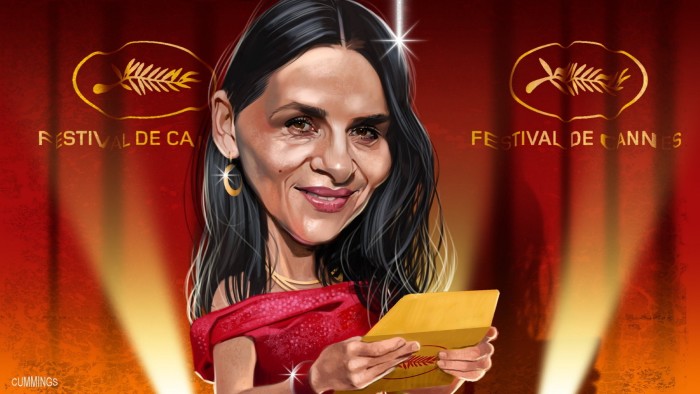
Journalists at the Cannes Film Festival had to press Juliette Binoche, the legendary French actor presiding over this year’s jury, several times for a reaction to fellow star Gérard Depardieu’s recent conviction for sexual assault.
When she finally did reply, it was with a poised answer that rebuked Depardieu by rejecting the refrain in France that calls him le monstre sacré of cinema, a “sacred monster” whose eccentricities are above criticism.
“First off, the term le monstre sacré has always bothered me because he is not a monster, he is only a man. He has lost his so-called sacred status apparently because of acts that had legal consequences,” she said. “It makes you think about the power that some people have, those who take that power, but I think the true power lies elsewhere.” She added that only the act of artistic creation was truly sacred.
The response was characteristically astute from the 61-year-old actor, who is known for embracing activist causes — including condemning inadequate responses to climate change and the halting progress of MeToo in France — while managing to remain beloved within a cut-throat industry and a box office draw.
Beyond the politics of MeToo, Binoche’s selection as the head of the Cannes jury this year was seen as long overdue. One of the most decorated actors of her generation, she made her name at the festival 40 years ago when she played an ingénue in art house director André Téchiné’s Rendez-vous.
The movie, which won the best director award, set a precedent for Binoche making successful films with auteurs including Krzysztof Kieślowski (Blue), Claire Denis (Let the Sunshine In) and Abbas Kiarostami (Certified Copy).
“She has worked with the greatest directors in the world,” says Frédéric Quinonero, who wrote a 2011 biography of Binoche.
“The longevity of her career comes from the fact she does not pick roles for the commercial potential of the film, but because she has an artistic goal and a quest for meaning.”
Binoche, who has two adult children and never married, was born in Paris in 1964 to artist parents. Her mother was a director and actor, her father a director and sculptor, and she has said that she was immersed in creativity early on. At the early age of four, however, her parents sent her to boarding school, leaving her with a sense of abandonment that became a wellspring of her work, she told The New York Times in 2021.
She is known to prepare meticulously for roles, although not every director has appreciated her efforts. In the late 1990s, she was replaced as the lead in Lucie Aubrac, a movie about a French resistance fighter, after clashing with director Claude Berri.
Binoche had met the real-life Aubrac multiple times and disagreed with what she regarded as the director’s subjective representation. “It was imperative for me that the truth of who Aubrac was be reflected [in the film] . . . but that did not matter to Claude Berri.” Getting ousted from the set felt like a failure, she told L’Express magazine.
Yet months after this she scored her biggest accolade, winning an Academy Award for her role as Hana, a nurse tending to a badly burned man in The English Patient. Critics lauded Binoche’s ability to portray vulnerability and compassion. The film confirmed her as a global star, joining the small club of French actors who manage to thrive in Hollywood.
Despite her fame, she is capable of unpretentious self-deprecation. She found it “as funny as everyone else” when she mixed up her words during her opening speech at Cannes, accidentally saying that the film industry needed more humidity instead of humility, according to film critic Jonathan Romney.
In a self-referential comic turn, she played herself in a 2017 episode of the hit TV show Call My Agent! in which she nearly bombed as the host of the Cannes festival because of a wardrobe malfunction while wearing a plumed, skin-tight gown. The character also fended off the advances of an oily movie executive by turning the tables and intimidating him with over-the-top sexual advances.
The gambit was true to life. Soon after the revelations about abuses committed by Harvey Weinstein triggered the MeToo movement, Binoche told Le Monde newspaper that she had rebuffed the producer. She had also, she said, resisted other instances where directors or agents had pressured or groped her. “Like all girls, I went through this, I learnt how to deflect, rebel and rise up against male impunity.”
MeToo has faced resistance in France from older actors like Brigitte Bardot, leaving some to view Binoche’s stance as complicated.
“She positioned herself as a strong woman who was able to avoid the worst of MeToo abuses, which has been seen by some as excusing the perpetrators,” says Quinonero. “But she has supported other actresses who went public with their awful stories.”
Elsewhere, her activism is more clear cut. For Binoche, art is a vehicle for emotion, political engagement and understanding the world.
In her opening speech at Cannes, she paid homage to Fatima Hassouna, a 25-year-old Palestinian photojournalist and the subject of a documentary selected for the festival, who was killed in an Israeli air strike in Gaza. “Fatima should have been with us tonight,” she told the audience. “Art remains and is the powerful witness of our lives.”
Additional reporting by Raphael Abraham in Cannes
Read the full article here