

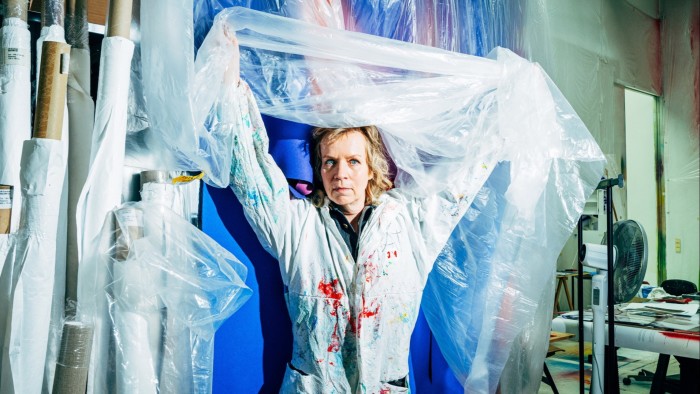
Katharina Grosse may be one of Germany’s most important painters, but she rarely picks up a paintbrush. Since the late 1990s, she has instead wielded an industrial spray gun, coating unconventional materials and sites — a derelict house in New Orleans, piles of rubble at the Venice Biennale, her own bedroom — in saturated swaths of colour. In these immersive site-specific installations, painting doesn’t hang quietly on the wall; it engulfs, expands, overflows. “I want to be really close,” says the artist. “Almost like a tender form of aggression.”
Despite their unruly surfaces, Grosse’s works are meticulously planned in her Berlin studio, a striking glass-and-concrete building in the city’s central Moabit neighbourhood. Its network of storerooms, workshops and offices reflect the logistical complexity of her practice. Yet pigment-streaked floors suggest it is still driven by a playful disorder.
Here, understatedly dressed save for a pair of shiny gold shoes, Grosse, 63, shows me models for several concurrent projects: institutional shows in Stuttgart and Hamburg, as well as a sprawling public commission for Art Basel. For the latter, titled “CHOIR”, she plans to cover the fair’s facade and the adjoining Messeplatz with giant scrawls of white and magenta — a colour she describes as “the most visible in the world”. Such an eye-catching shade, she points out, is essential in order to compete with the busy activity of the fair. “It’s a colour of being alert, of being aware . . . this is really a piece about attention.”
Bold and immediate, “CHOIR” encapsulates Grosse’s signature style: urgent gestures in riotous hues that unite varied structures and objects in a single painted image. She credits her spray gun with allowing her to achieve these vibrant, multi-layered compositions. “A yellow being sprayed on to a dark green, for example, is not getting mushed up by the paintbrush,” she says. “It lands clean on that surface, so the colour maintains its integrity.”
Powered by a compressor, the device also allows her to magnify the scale of her practice by spraying hard-to-reach surfaces at speed, as well as vary from faded to more dense zones of colour. “It has a different velocity than using a brush,” she explains. “It’s a continuous movement where I’m thinking and readjusting. It makes you fast. It makes you large. You can go over multi-dimensional surfaces with ease.”
Grosse also brings her prismatic vision indoors. Sitting opposite the Basel model is a mock-up for “Erdraum” (“Earthroom”), a new work that has just opened in Hamburg’s vast Deichtorhallen art centre, in which painted mounds of soil form a multicoloured trail through the space. Visitors are invited to walk across this hilly landscape surrounded by the artist’s canvases — a format she returns to between large-scale projects.
The piece captures a central ethos in her art: that a painting can emerge in both expected and unexpected ways, “on your arm, in a corner of an old building, on a wall, on a canvas or on a big textile”, she says. “There are all these different ways that a painting can appear and what size it can have, what kind of staging it can have. I think this is very theatrical.”
Grosse’s taste for the dramatic can be traced back to her childhood. Born in 1961, she grew up in the Ruhr region of West Germany, where her artist mother and linguist father exposed her to theatre and dance from a young age. “There was Pina Bausch in Wuppertal,” she recalls. “We also travelled a lot for theatre, to shows in Berlin or to see Peter Brook in Paris.”
After studying at the Kunstakademie Münster and Düsseldorf, Grosse took up an artist residency in Florence, where she began to rethink painting’s relationship to space. “I realised with all the Renaissance frescoes that painting can surround us in a more natural way, so that you take it in with your whole system,” she says. “It’s not just a little piece on the wall.”
This idea was radically put into practice in 2004 when she sprayed the bedroom of her Düsseldorf flat — including the bed, floor and the clothes, books and shoes strewn across it — in rainbow-hued acrylics, a work later restaged in the city’s Kunsthalle. More monumental interventions followed: in 2015, she installed three massive trees in the Museum Wiesbaden’s neoclassical hall, their paint-drenched roots dazzlingly exposed. A year later, for a project with MoMA PS1, she transformed an abandoned army bathhouse and the surrounding beach in New York’s Rockaway peninsula into a candy-striped landscape of red and white. When museums in Berlin were briefly reopened during the pandemic, she gave audiences a much-needed jolt to the senses with a kaleidoscopic installation at Hamburger Bahnhof that extended beyond the confines of the museum.
For Grosse, painting is not just a visual experience but a total bodily encounter: “the idea of a painting being so present that it goes into your visceral system, so strongly connected to your senses,” she says. “When I paint my whole intelligence as a being is triggered, that’s why I find it so exciting.”
While they might aim to transport viewers to otherworldly sensorial planes, Grosse’s works are nonetheless grounded by precision and control. She describes her approach as “strategic”, citing the choreographed performances of orchestras or sports teams as inspiration. The symphonic array of colours is carefully composed, each palette tailored to the specific demands of each project.
“Colour is one element that is part of a multi-faceted strategy,” she says. “In Basel I have so many different elements that play together, so in this case the magenta has to be really clear. In Hamburg, I have a different situation: a synchronicity of a very densely organised palette where the colours are intertwined into a stream of electric energy. Each work has a completely different attitude.”
Often spilling into the public realm, these installations possess an almost insurgent quality in the way they not only transform but claim their surroundings. “I think space is not defined by architecture only, it is defined or made by how we act in it,” says Grosse, before pointing again to the Basel model. “It is a claim, it is saying, ‘this is mine’, and it creates its own land or territory.”
Taking over that territory is no small feat. In Basel, for example, the site must first be covered in asphalt — “to give it the surface it can really spring out of, almost like a trampoline”. Such painstaking preparation is inevitable when working with architecture and public spaces, but the artist embraces these challenges.
“There are planning stages where you realise something isn’t going to work,” she says. “Sometimes there’s a special freedom that comes from liberating yourself from obligations. Other times, freedom arises because of the obligations you do have. And within those, you develop flexibility, imagination — even an anarchic undertone, which is fun.”
Does she still primarily see herself as a painter? “I think that I’m a painter who is doing something in very different conditions,” she says. “Some of those conditions can be things besides art and architecture — the trees, the wind, the weather. I like to see the work intertwined in an ecology with all these fields. It’s not separate, even when it’s shown in an exhibition space. It has a relationship to all these other things.”
‘CHOIR’ runs from June 16-22 at Art Basel, artbasel.com; ‘Wunderbild’, to September 14 at Deichtorhallen Hamburg, deichtorhallen.de; ‘The Sprayed Dear’, to January 11 2026 at Staatsgalerie Stuttgart, staatsgalerie.de
Find out about our latest stories first — follow FT Weekend on Instagram, Bluesky and X, and sign up to receive the FT Weekend newsletter every Saturday morning
Read the full article here