

Unlock the Editor’s Digest for free
Roula Khalaf, Editor of the FT, selects her favourite stories in this weekly newsletter.
Plenty of unlikeable women are the making of great novels. Amy March of Louisa May Alcott’s Little Women is spoilt and demanding, but she is redeemed by her self-awareness and ambition. Brett Ashley of Ernest Hemingway’s Sun Also Rises is dissolute and flighty; the plot’s devastating resolution depends on these traits anyway. Vanity Fair’s Becky Sharp is a corrupt and cheating social climber — but who else could William Makepeace Thackeray use to expose the frivolities of Britain’s upper class?
In the centuries-deep tradition of literary criticism, this is all well-trodden ground: no one serious considers agreeability a necessary asset of a protagonist. It is altogether more likely that we can access truth and beauty (and all that) through human failure than infallible virtue. And Irish writer Elaine Feeney certainly got the memo when casting her new novel Let Me Go Mad in My Own Way.
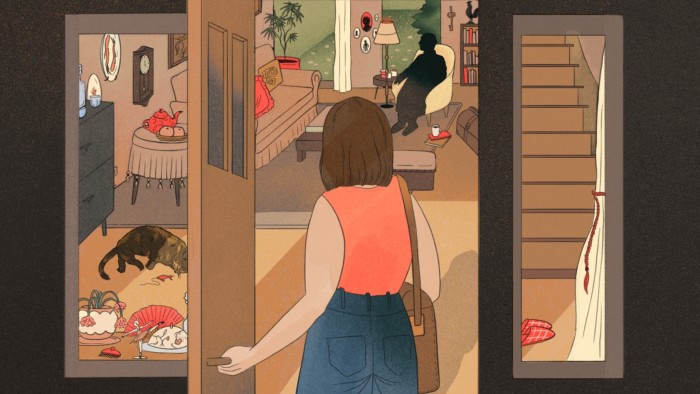
We follow Claire, a worthy forty-ish year-old woman, who moves from London back to her native small town in the west of Ireland following the death of her mother. Meanwhile, through a series of extended flashbacks, Let Me Go Mad excavates Claire’s bloodstained family history 100 years prior.
This is Feeney’s métier: the west of Ireland, intergenerational “trauma”, how to marry the sensibilities of the metropole to the social codes of rural Ireland. Her 2023 Booker-longlisted novel How to Build a Boat stands out as a particularly well-aimed example of the form (if it dwells a little too much on the literal techniques of shipwrighting).
Feeney is an accomplished writer, hyper-aware of her place in the canon. Some of Let Me Go Mad is reminiscent of Brian Friel’s play Aristocrats. And Feeney, a poet before she was a novelist, has a better grasp of atmosphere than most of her contemporaries — there is a danger that she’ll be lumped in with the Sally Rooney tradition (Irish female writers are accused of homogeneity), yet her prose is anything but sparse and detached. Her semi-surreal chapters about a horse are odd and sincere, and I enjoyed reading them.
But the problem with Let Me Go Mad is that we see it through Claire’s eyes — a woman unfortunately afflicted by having very boring ideas about the world. She says things like: “There was something magical about poetry in the summer” (please) and “Is love enough though?” “Lara was a city girl”, she says of her sister-in-law, “and the way of family life in the countryside was different.”
Other characters tend towards stereotype. There is Tom, an English writer with rich friends and stacks of The Paris Review; there is the woke academic with pink hair who talks about gender essentialism; the reticent, simpleton farmer who hates parties and misses conversational cues; the drunk truculent older brother with unresolved personal issues.
The sense, then, is that Let Me Go Mad is a half-finished book. Claire throws her phone into a river, and then later across a room (this strikes me as shorthand for “Claire is cross”). There are tautologous naiveties that may work in verse but not here: “murky confusion”, “claustrophobic confines”. Elsewhere, things “loom large”; Hands are described as “small and fluid”.
But the real reason Let Me Go Mad struggles is down to Claire. Not because she is unlikeable — though she is — but because she is dull. And any universe reflected back to us through a series of her banal observations cannot help but verge on the banal itself. It is a shame — behind Claire lurks a very good novel.
Let Me Go Mad in My Own Way by Elaine Feeney, Harvill Secker £16.99, 320 pages
Join our online book group on Facebook at FT Books Café and follow FT Weekend on Instagram, Bluesky and X
Read the full article here