

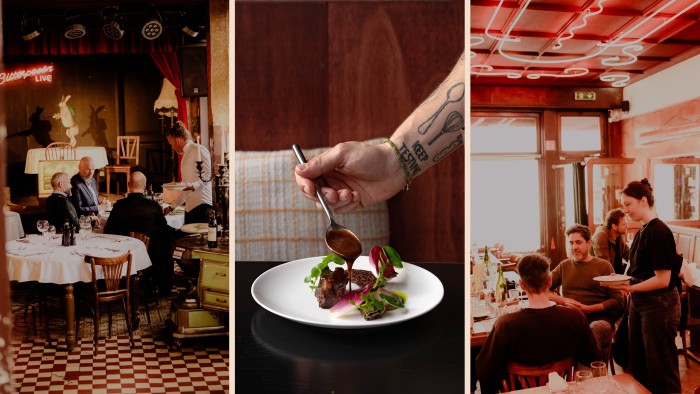
It might seem contrary for a hugely ambitious, double Michelin-starred restaurant to open for only 10 days a month, but Hertog Jan does it, I reckon, because it can.
The five-star Botanic Sanctuary hotel — like a country estate that has magically landed in the centre of Antwerp — is the latest home to chef Gert De Mangeleer and sommelier Joachim Boudens’ serenely beautiful restaurant. The room is almost unadorned, all the better to concentrate on the drama of the dishes. Being within a successful hotel allows the duo to do their own remarkable thing, a fortuitous collaboration all round.
For all the culinary pyrotechnics — almost literally in the case of a little scarlet-glowing log of Japanese binchotan charcoal that staff use tableside to caress confit red mullet, adding a whisper of smoke — there’s something understated about Hertog Jan, despite the advanced techniques, the luxury ingredients. The highest export grade of Wagyu beef, wildly buttery A5 from Kagoshima, for example. Or oodles of seductively good Royal Belgian caviar: in one instance, it’s spooned on to our plates from parcels of kombu leaves, which give the precious eggs a deep, unsalty savouriness.
There’s a focus on other, unimpeachable Belgian produce, too — hamachi from Zeeland, dressed with Holstein beef fat to do a bewitching impersonation of beef tartare; a wheel of Kato, a pungent, wrinkled goat’s cheese served straight, but also as a kind of deconstructed crème brûlée. Intent over the pass in his trademark leather apron, De Mangeleer, the youngest Belgian chef to win three Michelin stars, whips up astonishment after astonishment.
Since giving up the restaurant critic beat, I confess I’ve avoided that trope known as fine dining. It too often seemed to be teetering on the edge of ordeal. (I know: my struggle.) But Hertog Jan — plus a recent visit to Modena’s Osteria Francescana — have reminded me why people cross continents for this sort of performance.
It’s tempting just to stay in the hotel. This is, again, an understatement for what’s effectively its own mini-empire, with bars and several other excellent restaurants, including, in among the herb gardens, gingerbread house-like Het Gebaar, where chef Roger van Damme makes suitably fairytale pâtisserie to match his (also Michelin-starred) cooking. There are even beehives.
But venturing out is essential. Antwerp is renowned for a number of things: its dial-shifting fashion designers, its diamonds, art nouveau architecture, lively music scene, rich nautical history — it’s the second-largest port in Europe. Perhaps it’s not the first destination that comes to mind when people like me plan city breaks entirely stitched around restaurants, but it should be. It has it all going on — numerous Michelin options, plus every corner, every side street, every wrong turn I make unearths another tiny shopfront that’s been turned into a chic bistro, or a brown café where the food is considerably better than you’d imagine from the sometimes ramshackle exteriors.
And getting here by train is a breeze, straight into the impressive cathedral of a station that is Antwerpen-Centraal. While everyone is going to Berlin, Dresden or Prague, it’s worth remembering that the new European Sleeper line goes through Antwerp, so it’s well worth planning a stop here.
For me, it’s a destination in itself. I’ve decided to do a deliberate flit between old and new Antwerp, food-wise. One day is spent roaming round ancient bars, moody joints such as Elfte Gebod, all flamboyant, religious imagery, or Quinten Matsys with its glowing stained glass; or De Pelikaan, which still appears to be the haunt of equally ancient Antwerpers (with added cool young things).
My favourite is Borze Café just off the beautiful 14th-century Lange Nieuwstraat. A narrow, high-ceilinged room, it looks like it was designed by a Flemish Old Master in dramatic colours of sludge and dun, and the day’s menu is brushed on to foxed mirrors: charcuterie and cheeses, robust comfort food; stoofvlees (a beery, mustardy beef stew) and hachis parmentier (basically cottage pie) and the city’s beloved Dame Blanche (ice cream with hot chocolate sauce and whipped cream). I’m very much on board with the Flemish habit of serving superb frites with everything: stew and chips rules.
Another day is all about art — the city’s galleries are spectacular, even if I did gravitate to those housing fashion and diamonds — and cool, contemporary bars. Cantine, just steps from KMSKA (the Royal Museum of Fine Arts), has an air of ’50s Modernism and promises of “brave wine, fearless food”: Mediterranean-accented sharing plates such as mussels sobrasada, tortelloni al tartufo, calamarata pasta with ragu scented with orange zest and nduja. Or try Osaka, an almost-brutalist concrete den, for frosty Paloma cocktails and to slurp oysters zhuzhed with rhubarb and ponzu while perched on Bruno Rey chairs.
I head out of the centre to the gloriously Art Nouveau Zurenborg district, and Soixante, a cute-but-serious small joint on the fringes of ’t Groen Kwartier — a redevelopment of a former military hospital that also houses two cool hotels, the Jane and the August, and a rackety collection of creative businesses and cafés called PAKT.
At Soixante, a blue-painted former shop, three charming young guys — Louis Devos (sommelier), Jonas Van Sant (host) and Jakub Blogowski (chef, ex Bibendum in London) — make a largely local clientele feel at home with cleverly chosen wines and beautifully presented dishes: slender discs of acidulated yellow radish mimicking scales over North Sea crabmeat; translucent pickled kohlrabi adding texture to petal-pink langoustines; orange jewels of trout caviar contrasting with slender spears of broccoli and snowy turbot; fat, proletariat pierogi treated like aristocracy with drifts of black truffle. It’s the dream neighbourhood restaurant.
One nearby street, Cogels-Osylei, is populated with so many Art Nouveau architectural masterpieces, it gives me a painful dose of house envy. So Zurenborg is worth the trip for more than just a superb lunch (even if, in my book, there is no better reason).
But Antwerp also has a movement that is rather sexily straddling ancient and modern, especially around the old slaughterhouse district in Den Dam. It appears to have incubated its own version of France’s bistronomie — that marriage of forward-thinking cuisine with informal, bistro surroundings. Younger chef innovators have been repopulating the old meat restaurants that once lined the streets (love the idea that abattoir workers would finish a hard day at the cleaver to go out for more meat).
There’s Pietrain, which still focuses on meat — steaks, particularly — but does it with a contemporary eye: interesting cuts from its Josper grill and recherché wines. And the wonderful Café Commercial from one of the city’s hottest chefs, Davy Schellemans — his Veranda was at the forefront of the new Antwerp wave. It’s a blast of a place, one of the original meat restaurants reinvented with the lightest of touches: authentic swirly neon-lit ceiling casting a rosy glow over the buzziest of scenes — and some sensational small plates cooking. There’s always seafood and pasta on the menu, both unmissable: mine was a tartare of langoustines on a cushion of sweet brioche; plump, silky Zeeuwse mussels in a smoked butter sauce; and sheets of maltagliati laced with ripe veal shoulder ragu snowstormed with quantities of cheese. Staff are lovely, customers chilled and flavours dialled up to hallucinogenic — in a good way.
In a former pork butcher’s shop on a neighbouring side street is Bar(t)-à-Vin, one of the originators of the city’s natural wine scene. There are only ever a couple of dishes on offer every evening, with the justifiably celebrated beef tartare and homemade charcuterie as menu stalwarts. I also have a slab of crisp-melting pork belly with suave potato purée; the meaty theme is not coincidence. I’m in love with both the extraordinary Pappou! wine — pressed by foot — recommended by owner and sommelier Bart Adriaenssens (“It’s alive,” he says, not hyperbolically), and also the beautiful antique tiling that tells tales of choucroutes and pies from the building’s past life.
As with any cool new neighbourhood, first come the artists and the indie bars and restaurants in search of cheaper rents. Then the property developers and, yes, there’s definitely some activity on the latter front in Den Dam, even if it’s being done with what appears to be a typically stylish Antwerp touch: university lab buildings now inhabit the old concrete abattoir. But there are still glimmers of the unreconstructed, such as magnificently eccentric Bitterpeeën.
This brownest of brown bars is a one-off: there’s the small stage from which a stuffed hare holds court, and the ebullient owner Dimitri Van Coillie, who takes great pleasure in telling us how people like to spend all day over lunch and then get piano-playing drunk in the bar afterwards.
It’s its own curious little world, resistant to tourists and featuring some truly fine traditional food: Flintstone-sized bones for scooping out marrow on to points of white toast; copper saucepans laden with chocolate-brown carbonnade, rich with beer, the beef melting into its boozy gravy; or the smash-hit Bollekes van den Dam, pneumatic meatballs with slabs of vegetables, on the menu for more than 30 years. As befits the location, there are kidneys on the blackboard menu, too, brains, foie gras. When I email to book, Dimitri replies with a note that translates as “you’re so on it!”. And having found Bitterpeeën, I’m inclined to accept the accolade.
Ciro’s, on one of the city’s long, rather faceless boulevards, is another venerable beauty, wood-panelled and untouched since its birth in 1962. The menu is equally vintage, including an entry for paardenfilet (horse steak) billed as Black Beauty. Not tempted, I order the restaurant’s two classics, Toast Antonio (an elaborate collection of items on toast: meats and cheeses and seafood) and Steak Ciro’s. These are both retro heaven, the steak especially, a huge, black-crusted chunk of pink, juicy meat that comes with an artist’s palette of relishes and pickles, and a gravy boat of au poivre sauce. The place is full, mostly with a politely raucous older crowd. Given the number of martinis and steaks arriving at tables at lunchtime, none of them apparently too bothered about restraint. I’m choosing to believe this is the way towards a cheerful longevity.
I’m not sure which is more pleasurable: the forward-thinking Antwerp of Hertog Jan or the defiant old school. The city may not have the postcard good looks of Ghent or Bruges, or Brussels’ ponderous self-importance, but for those of us obsessed by restaurants, it’s like a jolt of adrenaline. You can do high-low, too: 16 Michelin-starred restaurants or the ageless glory of Frituur No 1, the frites crisp batons of sheer pleasure, the beef stew gravy an Antwerp classic — though, frankly, it’s impossible to hit a bad chip here.
It made me reappraise ways of eating I thought I was over. Take the new Wolf street-food market on a dock just off the river Scheldt: yeah, been there done that, tacos, lobster rolls, ramen, whatever. But this, in the dramatically handsome Saint Felix Warehouse, gives energetic new life to what’s become a bit of a foodie-tourist trope. Food and hospitality are, as ever, taken seriously. In Antwerp, even the cat café is beautiful.
Find out about our latest stories first — follow FT Weekend on Instagram and X, and sign up to receive the FT Weekend newsletter every Saturday morning
Read the full article here