

Unlock the Editor’s Digest for free
Roula Khalaf, Editor of the FT, selects her favourite stories in this weekly newsletter.
The Last Night of the Proms marks an annual turning point, the end of the summer festivals, the start of the autumn music season. This year, the last chorus of “Rule, Britannia!” had barely faded away when the London Symphony Orchestra stepped forward for the opening concert of its 2025/26 season at the Barbican.
The hard-working Antonio Pappano is now in his second season as chief conductor and will take charge of 18 concerts in London, culminating in Wagner’s Tristan und Isolde. Simon Rattle continues as conductor emeritus and pianist Seong-Jin Cho is the subject of an LSO artist portrait.
Away from the UK public’s view, the LSO also furthers its valuable work as cultural ambassador. In October, the orchestra returns to Vietnam for a special concert in Hanoi, where Pappano will conduct, as he did here. Born in England, raised from his teens in the US, he focused on English music last year, but for this concert looked to his other side with an all-American programme.
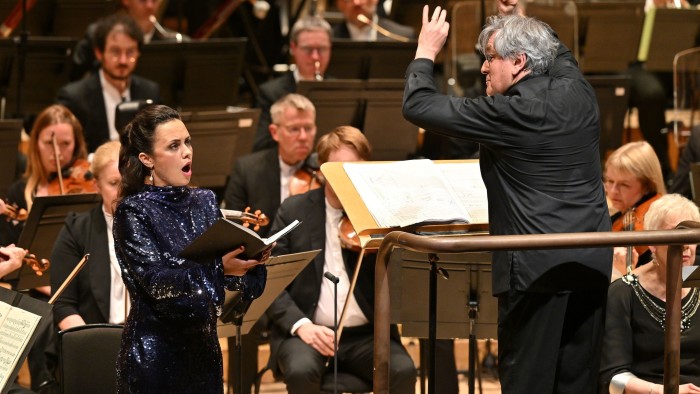
Although there was a flurry of activity for his centenary in 2018, Leonard Bernstein’s symphonies are played relatively rarely outside the US. Pappano chose the ambitious Symphony No 3, “Kaddish”, written in 1963, the year of President Kennedy’s assassination, an event that hit Bernstein hard. A setting of the Kaddish, a Jewish prayer associated with mourning, is sung by choir and soprano soloist, but the essence of the symphony lies in a lengthy text spoken by a narrator.
Having a composer write his own words is rarely a good idea, and this was no exception. Bernstein questions his religious belief in an extended outpouring of angst that is hard to bring off, but hand the narration to a singer, rather than an actor, and the temperature will rise. Felicity Palmer, formerly a charismatic mezzo, now 81, gave Bernstein’s text the works, and it gained hugely in emotive power.
Nothing about this performance was halfhearted. Pappano let rip whenever the narration let up and had sterling support from soprano Katharina Konradi and the London Symphony Chorus and Tiffin Boys’ Choir, who negotiated their tricky cameo decently enough. When the narrator exhorts us to “Believe! Believe!” and Bernstein’s music wells up with the same all-embracing human warmth that he found for the closing number of his musical Candide, the symphony seems an important statement of faith. Or, at least, it does when it is performed with the passion it was given here.
Aaron Copland’s Symphony No 3, which occupied the second half, holds a more certain place in the American repertoire. Where Bernstein’s music is urban, a product of cultural mix, the clean and fresh air of the Copland marks it out as belonging in the countryside, American music at its most pure. Pappano and an LSO on fine form gave it no less wholehearted a performance than the Bernstein. Although this symphony arguably does not need such all-out fervour, or such decibels, it certainly made a big impact.
★★★★☆
barbican.org.uk
Read the full article here