

There is more than one type of fairytale magic in cinema. This month you can see the second part of the Wicked diptych, boasting digital effects galore, a multimillion dollar budget and more flying monkeys than you can shake a broomstick at. But also on offer is a more economically made French film of genuinely hallucinatory enchantment. A modern reworking of The Snow Queen by Hans Christian Andersen, The Ice Tower is the product of one of cinema’s most singular imaginations: writer-director Lucile Hadžihalilović.
Her four features to date are what you might genuinely call dreamworks, of a very un-Hollywood variety. Her 2004 debut Innocence was an obliquely surreal allegory of the female experience of passing from childhood to adolescence (partly inspired, believe it or not, by Enid Blyton’s Malory Towers girls’ school stories). Her most recent film, Earwig (2021), set in a nightmare parallel Belgium, was about a captive girl who wears dentures made of ice.
The Ice Tower is another eerie coming-of-age tale. Set in the 1970s, it centres on a runaway teenager who wanders on to a film set and finds herself falling under the dangerous spell of Cristina (Marion Cotillard), the charismatic, capricious star of a Snow Queen movie.
Hadžihalilović’s film is a variation on Andersen’s fairytale — but it is also about the spells cast by cinema. Speaking in French at a London riverside hotel, she says: “There’s a certain alienation involved in cinema. It’s a kind of madness, and a drug — irresistibly attractive, and potentially toxic. The Queen haunts the studio like a ghost — she’s the living dead, in a way.”
We don’t see much of the film-within-the-film in The Ice Tower, apart from on-set moments featuring glistening fields of fake snow and a raven that could have flown out of Hitchcock’s The Birds. Hadžihalilović lets us imagine the movie for ourself. “I didn’t even think about whether it was a film for children or adults — it’s hard to tell. A key reference was Powell and Pressburger — The Red Shoes, Black Narcissus, The Tales of Hoffmann . . . But it’s bits and pieces — it could have been something by [Italian horror specialist] Mario Bava. There’s a touch of Jean Cocteau too.”
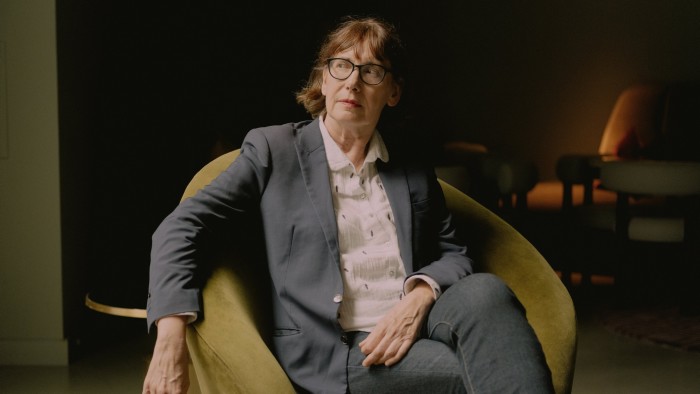
As ingénue interloper Jeanne, The Ice Tower has an extraordinary lead in newcomer Clara Pacini, a theatre conservatoire graduate who combines the waif-like otherworldliness of a fairytale heroine with a very modern toughness. Her bobbed hair also gives her something of the appearance of a younger Hadžihalilović, suggesting that Jeanne might be read as the director’s fictional alter ego. She swears the resemblance never occurred to her until people started pointing it out.
“I definitely dressed her pretty much the way I would have dressed at 13 or 14. And it’s no accident that the film is set in the 1970s, when I was in my teens. I only gradually came to realise that Jeanne was a cinephile in the making, perhaps even a future filmmaker.”
The film’s other lead, Cotillard, previously worked with Hadžihalilović on Innocence, in which she played a schoolteacher; she quickly went on to become a major international star. That hallowed status gives a certain self-reflexive aura to her performance as Cristina, and Hadžihalilović admits she was a little nervous to see whether Cotillard had changed.
“Fortunately, she’s not like Cristina!” she laughs. “I was hoping she hadn’t become the kind of actress who stays in character between takes. But she told me, ‘I’m not a Method actress — when you shout ‘cut’, it’s ‘cut’, and I come straight out of character’.”
For the small but significant role of Cristina’s director, Hadžihalilović cast her longtime partner, Argentine-born auteur Gaspar Noé, thinly disguised by a wig and a wisp of ’70s moustache. Hadžihalilović has worked with him as editor and producer, while Noé photographed some of her early work. But their films are entirely different in tone: hers ghostly and poetic while his (Irreversible, Enter the Void, Climax) are aggressively provocative in their will to unnerve. “Inevitably, we contaminate each other,” she says. “We have certain tastes in common, but we don’t make the same kind of cinema. Gaspar is much more direct, more head on, more spectacular. I tend to come at things from an angle.”
One reason that Hadžihalilović, 64, has only made four features to date is that her particular mode of fantastic cinema is hard to finance in France. Since she established herself, other French women directors have successfully created idiosyncratic takes on nightmare horror — Julia Ducournau (Titane), Coralie Fargeat (The Substance). Arguably, however, their films are easier to categorise as genre pieces, while what interests Hadžihalilović, she says, is something more fluid — “worlds that are halfway between the real and the imaginary, with their own rules”.
The daughter of doctors, Bosnian and French, Hadžihalilović grew up in Morocco and became an avid cinephile in her early teens. “There were a lot of cinemas in Casablanca, you could see plenty of new releases — Italian giallo horror, but also Ingmar Bergman, William Friedkin . . . You could see Bergman’s Cries and Whispers or [Dario Argento’s giallo] Four Flies on Grey Velvet, and personally I couldn’t see that much difference — Cries and Whispers terrified me.”
Her own films can be frightening, even if the chills are subliminal and we can’t always tell exactly what’s getting under our skin. One reason is because Hadžihalilović’s love of artifice keeps us aware that we are watching cinema — which creates the same effect that we feel when we dream and yet are fully aware that we are dreaming.
“Artifice is more exciting than the real,” she says. “It was more fun to shoot with fake snow than real, and more inspiring to film pieces of decor than actually be out shooting in the mountains.”
I suggest to Hadžihalilović that The Ice Tower is deeply nostalgic for a lost age before digital effects — a time of simpler, more immediate artifice, when a film director could shout ‘Snow!’ in the studio, and snow would fall.
“Yes,” she agrees. “Even if it’s really potato flakes.”
In UK cinemas from November 21
Find out about our latest stories first — follow FT Weekend on Instagram, Bluesky and X, and sign up to receive the FT Weekend newsletter every Saturday morning
Read the full article here