

This article is part of FT Globetrotter’s guide to Paris
On a side-street halfway down Avenue Georges Mandel, a tree-lined boulevard that branches off from the Trocadéro, is a sign that pays homage to one of the city’s most legendary residents. Allée Maria Callas is located in front of her gated home at number 36, where the singer spent the final period of her life. It is the same apartment masterfully recreated for director Pablo Larraín’s recent film Maria, starring Angelina Jolie as the opera phenomenon.
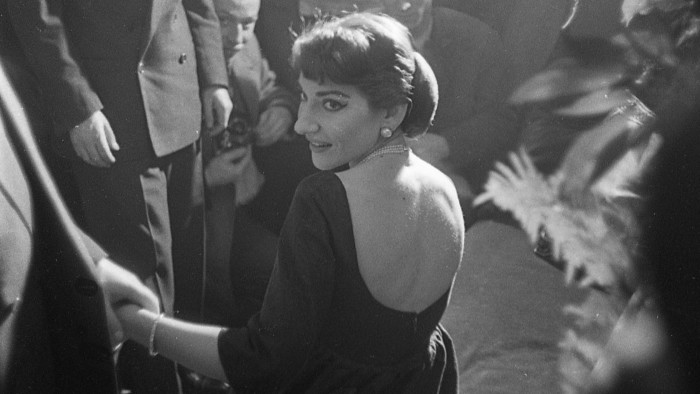
Known as “La Divina”, Callas is widely considered the greatest soprano ever. As I and a small number of tourists pass by her building to take photos, I’m reminded of what her life and voice still represent to people around the world, and how Paris is where they come to be close to her. With the release of Maria, alongside a documentary starring Monica Bellucci that follows the world tour of the play Maria Callas: Letters and Memoirs and recent events to mark the centennial of her birth, the singer is back in the spotlight, fuelling even more curiosity about her life and the Paris locations she frequented.
Following in Callas’s footsteps
Although Callas was born in New York to Greek parents, later raised in Athens and found international fame in Milan as the Queen of La Scala, Paris was the place she called home. “It serves as a character in her life story because in Paris she began again,” says Lyndsy Spence, author of Cast a Diva: The Hidden Life of Maria Callas. “Paris also introduced her to a [previously] unattainable level of glamour.” Callas permanently moved from Milan to Paris in 1963, and lived in her apartment on Avenue Georges Mandel, which was bought by her lover, Aristotle Onassis. She kept it after their separation, and it became a place of pilgrimage for visiting artists. It continues to draw admirers.
The building itself is closed to the public, but fans can book a stay in the Suite Maria Callas at The Ritz Paris, where she sought refuge between her recitals at the Palais Garnier. It is a plush haven with balconies overlooking the opera house, furnished in ivory and pink tones, with a sloped ceiling and a sense of space and seclusion that was important to Callas. The walls are covered in portraits of “La Divina” looking poised. “There’s something magic about that suite,” a concierge explained to me. “It’s like her spirit is there.”
The Palais Garnier is perhaps the most prominent Callas landmark. “She gave a concert there and also sang in two full-length operas [Norma and Tosca],” says Spence. In 1958, Callas first sang there in a gala concert on behalf of the Légion d’Honneur: “Perhaps the most glamorous production given in postwar Europe,” adds Spence, “attended by film stars and royalty, and, most significantly, Onassis.”
Dining and drama
For 17 years before her untimely death in 1977, Callas reigned over Paris’s high society. “Everyone asks about Maria Callas,” a waiter at Maxim’s restaurant told me on a recent visit. “People still try to sit at her regular table to feel closer to her.”
Opened in 1893, Maxim’s was her favourite restaurant, and it is where Callas held court over the beau monde of the time, largely steered by her closest friends the Rothschilds, Liliane Bettencourt and Maggie Van Zuylen. Maxim’s is also associated with the image of “La Callas”, the great diva — her public persona fraught with complications, revenge and romance (often because of Onassis). To the left of the restaurant’s entrance, beneath a series of mirrors and surrealist art deco furniture, is the King’s Table, where she would entertain friends and order her favourite dish, steak tartare. It was La Callas, not Maria, who hosted the restaurant’s 75th-anniversary bash to steal the spotlight from the marriage between Onassis and Jackie Kennedy. It was also the scene of a famous scandal in 1970 when Onassis, who was still married to Kennedy, and Callas reunited there for dinner. Kennedy insisted on eating at the King’s Table the night after.
Elsewhere, on certain nights, Callas and her troupe would party at Chez Régine, the pioneering discotheque opened by Paris’s self-styled “Queen of the Night” Régine Zylberberg, after they had finished with Maxim’s. Régine was the place to see and be seen for stars like Brigitte Bardot and Alain Delon, socialites and royalty, and there are instances of Callas being hounded here by the paparazzi (including, unsurprisingly, with a recently married Onassis).
A club still operates there, although it has more than a little faded glory. According to a member of staff, there are the same mirrors on the ceilings; the same quotes from artists on the walls; the same gold and silver wall lights; and, the pièce de résistance, a translucent dance floor with an image of a panther, which all remain from the club’s heyday. Like all Greeks (myself included), Callas appreciated kitsch. And she was never above visits to the cabaret at both Crazy Horse and Le Lido, the iconic theatre on the Champs-Élysées that was famed for its burlesque performers. The red and gold furnishings of Le Lido’s seating area are a throwback to its 1960s golden age, when Callas was pictured here with French rock star Johnny Hallyday.
A more refined stop is Bar Les Ambassadeurs at the Hôtel de Crillon, a stone’s throw from Maxim’s. Les Ambassadeurs remains an elegant institution with a decor reminiscent of les années folles of the 1920s. It was here that Callas was sometimes snapped leaving in the early morning — with Onassis in tow. Callas was also known to dine at the stylish Maggie in Pigalle for dinner and Au Pied de Cochon by Les Halles for lunch. Although touristy, this is a classic Parisian brasserie, with a famous onion soup that warmed me on my cold rush through Callas’s Paris.
Couture and legacy
When it came to fashion, Callas loved to shop at her friend Yves Saint Laurent’s store, says Spence, which was then at 21 Rue de Tournon (the space is now occupied by a hair salon). Saint Laurent also designed clothing for Callas’s on-stage ensembles. Another of Callas’s favourite shopping institutions, Dior’s boutique at 30 Avenue Montaigne, remains. She was also very loyal to jeweller Boucheron at 26 Place Vendôme — a fabulous doll’s house of a building with a baroque decor not too different to Callas’s apartment. “It was a regular sight for locals to see Callas walking her beloved poodles close to the Champs-Élysées,” says Spence.
Final tribute
To pay respects, many people stop by Callas’s cenotaph at Père Lachaise cemetery (often while seeking out other famous grave sites, which include those of Oscar Wilde, Frédéric Chopin and Edith Piaf). Although her ashes were scattered over the Aegean in 1979, as per her wishes, it remains a symbolic place of pilgrimage for fans. An unassuming plaque can be found surrounded by loving notes from visitors from around the world.
It is Paris where we fans are able to connect with her triumphant but tragic life. And in each location, I found a lingering sense of the Callas myth. But Paris is also where she felt truly human. Spence sums it up best. “In Paris,” she notes, “she could be Maria instead of La Callas.”
Follow FT Globetrotter on Instagram at @FTGlobetrotter
Read the full article here