

Unlock the Editor’s Digest for free
Roula Khalaf, Editor of the FT, selects her favourite stories in this weekly newsletter.
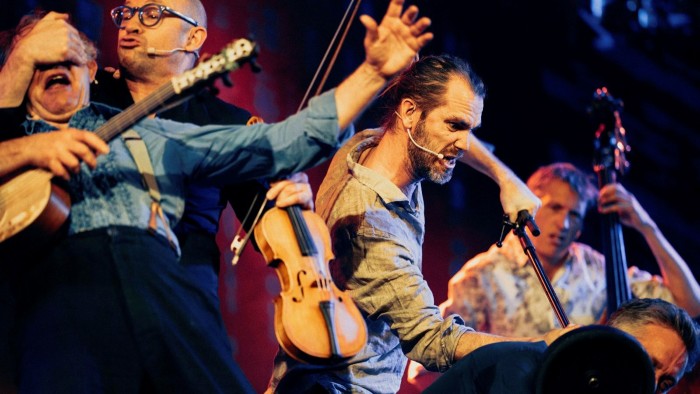
Smartphone cameras light up the scene and the audience roars its approval as Norwegian violinist Bjarte Eike half walks, half dances to the front of the stage. “Now let’s see if there’s some noise in you. One, two, three, four!” he bellows, before launching into a feverish, rhythm-fuelled whirlwind of a piece. Watching the crowd at Camden’s Koko from the nightclub’s lavish, rococo-inspired balcony, you might assume it was lost in a rave. In reality, this is one of the Alehouse Sessions, a unique baroque concert series from Eike and his early music ensemble, the Barokksolistene.
Founded in 2007, the Sessions aim to capture the musical spirit of 17th-century Britain, when Oliver Cromwell’s Puritan regime shuttered theatres, forcing professional musicians to practise their craft in taverns. Yet, unlike most historically informed performances, this one blurs baroque works with jazz, folk, sea shanties, improvisation and elements of US country music. Meanwhile the musicians move fluidly between playing their instruments, singing and taking on theatrical roles; at one point, for instance, they interrupt a piece to play out a drunken brawl in slow motion.
It’s not an easy concept to pin down on paper, but that hasn’t held anyone back. As part of a UK summer tour, the Barokksolistene will perform at the Edinburgh International Festival and Snape Maltings Hall in Aldeburgh in August, before making their Royal Albert Hall debut with an all-night “From Dark till Dawn” Prom.
But first, they will travel to the Longborough Festival in July, to put their own stamp on Purcell’s Dido and Aeneas. Speaking backstage at Koko, Eike explains that the plan is to transform the 1689 opera into an Alehouse Sessions-style extravaganza, creatively filling musical gaps left by the loss of Purcell’s original manuscript. “Our aim is to give the characters of Dido and Aeneas a bit more depth,” he says.
For this, they have woven in additional tunes from the wider Purcell canon, along with folk ballads, sea shanties and a wake for Dido after her death. They have also included the character of King Iarbas, who is usually left out of the opera, but, in legend, gives Dido the land for Carthage, before attempting to claim her hand in marriage. “[In operatic productions] Dido can often seem a bit spoilt for taking such offence at Aeneas’s departure,” Eike explains. “But if you understand the political background — that Dido faces a terrible choice because she doesn’t want to marry Iarbas, and that her alliance with Aeneas is necessary to form a formidable force against Iarbas — it all starts to feel much more like Game of Thrones.”
This isn’t the first time Eike has referenced popular culture to illustrate his musical intentions. Ever since the Alehouse Sessions started to gather momentum, he has described their repertoire as “just old pop music”. Some might accuse him of reductivism, but he explains that his position is rooted in historical research. “When skilled musicians brought their heritage into 17th-century pubs, [their music became] a bit ‘ruder’,” he says. “Purcell’s hornpipe ‘Hole in the Wall,’ for example, is now mistaken for an Irish folk tune . . . [It shows that] if you only play Purcell’s music in a lofty, elevated way, then you miss out on something important.” He grins wickedly. “And since I’m not English, and don’t have the weight of this tradition on my shoulder, it’s easy for me to stir things up.”
Bucking tradition has always been second nature to Eike, who insists he never intended to follow the conventional route of a classical violinist (“I see myself more as a musician who just happens to play the violin”). As a teenager studying classical violin in Gjøvik, central-eastern Norway, he immersed himself in the town’s lively folk and rock scene, regularly joining local jam sessions. But it wasn’t until he began studying at the Grieg Academy in Bergen and met early music specialists there that he found a way of synthesising his interests. “As a baroque player, it’s much easier to connect musically with jazz or folk musicians than it is if you play in a very dramatic, romantic style with lots of heavy vibrato,” he says.
Some critics have deemed his approach to be inauthentic, but Eike rejects this. “For me, authenticity isn’t about offering audiences a museum piece . . . we cannot recreate the audiences or performers from early times [as we] can’t unsee or unhear The Beatles, the second world war, and so on. These will be part of how you perform, no matter how much of an expert you are on the aesthetics of earlier periods,” he says. “I believe that authenticity means being true to oneself; daring to show and expose yourself fully as a performer.”
In that regard, the Alehouse Sessions are truly authentic, because, for all the virtuosity of the players, what primarily comes across is their sense of warmth, fun and sheer musical disinhibition. “For some people, attending classical concerts is a bit like going to some fancy restaurant. [Faced with] a table full of different knives and forks, you think ‘I’d better not. I’ll go to a café instead,’” says Eike. “But as soon as you understand that there are no behavioural codes at our concerts . . . then the barrier is removed.”
barokksolistene.com
Read the full article here