

Natalia Bakhtadze picked me up from a Tbilisi bus station in her jacked-up Toyota 4Runner, a case of fine wine (Georgian, of course) clinking behind her seat. In the boot was winching gear, a tool kit and a supply of khachapuri, the ubiquitous Georgian cheese-stuffed bread. As we sped out of the city — Natalia swerving to avoid reckless drivers and reckless goats — she told me how her ancestors were from the Javakheti highlands, our destination, and how her “blood screamed” for the place.
We were heading south — unlike most of the travellers who have been flooding to Georgia in recent years, despite fears about the ruling party’s growing authoritarianism and support for Russia. The number of international visitors rose 37 per cent between 2022 and 2024, and new flights look likely to bring even more tourists this year. At the end of last month British Airways started the only flights between the UK and Georgia, quickly followed by easyJet, which launched services to Tbilisi from London, Geneva and Milan, as well as Transavia France, which has new flights from Paris, and Edelweiss, with a new service from Zurich.
Many visitors come for a culture-rich city break in Tbilisi (see below), to tour the vineyards of Kakheti in the east, or the mountain villages of Svaneti in the north. Instead, Natalia, co-founder of the Georgian Ecotourism Association, and I were going to spend six days exploring Javakheti, often known as Georgia’s “lake district”, somewhere that had previously eluded me despite 15 years of visiting the country.
A 280,000-hectare wetland ecosystem crossed by the volcanic cones of the Abul-Samsari mountains, its villages are home to a patchwork of ethnicities, with Armenians the majority. Seljuks, Mongols, Persians and Ottomans all fought over these wild borderlands at the heart of the old Silk Road. More recently, the area formed a buffer zone between the Soviet Union and Nato, its inhabitants largely sealed off from the outside world — a fact which has led to an enduring sense of isolation and enigma.
Javakheti’s story is encoded in its ruins, its summits craggy with cyclopean forts and medieval castles. On our first morning, after a night at the pretty, stone-built Vardzia Resort — the region’s only upmarket hotel — we followed a recently marked hiking trail up a wide, rocky valley to Tmogvi, a 9th-century fortress built to ward off Byzantine invaders. It was a perfect autumn day, still and golden, the world glistening with dew.
Daffodil-yellow butterflies flitted among spires of mullein and purple sage. We ate small, sweet wild apples from the trees. For a while we were joined by two gargantuan dogs, one the size of a small donkey, who gambolled about us, tails aloft. Otherwise, we saw no one. Little was left of Tmogvi itself, its ruins clinging to the ridge like broken teeth, but the walk, and the gilded beauty of the day, was enough.
We drove east, the near-empty road slaloming through steep-walled gorges and rolling hills dotted with grazing flocks of sheep. It was a spacious landscape, redolent of Mongolia. Occasionally we passed through a village, where headscarved old women sat on doorsteps and Soviet-era tractors ploughed the black earth, trailed by a wake of gulls.
Our next few nights were spent in simple village guesthouses owned by kindly Armenians with moss-green eyes. One place, Family Corner in the village of Gamdzani, was an island of hospitality in the treeless steppe, its owner, Samuel Margaryan, a titan of a man with a laugh to match. Over a supper of pickled fish, lavash, sour cream, fried potatoes and Armenian brandy, he told me his ancestors had settled here in the 19th century, fleeing the Russo-Turkish wars. Further waves of refugees arrived in the wake of the 1915 genocide.
The following morning we joined Grigor Saakyan, a local birdwatching guide, beside Kanchali, one of Javakheti’s biggest lakes. Black cattle and fat-bottomed sheep grazed the shore, and to the north rose Didi Abuli, at 3,301 metres the plateau’s highest peak. The area’s wetlands are a mecca for migratory birds and we watched great white pelicans, common cranes and a noisy flock of Armenian gulls. “They’re shy,” whispered Grigor as the cranes took off, levering their elegant frames into the air with stiff, heavy wing beats.
These lakes, many of them drained and dammed during the Soviet era, are now recognised as being of international importance under the Ramsar Convention. More than 300 species of bird have been recorded here, along with marbled polecat, lynx, wolf and brown bear. But few local people realised the value of their natural environment, lamented Grigor, and many were leaving for low-paid jobs in Moscow and Yerevan. “I want to encourage people to value our nature,” he said. Both he and Natalia hoped eco-tourism could provide a solution. For now though, tourism is scant: the only other foreigners we saw were a young Lithuanian couple who’d hired a car in Batumi, on the Black Sea coast.
Georgia’s largest lake is Paravani, which Natalia and I drove around the next day. In the village of Paravani, once on the main trade route between Armenia and Byzantium, magpies swaggered along the broken walls of a 12th-century Silk Road caravanserai. Beyond here we followed a dirt track into the mountains, where our attempt to climb up to the fortress of Shaori, at the top of Mount Koroghli, was scuppered by time and the summit’s formidable skirt of boulders. But the view from halfway up was extraordinary, across the inky water to a ripple of mountains, clouds drawing wagons of shadow across their flanks.
That evening, under a star-strewn sky, we arrived in the home of the Strukov family, a brick house whose wooden doors were painted with flowers and dancing women, on the edge of the village of Orlovka. Beyond their cow shed and potato fields surged the hills and the rugged spine of the Abul-Samsari range. “Welcome” said Yura Strukov, a thickset man with blue eyes and straw-coloured hair, shaking my hand with such force it almost made me wince.
Yura is one of Georgia’s last remaining Doukhobors, meaning “spirit wrestlers”, a sect who rejected religious authorities in favour of individual revelation and whose communities are rooted in pacifism and equality. The name was originally used by Orthodox priests as a slur (suggesting the group were fighting against the Holy Spirit) but was adopted by Doukhobors, who saw themselves as wrestling on behalf of God, and using compassion rather than violence. In 1841, after refusing to serve in Tsar Nicholas I’s army, 14,000 of them were banished from Ukraine to the Javakheti plateau.
In 1895, they received an order to supply one man from each household to fight in Russia’s war against Turkey. Later Yura took us out in his battered Subaru to see the site of their response, steppe eagles taking off from the ground as we passed. Thirty minutes from the village, he stopped the car. “That’s Turkey over those mountains,” he said, nodding towards the south. “And Armenia’s beyond that ridge. It was here that our people came and burned all their guns.”
Beatings, imprisonment and further exile ensued. Now, after waves of emigration to Canada and Russia, only 40 families were left. It was easy to spot the remaining Doukhobor houses, their picket fences and shutters painted a bright turquoise.
We spent that evening around the Strukov’s kitchen table, Yura’s 17-year-old daughter Nina, a white headscarf poking out from beneath her black hoodie, serving us borscht and omelette. With so few Doukhobors left, Yura wanted to share their culture with outsiders, so had started hosting travellers in their family home. “To our meeting, to your work, to the world,” he boomed, raising a tumbler of homemade vodka in the first of many toasts.
After the fourth toast Yura launched into a passionate speech about potatoes. He spoke rapidly, his baritone voice filling the little kitchen. From potatoes he moved on to cheese. Oh how Yura loved cheese! He made five different types. It was famous throughout Georgia. Nobody made cheese like the Doukhobors! When he opened the fridge it contained nothing but vodka and five-kilo slabs of hard yellow cheese.
The toasts became longer. My throat burned. My head swam. At midnight, after a lengthy paean to Tolstoy, a great friend to the Doukhobors, I fell into bed, swaddled under heavy blankets.
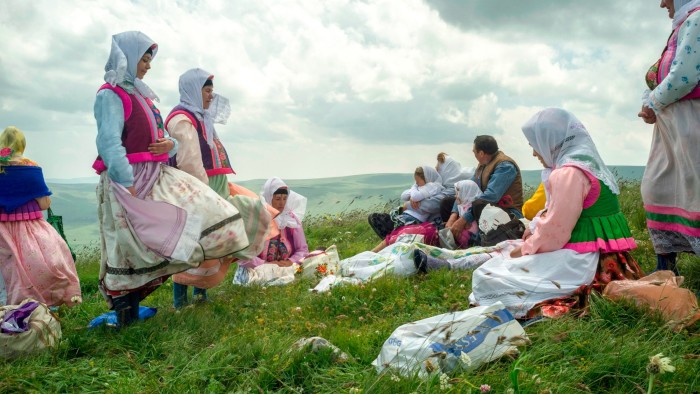
The Doukhobor faith is a religion without priests, altars or idols. The following morning, a Sunday, I listened to three elderly women sing, their voices weak at first, then swelling to fill the plain wooden prayer house in the neighbouring village of Gorelovka. They wore white headscarves and bright silk skirts, their green and pink waistcoats stretched over ample busts; a row of matryoshkas. The bright colours were to distract people from the wearer’s face, one of them later told me. The women turned to each other and bowed as they sang, in recognition of the spirit of God that resides in every one of us.
By the last day of my journey summit fever had set in. I had to climb a mountain before I left Javakheti! Leaving the Strukovs harvesting potatoes, Natalia and I drove the short distance to Mount Madatapa, its grey-green cone stamped on the sky a few miles south of Orlovka, and set off up an unmarked route to the top. Natalia puffed and swore her way up, having not climbed a mountain for years, but I was in high spirits, with the warm sun on my back. Larks flew up from clumps of sedge. Below us, Lake Madatapa shone like a disc of beaten silver.
Sitting on the 2,700-metre summit, elated and leg-weary, I looked down across the landscape we’d been traversing for the last five days: rolling grasslands, vast skies, a sweep of volcanic peaks sighing away to the horizon, the lakes. And there was Orlovka, its houses huddled in the soft green lap of the hills. The French travel writer Sylvain Tesson wrote that “Cold, silence and solitude are conditions that tomorrow will become more valuable than gold”. If that’s true, then Javakheti is a treasure chest.
Find out about our latest stories first — follow FT Weekend on Instagram and X, and sign up to receive the FT Weekend newsletter every Saturday morning
Read the full article here