

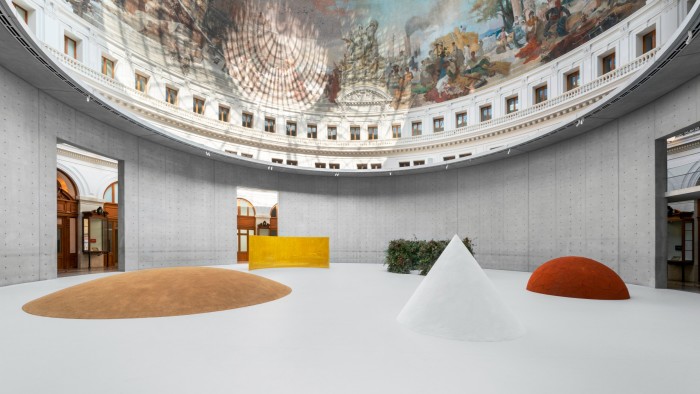
A curving wall of beeswax, a circle of interwoven branches, two mounds of earth and a cone of salt have been installed under the grand 19th-century cupola of the Bourse de Commerce in Paris, the exhibition space run by French billionaire François Pinault. The sculptures are the work of the American artist Meg Webster and they sit at the heart of Minimal, a new show that argues that the story of minimalism as we know it — with its mostly male, white and American stars such as Donald Judd, Carl Andre, Dan Flavin and Sol LeWitt — is woefully incomplete.
Artists of colour and women such as Webster whose “work significantly engages with the language of minimal and post-minimal art”, have been excluded from mainstream histories of the movement, says the exhibition’s curator, Jessica Morgan. So have artists from Asia, South America and Europe who grappled with the same concerns as their US counterparts in the 1960s, including economy of form and material and a focus on art’s spatial interaction with spectators: sculptures were placed directly on the ground, for example, and not on pedestals.
Institutions are slowly beginning to acknowledge the contribution of these artists: a 2014 show at the Jewish Museum in New York used a global perspective to revisit the institution’s landmark 1966 exhibition Primary Structures — the pivotal display in presenting a generation of American (and a few British) artists as a coherent group who would come to be known as minimalists. In 2018, a major survey at the National Gallery of Singapore and the ArtScience Museum Singapore examined the movement through a south-east Asian lens.
Morgan, who is director of the Dia Art Foundation in New York, gives these artists centre stage again alongside their marginalised US colleagues. Only the arte povera group from Italy is missing from the show because the Bourse de Commerce hosted a survey last year. “I hope the ghosts of those artists are still present in people’s minds as they visit this exhibition,” says Morgan.
Meanwhile, at Art Basel Paris, works by many of the less familiar names included in Morgan’s exhibition are on display on the stands of their galleries alongside pieces by the acknowledged giants of minimalism, underscoring the important role that art dealers have played in encouraging curators to expand the established canon.
Take Webster, now aged 81. She was taught by Donald Judd and Richard Serra, and her organic abstractions made from locally sourced, natural materials, serve as a poetic counterpoint to the industrial heft of her mentors’ art. “She’s an exceptional artist and it’s mind-boggling that she is not better known,” says Morgan, who first saw Webster’s work at the Paula Cooper Gallery in New York more than 20 years ago. “I’ve been obsessed with it ever since.” At Art Basel Paris, the gallery is offering a moss bed by the artist (1986/2025) for $200,000 — “we’ll be watering it throughout the fair,” says the gallery’s Steve Henry — alongside works by Judd, Andre and LeWitt.
Also on display at the Bourse de Commerce are two sculptures by Senga Nengudi, who was born Sue Irons in Chicago in 1943 and adopted her African name in 1974. Her Water Composition sculptures from 1970 consist of heat-sealed vinyl bags filled with coloured water which are draped over ropes fixed to the wall, with the liquid pooling into biomorphic forms on the floor. At Art Basel Paris, a sculpture by Nengudi, “R.S.V.P. Reverie-Stale Mate”, 2014, part of a series made with nylon tights filled with sand, is on offer for $90,000 with Sprüth Magers. “A striking aspect of her work is her use of inexpensive material,” says Philomene Magers. “Pantyhose, for example, is an everyday item that a woman might carry in her handbag which evokes the female body itself: skin that stretches, transforms and adapts throughout a lifetime. The choice of such an accessible medium also reflects the precarious conditions women artists faced at the time, often working without significant production budgets.”
Another exceptional talent is African American sculptor Melvin Edwards, who came of age during the civil rights era. His sculptures made using lines of barbed wire to dissect space use the language of minimalism to speak of segregation and brutality against Black people in the US. A 1969 work from this series is on display in Morgan’s show and Edwards is also the subject of a travelling solo exhibition at the Palais de Tokyo (opens October 23), part of an American season conceived by Naomi Beckwith, deputy director and chief curator of the Guggenheim Museum in New York. “Melvin was dismissed by a lot of critics early on,” she says. “They were very uncomfortable with his barbed-wire sculptures, which engender a sense of sympathy with those who are literally entangled in barbed wire. They don’t fit neatly in a canon of minimalism framed as a white American, avant-garde response to the excesses of gestural work like Abstract Expressionism. That kind of framing is the death of a broad art history.”
At Art Basel Paris, Galerie Buchholz is presenting one of Edward’s Lynch Fragments series of wall-mounted sculptures which he began in 1963 and continues to this day (“Tengenenge”, 1988, $175,000). Created by welding together found objects such as metal tools, chains, and tubular elements, the piece “refers to a community of stone carvers in Zimbabwe that Melvin visited in 1986 and 1988,” explains the gallery’s Filippo Weck. “The work’s title, tied directly to a real place, and the name of the series itself, contrast with the sculpture’s more abstract and poetic presence. This tension between the form and the meaning it suggests is central to Melvin’s work.”
Looking beyond the US, the Bourse de Commerce gives a strong showing to Japanese artists drawn from Pinault’s extensive holdings of art of the mono-ha (“School of Things”) movement which emerged in Japan in the 1960s, where a group of artists such as Lee Ufan (who was born in South Korea but moved to Japan aged 20), Nobuo Sekine, Kishio Suga and Jiro Takamatsu rejected representational art to explore the inherent properties of materials like stone, wood, paper and metal, often using these in their installations unaltered in an effort to engage with the fundamental nature of reality itself.
At Art Basel Paris, the work on offer by artists associated with the mono-ha movement include three pieces by Kishio Suga at Mendes Wood, priced between $15,000 and $35,000, and dating from 1996, 2000 and 2010. “They focus on the artist’s exploration of the medium of metal,” says the gallery’s Luiz Rodrigues. “Suga has spent more than five decades creating works that feature arrangements of natural and industrial elements aiming to unveil things as they are.”
At Pace Gallery, which has a long history of championing minimalism, offerings by mono-ha artists include a new canvas by Lee Ufan (“Response”, 2025, $900,000) and historical works by Jiro Takamatsu (“Compound No 704”, 1976, iron, brass, $85,000, and “Orange Rectangle”, 1973, coloured paper, $52,000) which are presented alongside paintings by US minimalist heavyweights Agnes Martin (in excess of $4mn) and Robert Ryman (in excess of $2mn).
Interest in these artists is increasing, says the gallery’s Marc Glimcher. As the market for emerging talent faces a downturn, collectors who had “been avidly buying young artists are suddenly interested in trying to collect work from an earlier period, both by the masters and the unknown artists,” he says. “Previously, they were keen to find the next hot, emerging artist. So when they pivot to focus on the past, they’re very interested in discovering the overlooked artists from that time.”
What they will find when they look back to the 1960s is an art scene which is profoundly different to the individualistic landscape of art making today; it was “perhaps the last truly radical global moment in art making,” says Morgan.
To January 19, pinaultcollection.com
October 23-February 15, palaisdetokyo.com
Find out about our latest stories first — follow FT Weekend on Instagram, Bluesky and X, and sign up to receive the FT Weekend newsletter every Saturday morning
Read the full article here