

“The place is a dream of quiet, well-bred tranquillity,” wrote Henry “Chips” Channon of Kelvedon Hall, the stately home that the American socialite and Conservative MP — best known for his scandalous dairies — bought in 1937 with his wife Honor Guinness. Shrouded by woodland in the Essex countryside, beside a water lily-strewn lake, the grand 18th-century house is still owned by the Channon family, its red-brick facade giving way to a warren of rooms in a mishmash of styles.
The flamboyantly mural-covered art deco “monkey bathroom” harks back to Chips’s day, as does the neoclassical-style plasterwork lining the corridors. Bedrooms are papered in patterns by interior designer David Hicks, while classical paintings hang alongside contemporary art collected by current chatelaine Katie and her late husband Henry Channon.
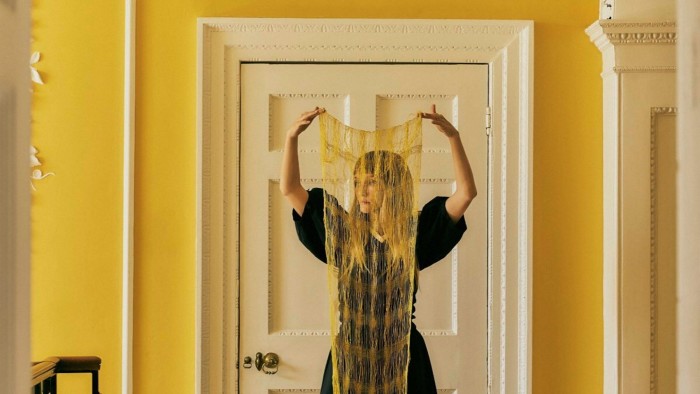
“Kelvedon feels sort of higgledy-piggledy, and really romantic,” says India Montgomery, founder of peripatetic gallery The Dot Project. As part of an artist-in-residence programme in collaboration with HeritageXplore, a digital platform promoting Britain’s independent historic houses, Kelvedon and The Dot Project have recently hosted Australian artists Heath and Tais Rose Wae, and their two children.
It’s one of a number of projects pairing artists with grand estates — offering physical and mental space for creativity, and bringing a new purpose to crenellated Scottish castles and frescoed Italian palazzos. It’s also part of a wider trend of private homeowners inviting artists for short residencies.
“When we were driving here, I was like, should I be wearing a suit? Do I bow?” says Heath of arriving at the Grade I-listed property. “I don’t even know what the rules are here.” But for the month of August he and his family happily immersed themselves in life at Kelvedon. They slept in the main house, strolled in the rose garden and swam in the pool. When Katie Channon was home they had dinner together; when she was away, they tended the vegetable garden.
“Our time here has been punctuated by going to pick blackberries or going to look for deer with our son,” says Tais. “There’s been lots of inspiration. It’s so eccentric, so full of art and history. We’ve been surprised by how much that has influenced us and the works we have made.”
Using an outbuilding as a studio, Heath’s usually “heavily minimal” paintings began to incorporate elements of the surroundings — from water lilies to sculptures — while the influence on Tais is woven into her creations. “The first piece I made has a really fine gold-silver thread moving through it; I was thinking about the gilded frames of the paintings.” The work of both will be exhibited in situ from September 22.
Two further HeritageXplore x The Dot Project schemes are ongoing: Elveden Hall in Suffolk, the derelict Italianate mansion owned by the fourth Earl of Iveagh, is being enlivened by painter Jack Penny; and at Belvoir Castle in Leicestershire, British artist Nick Jensen will be in residence during October.
They are just three of the more than 30 houses featured on HeritageXplore, launched just over a year ago by Violet Manners (the daughter of the Duke and Duchess of Rutland, who grew up at Belvoir). “My main objective is to inspire the next generation of heritage enthusiasts — art is a wonderful vehicle to support that mission,” she says. “I’ve spent so much time talking to [the owners of] independent historic houses, and so many of them said, ‘We want to do an artist residency, but we don’t know where to start.’”
The initiative has precedence. In 1759, artist George Stubbs was based at Goodwood House in Sussex for nine months and a number of his equestrian paintings still line the walls. “If you go to Petworth House [in West Sussex] there are Turners everywhere because he was just living there, painting,” says Lovisa Berntson Vit, co-founder of London’s Berntson Bhattacharjee Gallery. “There was a tradition of patronage that we don’t really have any more — but why wouldn’t we?”
In 2022, Berntson Vit set up a “pilot” residency at Claestorp, west of Stockholm. At the estate, which has been in the same family for more than 500 years, owners Jan and Cecilia Lewenhaupt hosted Norwich-born abstract painter Jessie Stevenson, whose vast expressive canvases are inspired by the landscape around her. This summer, Berntson Bhattacharjee organised another homestay for Stevenson in the former hunting lodge owned by gallery manager Holly MacDonald’s parents in Glenelg, in the Scottish Highlands.
For artists, a residency offers “space to take you out of the hamster wheel”, suggests Berntson Vit. For painter Clare Woods, who recently spent two weeks at Cortachy Castle in Scotland, working in a new environment “allows your brain to think in a different way. Plus most artists have studios in industrial estates, really grotty places without any heating, without any windows, so to be in a beautiful studio looking out on a field full of cows and ancient trees was a very different way of working.”
Cortachy is the part-time home of art collectors David Roberts and his wife, the artist Indrė Šerpytytė; since 2022, they have run a residency programme there through their foundation, The Roberts Institute of Art, which is focused on supporting contemporary artistic practice. “It started organically,” says Šerpytytė. “Artists would come and stay with us as guests and we began hearing how inspiring this place is, how amazing the light is, so we just thought, let’s share the beauty and the magic.”
Residents stay in the old gatehouses and paint in the castle’s former kitchens. “I became obsessed with the estate’s walled garden,” says Woods, whose luscious, luminous scenes are currently on show at Martin Asbæk Gallery in Copenhagen (until September 27). In Scotland, she used the change of scene to experiment with a smaller scale — and revelled in the solitude: “It’s in the middle of nowhere, with no distractions. No children. No friends. No nothing!”
For others, the relationship with the host is key. Heath sums up his time at Kelvedon as “a beautiful interaction”. In Sweden, “the Lewenhaupts showed Jessie their art collection, they showed her around the landscape and other private homes that she would never have otherwise had access to”, says Berntson Vit. “It becomes very personal — and rewarding.”
For the homeowners, too, it’s an enriching experience. “Being able to dive into the practices of four artists every month is a gift,” says Edoardo Monti, who began inviting artists to stay and work in his family’s 13th-century palazzo in Brescia, northern Italy, in 2017. “It also gives us the chance to keep the palazzo alive — the building’s soul is constantly evolving through the presence and creativity of the artists.”
Today the Palazzo Monti scheme attracts around 1,800 applications each year from across the globe. They are understandably drawn to the space itself — complete with Baroque-era frescoes — but also, says Monti, “the sense of Italian hospitality. All three of us who run the programme live in the palazzo, which means we can offer assistance and companionship 24/7.”
It’s not just private homes — those open to the public are hosting artists too. On the Scottish island of Bute, the neo-gothic mansion Mount Stuart runs an emerging artists residency, focused on community and social engagement. Earlier this summer, Wolterton Park in Norfolk, a Palladian house commissioned by politician and writer Horatio Walpole, launched its art and culture programme with an exhibition by Maggi Hambling and Ro Robertson, and artist residencies: both Dutch artist collective De Onkruidenier and Norwich-based Clay Research Group (CRG) made work on site using clay and other materials excavated from the lake.
In some cases, the artists leave a tangible trace of their time. At Wolterton, tiles fired in an outdoor kiln built by CRG in the walled garden will be incorporated into buildings such as the stable block and cottages; they hope to use the plates and pots in the café. At Kelvedon, one of Heath’s paintings will remain on the estate. They become, says Manners, “part of the historic house’s story”.
HeritageXplore x The Dot Project exhibitions: Heath Wae and Tais Rose Wae at Kelvedon Hall, September 22-October 8; Nick Jenson at Belvoir Castle, November 4-5; Jack Penny at Elveden Hall, October 1-26; heritagexplore.com
Find out about our latest stories first — follow @ft_houseandhome on Instagram
Read the full article here