

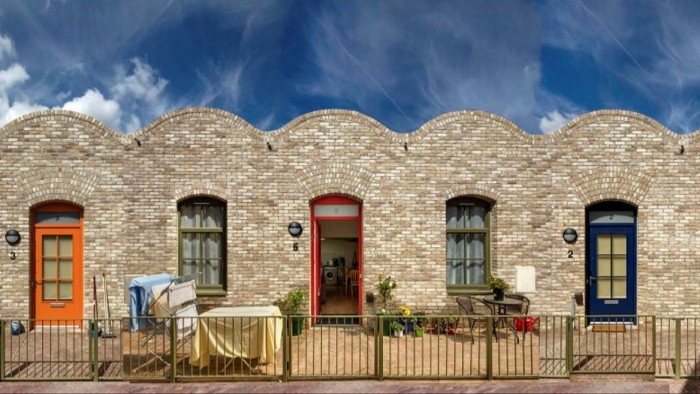
Once occupied by a run of dilapidated garages, the site in Barking, east London where Peter Barber was tasked with designing 16 houses in 2019 was exceptionally narrow. The most obvious solution for these homes for the over-sixties was to stack them over multiple storeys. Barber, however, had been reading about isolation among older people and persuaded his client to back a more radical strategy.
On either side of the traffic-free street, just 6 metres wide, Barber dispensed with back gardens and instead built single-storey cottages with narrow terraces at the front. “What we hoped would happen did happen,” the architect recalls. “When I went down there after two weeks, it was a sunny day and [the residents] were all sitting outside the front chatting to each other. They said: ‘Well, this is how we used to live up until 1967, when our houses were all bulldozed and we were put in tower blocks.’ They grew up living in an environment where people were in and out of each other’s houses, with front doors left open.”
Barber views the Ilchester Road project as a modern interpretation of the traditional London mews house. It’s an archetype that the city’s architects are increasingly turning to as they face the challenge of building on ever more constrained and overlooked sites — and as communities become more isolated.
Threaded across the wealthier parts of 18th and 19th-century London, the original mews formed a discreet accompaniment to the city’s more public streets and squares. These modest service buildings, sited at the end of each large house’s garden, were created to accommodate stables and coach houses, often with staff quarters built above. At a time when sewage was removed by covered carts at night, the mews doubled as a means by which this unlovely operation could be conducted out of sight.
When the advent of car ownership made these outbuildings surplus to requirements, a significant number were converted into enviably situated, if compact homes. The young Agatha Christie settled in a mews house at 22 Cresswell Place, Chelsea, and went on to employ the fashionable setting for her Hercule Poirot story Murder in the Mews. “The walls were silver and the ceiling emerald green,” she wrote of the crime scene. “There was a tall antique walnut bureau, a walnut tallboy, and several modern chairs of gleaming chromium.”
Al-Jawad Pike Architects’ housing at Chowdhury Walk, for the London borough of Hackney, is another project that shows how we can imaginatively infill postwar estates that local authorities today deem to be under-developed. Built, like Ilchester Road, on a site formerly occupied by garages, it is also predicated on the creation of an intimate traffic-free street. The design, with homes rotated so they face the street at an angle that means they avoid being overlooked, was shortlisted for last year’s Stirling Prize.
“People peering in or out is something that causes planners a great deal of anxiety,” says Barber. “So the idea of a mews, which is rather introverted, and doesn’t require views back into the land behind, like a normal terrace house would, is a real gift.” Barber is often commissioned to design buildings on sites that are just 10-12 metres wide, “which is probably about the amount of space that was left for most mews between the grand houses in Holland Park and Bloomsbury”, he says. And being frequently traffic-free, or with limited parking, mews “can become much more sociable spaces than an ordinary street — places for people rather than cars”.
The 1960s saw an explosion of new-build homes in London’s original mews. A significant cluster can be found in Camden, which had been recently liberated from the smoke, grime and noise of passing steam trains when the railways switched to diesel and electric locomotives. Set among modest structures that were often still in use as workshops and garages, proposals for new buildings enjoyed a creative licence that Britain’s conservative planning departments rarely extended to more conspicuous sites. Many of these buildings were designed — and frequently built — by young architects for their own families. These small sites, often chosen because of restrictive budgets, demanded innovation, and a custom-designed mews house often became a professional calling card — or even a built manifesto.
John Winter’s 2 Regal Lane, for example, was built for just £1,300 in 1961, adapted from the walls of a garage. (Winter also saved money by driving around construction sites in his car, asking builders for surplus bricks). Another brilliant example is the house that the architect Ted Cullinan and his wife Roz self-built at 62 Camden Mews over three years of weekend labour, completing in 1964. With funds in short supply, extensive use was made of salvaged materials, including bricks that had been rejected by builders at the nearby Royal College of Physicians — a building designed by Cullinan’s then employer Denys Lasdun.
The first point of interest is the house’s orientation. While neighbouring properties open straight on to the street and have a garden at the rear, the Cullinans’ house and garden are laid out as two parallel strips, each running the full length of the plot. A wide overhanging roof brings to mind the work of Frank Lloyd Wright, which Cullinan had seen when he had studied in the US.
At nearby 15-19 Murray Mews, the problem of being overlooked was tackled by dramatic, 45-degree glazed roofs that extend over two stepped storeys, limiting the need for street-level windows. At number 43, built by John Townsend in 1977, the roof lights are carefully angled so an onlooker can only see the reflection of the sky. Others, such as Philip Pank’s 1967 Torriano Cottage in Kentish Town, are arranged around courtyards, or employ high clerestory windows on the ground floor. CZWG’s flamboyant 1984 Lonsdale Place project in Islington, however, has no such privacy concerns. The three homes employ unusual (and huge) double-height, street-facing circular windows.
Wembury Mews by Russell Jones was completed in 2020 — this Highgate home makes the most of a narrow site with a long courtyard providing light to the galley kitchen. It also embraces the mews setting with a cobbled driveway to match the original carriageway, and square timber-framed windows the size of a garage door. Similarly, Trewhela Williams’s 2023 Belsize Park renovation makes a feature of the garage opening by embellishing it with an elegantly louvred timber facade.
But Barber’s Edgewood Mews in Finchley, built in 2023, is perhaps the most large-scale contribution to London’s mews house tradition. Incorporating 97 red brick homes, the scheme is sandwiched between the back gardens of interwar suburban villas and one of London’s busier arterial roads. Yet, through an ingenious manipulation of the building’s profile, Barber imbues the 200-metre pedestrian thoroughfare with an atmosphere that is unmistakably mews-like. With tall glazed arches at the lower levels, and box bay windows and step backs in the red brickwork above, it has a romantic, almost crenellated profile. The noise of the nearby traffic is blocked, children play in the street and neighbours converse across the short gap between roof terraces.
Today, architecture studio OMMX is working on its own interpretation of the London mews tradition by inserting modest, backland “shell” dwellings on constrained former garage courts in Enfield, treating them as adaptable service structures that residents complete over time. These “naked houses” are delivered watertight and habitable but largely unfinished — so occupants can customise and extend as needs change. The scheme, which is due for completion next year, comprises 22 units but offers a model that deserves wider application.
Barber acknowledges that the level of intimacy of a mews home is not everyone’s ideal. “But one of the important things I’ve learnt in 40 years of building housing is that to generalise is a mistake. That’s why design standards are difficult,” he argues. “They assume there’s a Mr And Mrs Entirely Normal. And of course, that person doesn’t exist. For some people, living at the top of a tower block with distant views and absolute privacy is their idea of heaven. For others that would be very isolating.”
And whether or not the mews life is for you, as London faces the challenge of building new homes within its typically low-rise and often sparsely populated periphery, the mews remains a highly relevant model, rich in association with the city’s history.
Ellis Woodman is the author of ‘At Home in London: The Mews House’, co-published by the Architecture Foundation and Mack
Find out about our latest stories first — follow @ft_houseandhome on Instagram
Read the full article here