

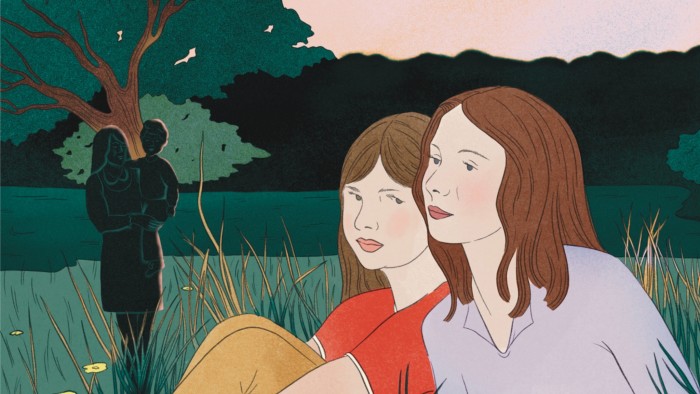
My Sister and Other Lovers is Esther Freud’s 10th novel, but it links right back to the beginning of her career. It’s a sequel to Hideous Kinky (1992), the much-praised debut inspired by Freud’s childhood, spent travelling the Moroccan hippy trail with her sister and their free-spirited, peripatetic single mother. My Sister and Other Lovers picks up the story when the sisters — Lucy, our narrator, and Freud’s alter ego; and her older sister Bea — are in their teens.
They’re back in the UK with their mother and a new younger brother, Max, whose father their mother has just left. We meet them on a ferry bound for Ireland, heaving its way across choppy seas, the air thick with “the churn of engine oil, the dry salt smell of chips”. It’s a million miles away from the souks of Marrakech. A visit to their maternal grandparents in County Cork also features a lot more rain. Bea’s flares are “stained wet halfway to the knee” after their mother takes them hitchhiking in a storm. Clothes are moth-eaten. Internal walls are beaded with damp.
Back in England, they move into a communal house where well-meaning ideals clash with harsher realities — people filching gas from one another, affairs between housemates. There are trips to Scotland — with echoes of Emma Tennant’s novels, or Elspeth Barker’s O Caledonia — and the home of an aristocratic family who have fallen on hard times. The parents are making ends meet by providing American tourists with “the full Scottish Country House experience,” while their own children subsist off tinned ravioli.
Bea escapes to London before Lucy (who later follows her as a drama student) and soon develops a drug habit. One memorable Christmas, Lucy finds her sister and her friend Sally shooting up after lunch. That Sally later dies from Aids — she contracts HIV while imprisoned for drug smuggling — is relayed almost as an aside. Just how autobiographical this novel is, we don’t know, but the way Sally flares up and then disappears from the narrative carries the sharp tang of authentic memory.
Lucy becomes pregnant at 18 — the same age their mother fell pregnant with Bea — and has an abortion. She’s steadfast in her decision and supported by her mother, but she’s also very aware of the difference between their choices. Was she thinking how “she too had been pregnant at eighteen,” Lucy wonders when she makes her confession. “That she’d been happy? That she’d kept the news from her own mother, who might never have known if she hadn’t been spotted, wandering through London with two girls?” The shadow of Ireland’s punitive treatment of teen mothers in the 1950s sits in sharp contrast to the lack of judgment Lucy’s mother offers her in England in the 1970s.
And when Lucy later becomes a mother, to her beloved daughter Pearl, we’re able to understand the more claustrophobic elements of their mother-daughter dyad through the prism of Lucy’s very different experience of being mothered herself. Freud is too subtle a storyteller to hammer the point home, but the implication looms large.
Hideous Kinky married the cocktail of unvarnished truth and inherent unreliability that marks the best child narrators, and Freud invokes a similarly fragmentary, often hazy style of narration here. The chapters often feel more akin to short stories — interlinked, but ultimately discrete units. But once I acclimated to the tone, I was swept up into this world of visceral intimacies, the fraught but powerful relationships between the main characters more than gripping enough to carry me along.
More minor characters — such as the aforementioned Sally — appear without introduction and exit without fanfare. And although the story is told chronologically, time expands and contracts in different ways at different points. Lucy is pregnant in one chapter, for example, then in the next, her daughter is already three years old.
Through it all, though, is the tension between Lucy, Bea and their mother. Lovers, husbands and fathers come and go, but the women remain a constant presence in each other’s lives. Theirs is an abiding, albeit troubled, triumvirate. As a child, Bea is abused by one of their mother’s boyfriends, something their mother minimises or refuses to engage with later in life, which causes Bea much pain. As such, Lucy often finds herself torn between them, “caught in their dance”. There’s Bea, “sharp-eyed, a raven on my shoulder”, and “Mum, whose face I knew better than my own, loved more painfully than anyone I’d ever known”. Both making demands of her. Never named, their mother exists in Lucy’s story only in relation to her daughters. Bea, by comparison, is a fully fledged individual in her own right.
Fittingly so, since it’s the relationship between the sisters that lies at the heart of the novel, and Freud teases out its various pressure points with delicate, moving effect. Lucy is the keeper of her sister’s secrets — from the track marks on her arms, to her revelations of her childhood trauma — and the quieter of the two for many years.
But this is also about Lucy finding a way to tell her own story. Especially in the face of Bea’s eloquence and loudness — after getting clean, she becomes a photographer and filmmaker, writing a script based on their childhood (echoes of the film adaptation of Hideous Kinky, starring Kate Winslet, abound). “Bea’s childhood was almost unrecognisable from my own,” Lucy is forced finally to admit when, on one occasion, her sister holds forth to others in her company.
As a young adult, out in the world for the first time, yet still trailing in Bea’s footsteps, Lucy and a friend bemoan “the quandary of [being] the younger sister — what to do when it had already been done” and this turns into a life-long struggle. This beguiling story of female experience and family ties is well worth the three-decade wait.
My Sister and Other Lovers by Esther Freud Bloomsbury £18.99, 288 pages
Join our online book group on Facebook at FT Books Café and follow FT Weekend on Instagram, Bluesky and X
Read the full article here