
Nobel chemistry laureate Frances Arnold: ‘Whole swaths of science are just going to die on the vine’

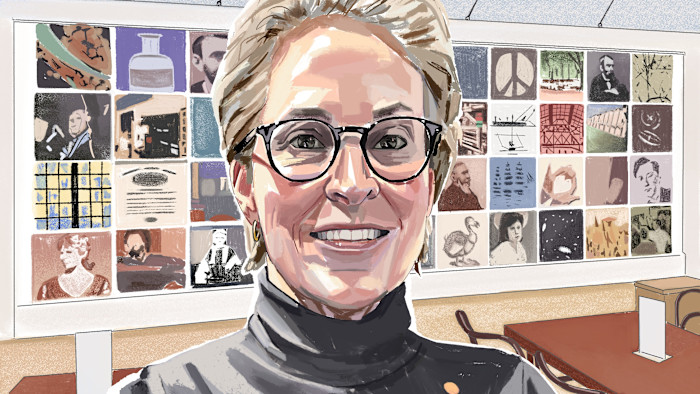
The first thing Frances Arnold and I do when we meet for lunch in Stockholm’s Nobel Prize Museum bistro is check who is under our chairs. Arnold upturns hers and exclaims: “Oh, I have Jim Allison from 2018!”
It’s a serendipitous discovery. In December that year, Arnold sat alongside Allison in the splendour of the Swedish capital’s concert hall as they waited to pick up their Nobel prizes. Allison won for medicine, Arnold for chemistry — one of a handful of female recipients, following in the footsteps of Marie Curie.
Nobel honorees traditionally leave their autographs on the furniture of the restaurant where we now occupy a quiet side room. Arnold and I briefly discuss searching the premises for hers, but decide that other diners might not share our delight in the hunt.
Instead we settle down for what we hope will be a restorative lunch after the four-hour long banquet and other festivities the previous evening to honour the latest Nobel winners.
“It feels great. I love being in a country that celebrates science,” she laughs pointedly. “What’s not to like about that?”
The implied contrast with her home nation, the US, hardly needs stating. President Donald Trump’s administration has slashed funding for research institutions and cancelled support in areas it dislikes, such as vaccines, climate change and diversity. Many scientists fear the strategy will dismantle a model that has powered innovation and the economy since the second world war, even if Congress has just softened the financial blow.
Arnold says she is not surprised by the White House’s cost-cutting push, nor the ideological impulse, but is shocked by its scale and scope: “I knew it would be bad but I had no concept of how bad it could be.”
The magic of the banquet has given way to a drizzly Nordic midwinter day. Arnold and I agree that comfort food is called for. She is pleased to see a celeriac soup and opts for the main course of cured salmon with vegetables and cress. I also go for the soup followed by a venison loaf with juniper gravy, blackcurrant jelly and pickled cucumber.
We talk further about Arnold’s fears that what’s happening in US science will cause “permanent destruction”. She says she has lost a couple of excellent members of her team at the California Institute of Technology (Caltech). “Two women who would have made their careers in the United States in the past, they said, we’d rather be in Europe — and I don’t blame them.”
It’s all the more disorienting for her because, little more than a year ago, she was co-chair of former president Joe Biden’s council of scientific advisers. There, she says a touch ruefully, she learnt that “science is easy compared to people”, who are constantly balancing technical proposals against various political interests. “We would make recommendations and they wouldn’t always happen,” she adds. “But I think they were weighed.”
By contrast, she sees the current administration as being interested only in a “limited range of topics”, notably AI, quantum and some areas of biotechnology. “There’s whole swaths of science that are just going to die on the vine.”
Arnold’s point is that science is more multidisciplinary than ever before. It’s an insight that is central to her career. She won her Nobel for fusing aspects of chemistry, biology and engineering to, as she has put it, invent a “whole new way of making materials and chemicals that we needed in our daily lives”. The key was to harness the power of enzymes, which catalyse the chemical reactions vital to living cells, for industrial uses. These techniques are now used for the more efficient manufacture of products from plastics to pharmaceuticals — in some cases cutting out the use of pollutants such as heavy metals.
The Nobel committee described the innovation as laying the foundation for a “revolution in chemistry”. I say that, judging from her public comments about how AI can drive the invention of new biomaterials, she seems to think she can pull off another similarly seismic transformation of the field.
“I like to overstate things to get people thinking,” she says as we seize gratefully on the hot soup and accompanying sourdough. “But it’s not entirely a mad dream.”
Arnold is part of a growing scientific movement that seeks to yoke evolution to AI. Her work looks for patterns in biological information in order to make predictions about how to design useful new molecules from well-known enzymes such as proteases, which break down proteins. She compares it to how large language models can compose text based on a database of literature.
“What we see is that this also holds true for the language of life,” she says. “You can compose new DNA, like you can compose a new short story in the style of such and such. I can compose an enzyme in the styles of a protease, but that has other properties that nature would not have given me. I love that!”
Arnold explains that a kilogramme of a manufactured drug generates many times that mass in waste. Enzymes can short-cut multiple-step syntheses, reducing the amount of garbage generated. Her group finished a project last year funded by the Gates Foundation non-profit and aimed at simplifying and lowering the cost of making drugs for diseases such as tuberculosis. “These things are happening!” she says.
The lightness of Arnold’s account coexists with a keen awareness of the dark side of AI-assisted bioengineering. In 2024, she and dozens of other scientists signed an agreement committing to reduce the risks that the technologies could be “misused, intentionally or otherwise, to cause harm”. They argued this should be done by controlling access to the equipment needed, rather than restricting the use of AI. The threat was underscored in October when researchers reported and fixed a “striking vulnerability” in software that guards access to genetic material used to make deadly proteins.
There is also the question of whether the volume of nonsense generated by AI predictions limits how helpful they are. The process does throw up ideas for molecules that can’t be made or aren’t functional, she says. But the bigger picture is that the methods are improving all the time, as is our understanding of how living cells work. “Right now, maybe 99 per cent of the predictions are useless . . . But all you need is one that’s good — and that’s your drug.”
Arnold sees the development of AI from the inside as well as observing from without. She is on the board of Alphabet, parent company of Google. I ask about the tension in Big Tech companies of wanting to be seen as ethical and progressive, but at the same time striving to maximise profits and dominate markets. She gives short shrift to the idea that she might encourage discussion of this point.
“The answer is no,” she says. “My role is not to lead that debate . . . As a board member, I have a fiduciary responsibility to the company.”
It’s been a long journey for Arnold from Pittsburgh, Pennsylvania, where she grew up in “a very interesting time, in a very interesting place”. She turned 14 in 1970, with the steel industry soon to decline, the Vietnam war raging and young people rebelling against their parents’ ideas.
“I was interested in knowing what the world looked like outside of my little space in my family and in Pittsburgh,” she says. “So I did crazy things.”
She hitchhiked to anti-war protests in Washington and later lied about her age so she could work as a cocktail waitress. At the age of 18, she started a gig as a taxi driver, hiding her hair under a hat to head off hostility from passengers who didn’t like the idea of a woman behind the wheel. “I paid my own rent, I had my own apartment, worked in music,” she recalls. “It was tough, it’s not easy to do that when you’re that young. But then I went to college and I still had that rebellious spirit.”
Arnold studied engineering at Princeton, where her father, an experimental physicist, had done his PhD. She acknowledges that he probably “put in a good word” for her, although she points out that she had excellent SAT scores and a compelling back-story. “The other thing was that this was 1973 — there were no women in engineering,” she says. “And they said, ‘Well, she’s got the firepower to do it. Let’s see if she can do it.’”
Princeton at that time was a place where you could “get a degree in engineering without knowing a lot of engineering”, she says. “It’s mostly applied math. So I had a gentleman’s degree in engineering, but I was well educated.”
In 1979, after travelling in Latin America, she took a job at a new national laboratory named the Solar Energy Research Institute in Colorado. This was a Sliding Doors moment when it briefly looked as if the US might embrace renewable energy resources in response to fears of both climate change and limits to oil supplies. President Jimmy Carter even installed solar panels on the White House, which were removed by his successor, Ronald Reagan.
Arnold says she “bought into” Carter’s goal of 20 per cent of energy generation from renewables by 2000, but notes that the “technologies were terrible”. There was a “long road” between what they envisioned and what they could actually do. China later picked up the ball and now dominates the solar technology market. “By not investing in these long-term things, you lose out,” she adds. “So, yes, we did miss an opportunity, but did we take other opportunities? Undoubtedly yes.”
Arnold went into chemical engineering at a time when the semiconductor and biotechnology industries were starting to flourish. She says she was lucky in graduate school at Berkeley to have learnt from teachers such as the evolutionary biologist Allan Wilson and the biochemist Dan Koshland.
Her idea was that nature would have done a lot of the hard work about making processes resource-efficient and repeatable. Caltech, which she joined in 1986, turned out to be the place where she could develop those ideas. The relatively small size of the faculty meant it was “a perfect environment at the time to do highly interdisciplinary work”.
“The environment had the tools, the money and the exalted ambition to do things that really mattered — to do things that would change the way science is done.”
We have eaten our main courses quickly. Arnold, a fish lover, says she enjoyed her gravlax. My deer meatloaf was subtler than I had expected.
Arnold declines dessert, opting for green tea instead. I persuade myself that it would be churlish to turn down a serving of blackcurrant-garnished “Nobel ice cream”, and add a double espresso.
Arnold’s work since her prize has focused on making chemistry greener through techniques such as producing insect pheromones to combat crop pests. That research is the basis for one of three companies she has co-founded. In the mid-2010s, her team made waves by using enzymes to bind carbon, the foundational element of life, and silicon, its counterpart in computing. This was the first time the combination, based on a protein from a bacterium that grows in hot springs in Iceland, had been achieved biologically. It suggested potential new pathways into cheaper and cleaner manufacture of carbon-silicon compounds in products from paints to semiconductors.
“I think it opened people’s minds to the fact that evolution has not stopped, and that a whole new chemistry is being created all the time,” she says. “Not just by Frances Arnold, but by the biological world, given new opportunities.”
In a neat bit of chemical symmetry, Arnold and colleagues reported in 2024 that they had engineered an enzyme to break human-made carbon-silicon bonds. This provides a potential route to break down polluting siloxanes, synthetic compounds that are found in many consumer products, from cosmetics to cookware. “If you make carbon-silicon bonds, you should be able to break them,” Arnold reasons, pointing to how enzymes could help in the fight against other persistent environmental problems such as so-called forever chemicals.
“Chemistry has been largely good — for human beings, at least, if not for the planet,” Arnold says, but adds that there is an evident downside to making large numbers of chemicals that have never existed in nature.
She says this impact dawned on her during the early 2000s. She, her husband and three sons travelled around the world for a year, to countries including Madagascar and South Africa. “I realised that a lot of these places that I had been to in the ’70s and ’80s were under threat already,” she says. “The wild world that I explored 50 years ago was 1771596473 much less wild. And chemistry plays a big role in that.”
Arnold is one of only eight female winners of the Nobel chemistry prize since it was first awarded in 1901, although half of those have been in the past eight years. I mention the striking spectacle on the awards stage the previous day of Mary Brunkow, co-winner of the medicine prize, as the only woman flanked on each side by six male laureates.
“Hey, at least there was one!” Arnold says, before noting that more women will be coming through from younger age groups. “I want to live long enough to see the wave where there’s nine women and one guy,” she says.
We turn to a more difficult moment in Arnold’s career. In 2020, she retracted a paper published in the journal Science the previous year, because the results were not reproducible and laboratory data was missing. She described the admission as “painful” but “important to do”, adding that she was a “bit busy” when it was submitted and had not done her job well.
While her openness drew praise, it made her a target too.
“It should be easy to do it, it should be easy to say, ‘Oops, this did not reproduce’,” she says. “It shouldn’t be that you get attacked online or your university gets hate mail . . . ‘She doesn’t deserve the Nobel Prize’, and all this.”
Arnold says she was able to absorb the shaming because of her standing and track record, but less experienced researchers might not be able to do so. “Imagine if you’re a young scientist and you do that, you’re just putting your neck on the chopping block,” she says. “The public is not kind.”
It’s almost time to head out into the mid-afternoon darkness, armed with chocolate coins depicting Alfred Nobel’s face. I ask Arnold, who turns 70 this year, what she would like her legacy to be. She says she already has one in her hundreds of former students, many of whom will come back to Caltech for a party.
On a global scale, she offers pragmatic optimism. “I’m an evolutionist — life will go on, in one form or another,” she says, the postscript perhaps more unnerving than she intended.
Our technological progress is impressive but needs support through regulation such as carbon taxes, she says. Then the impetus would be there for the kind of chemistry she advocates — one that is both life-enhancing and profitable.
“There are many successes where you can both make money and do the right thing,” Arnold adds. “It’s a small intersection, but that’s where my sweet spot is. Make it practical and useful — and people will use it.”
Michael Peel is the FT’s science editor
Find out about our latest stories first — follow FT Weekend on Instagram, Bluesky and X, and sign up to receive the FT Weekend newsletter every Saturday morning
Read the full article here