

Two winters ago, I took a long, lonely walk through the highlands of a prefecture on the edge of the Tibetan Plateau in north-western China. Vivid memories still linger: the spearmint-fresh air in my lungs, the sky rinsed of clouds, streams braiding through valleys, ice crystals forming at their rims. For hours, I saw no one; just yaks and sheep grazing the slopes. Each hill crest led onto another, in an endless roll of frost-yellowed grassland that was meditative in its monotony.
I had come to report an HTSI story on Norlha, a textile atelier in the village of Ritoma, where members of Tibetan nomad families and former nomads spin yak down, known as khullu, into cashmere-soft scarves and coats. I’d also hoped to stay at Norden camp, Norlha’s hospitality spin-off about an hour and a half to the west, but arrived a few weeks too late: the camp had just shut down for a complete rebuild after its first decade of operations.
Two years and an hour-long flight from Chengdu later, the new Norden has just opened to guests. The landscape is the same; wild garlic and periwinkle-coloured asters speckle the hills like confetti. But tourism has multiplied since my last visit. New accommodations with names like Grassland Happy Camp have cropped up everywhere, as have buses offloading camera-toting Chinese tourists at viewing platforms and corrals, where they ride bored-looking ponies for a few yuan.
Norden, by contrast, feels far removed from the fray (in the endless steppe, “fray” is relative anyway). Swallowed in a tangle of willows and shrubs wedged between two rivers, the camp sits in winter pastures still used by nomads who graze their herds on the surrounding hills. I’m welcomed with a khata, a silky ceremonial scarf, made by founder Yidam Kyap, who was born into a semi-nomadic family nearby, and his Tibetan-American wife Dechen Yeshi, who co-founded Norlha with her mother in 2007.
When Kyap launched the camp’s first iteration in 2013, it was an experiential extension of Norlha’s founding principles. Yeshi set up the atelier in Ritoma to create year-round jobs. Gannan, part of Tibet’s historic Amdo region, has long been home to nomadic communities that moved their yaks across its plains – a way of life that has become harder to sustain. Over the years, many young Tibetans gave up that life for small apartments and city pay cheques. Norden aims to inspire them to stick around, Yeshi says. It now employs some 50 people – mostly young, all local – who receive year-round salaries (which means they’re paid even when the camp is closed for the winter).
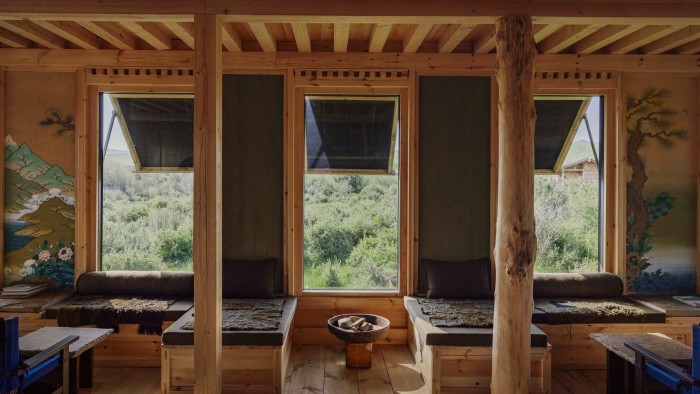
While the original Norden offered a more literal immersion – guests could sleep in baku, the nomads’ traditional black yak-hair tents – it lacked the comfort some travellers expected. Those tents have been replaced by nine wooden cabins. Designed in collaboration with Maine-based architect and long-time family friend Blake Civiello, who celebrated his wedding at the camp in 2019, the new structures balance durability with tradition. Built using old Tibetan joinery techniques, they were pieced together from wood salvaged from old village homes and unvarnished pine timber that, as Kyap puts it, “will age like wine”. The baku, meanwhile, live on as dining tents and wood-stove-warmed private lounges in most of the cabins’ wild “backyards”.
Inside, each one is unique, with a colour palette tuned to its specific views (the Tree cabin is green and brown; Moon is silvery grey and midnight blue). Greek architect Ileana Liaskoviti, who also designed the Ritoma showroom, brought in a wood-heavy, wabi-sabi austerity, and softened it with one-off textiles – curtains, bedspreads, rugs and tapestries from khullu and silk – designed, felted and woven at the Norlha atelier. Australian designer Narelle Dore arranged twigs, pebbles, dried flowers and other highland flotsam into ikebana-like compositions that line the walls; French ceramicist Elise Gettliffe, who spent four months at Norlha’s artist residency in Ritoma, produced vases and crockery inspired by nearby monasteries’ walls.
I stay in the River Loft, one of two double-storey cabins. The indigo-blue accent walls are the same shade that colours the ceilings of Labrang Monastery, Yeshi tells me. My young butler, clutching a notebook scribbled with English phrases, runs me through the essentials: electric underfloor heating, copper washbowls and an eco-toilet, where, with a few scoops of soil, my business is handed back to Mother Nature.
It’s only after a while, though, that I register the missing bathroom. For that, you follow the “yak path”, a stone trail looped around the camp, weaving past trees and piles of pebbles engraved with spidery Tibetan script. The communal bathhouse consists of six self-contained suites from Tetris-stacked slate and reclaimed juniper wood. “It was a big conversation, actually,” Yeshi says of the decision not to have private bathrooms. “But the amount of digging it would take to lay pipes through this fragile ecosystem just wouldn’t fit our ethos.” She concedes it might be a notch too rustic for some, but with their copper-clad tubs, indoor-outdoor showers, alfresco lounge nooks and private sauna booths, no one will be roughing it. When I pad over the following morning, a bath has already been drawn, and there’s tea waiting. I soak for an hour in juniper-scented bliss.
That same unshowy indulgence carries into the meals, served in the private baku clustered around the firepit, or sunken picnic “booths” ringed by wildflowers. The set menus, which chef Lynus Lim – brought in from London’s Evernight izakaya – describes as “about 80 per cent Tibetan, 20 per cent rest of the world”, are simple but delicious: grissini rolled from tsampa (roasted barley flour, a nomad staple), lamb hotpot, or one-bite momos filled with shiitake and yak mince. At the bar, its walls covered in dazzlingly intricate thangka-style paintings of the kind often found in Tibetan temples, punchy drinks incorporate chhyang barley wine and clarified yak milk.
I leave camp only twice. Once, at dawn, for the Labrang Monastery, a village-sized sprawl of gilded roofs, temples and study halls, where women with long black braids circle the kora, a prayer path lined with spinning mani wheels. Another afternoon I head into the hills, a short but bone-rattling jeep ride away, then on foot through shin-deep plumey grasses and edelweiss. A laptse pole wrapped in prayer flags marks the summit. We toss paper wind-horse effigies for good fortune, watching them scatter like Post-its in a storm. There’s also talk of guided nature hikes and in-house yoga sessions, and a more hands-on activity schedule may follow next season. Or not. “We really want guests to just enjoy the camp itself,” Kyap says. “Be one with nature.”
That simplicity is the point. “When nomads [who’ve settled in cities] talk about what they miss, it’s not necessarily the herding or the animals,” Yeshi tells me later. “It’s the freshness of the air, and being in tune with the rhythms of nature.” Norden, she says, tries to channel a way to exist in and connect with the landscape without having to contend with its hardships. “We’re all becoming separated from that connection,” she says. “Here, you feel what the Plateau can give, and can celebrate what Tibetans love most about it.”
Chris Schalkx stayed as a guest of Norden camp, from £895, nordencamp.com
Read the full article here