

Unlock the Editor’s Digest for free
Roula Khalaf, Editor of the FT, selects her favourite stories in this weekly newsletter.
Bellini’s Norma premiered at La Scala in 1831 and the opera soon established itself as a crowning achievement of the bel canto genre. Yet before Friday it had not been performed at the Milan house for 48 years. Such a lengthy absence in a city that sees itself as the cradle of Italian operatic culture is little short of baffling. The weight of history may be at least partly to blame: Maria Callas’s legendary performances here set a high bar.
The plot — about a Druid priestess who, with the Roman governor, secretly bears children she eventually contemplates killing in revenge — is a vehicle for some of the most ravishing music in opera. The last person to attempt the title role at La Scala was the great Spanish soprano Montserrat Caballé, in 1977. The stakes for her successor on Friday night could hardly have been higher.
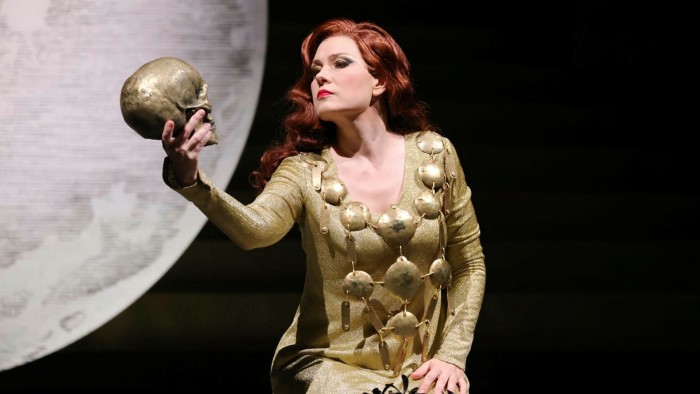
Perhaps this production’s stage director, Frenchman Olivier Py, was also feeling the heat. The curtain opens onto a stage dominated by a cardboard cut-out of La Scala’s facade, in front of which tunicked Austrian soldiers (the opera’s Roman occupiers) execute a Redshirt (the Gauls), shifting the action to the Risorgimento era. We soon learn that Norma is a company singer preparing for another great Callas role: Cherubini’s Médée. This invites a comparison between the sorceress of Greek mythology who does kill her children and the Druid priestess who does not.
It is a clever idea pursued with conviction, but also a confusing one. Camp dance routines and golden theatrical masks recalling ancient Greece add layers rather than lucidity. Py is one of the more talented directors La Scala has booked in recent years, and stagecraft was slick, with an effective revolving stage bringing various facets of a deconstructed La Scala into view. Ultimately, though, the surest path through the dramatic clutter was simply to surrender to the music.
Fortunately, the music was sublime. Fabio Luisi, a master of bel canto, was the driving force in this performance, offering a lucid and restlessly inquiring reading. The conductor explored the full nuance of Bellini’s rich score, favouring transparency and sometimes daringly slow tempi. His control was total, and the orchestra played with discipline and fire. The result was a performance that could pivot from hushed tenderness to dry, rollicking militarism in an instant.
That assuredness gave the singers firm ground. After an audibly nervous start, Marina Rebeka was in her stride by the “Casta diva” aria, about 20 minutes from the start, and showed precisely why she had been cast in the title role. Her steely voice evidenced power and edge, but also a suppleness that lent her long, legato phrases expressive shape and emotional depth. In what was like an exorcism of the ghosts of the past, she was greeted at the curtain with incandescent applause.
As Norma’s love rival Adalgisa, Vasilisa Berzhanskaya was formidable, multi-faceted and intense. Freddie De Tommaso’s butch Pollione was less complex but nevertheless thrilling to hear. The veteran Michele Pertusi gave a masterclass in poise and subtle characterisation as Norma’s father Oroveso. The well-drilled and expressive chorus reminded just how expansive Bellini’s musical palette can be. Notwithstanding predictably vociferous booing reserved for Py — perhaps unfairly, given La Scala is not brimming with directors offering original ideas — Norma’s long awaited return was a success.
★★★★☆
To July 17, teatroallascala.org
Read the full article here