

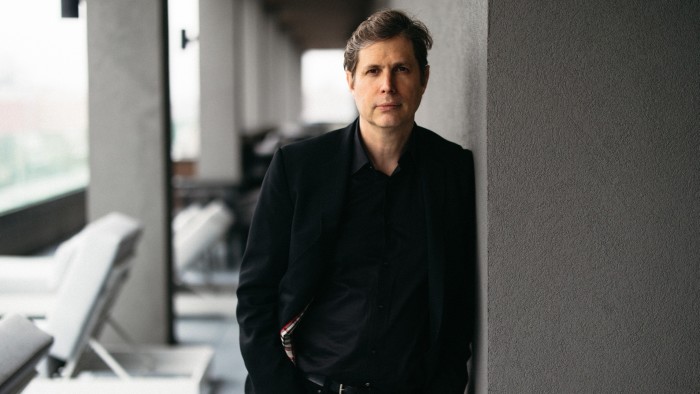
“I hate it when people compare things to Kafka. I’ve written dramas about Kafka,” exclaims an indignant Daniel Kehlmann, before adding: “But this really is Kafka!”
The prompt for this outburst, delivered in the kitchen of his 13th-floor apartment in Harlem, New York with commanding views down towards Central Park and beyond, is one of those immigration horror stories one hears a lot in the US. In this case someone whose visa was deemed invalid and withdrawn by a border guard was then confronted by another official who demanded to know where their visa was.
It is the launch day of the US edition of Kehlmann’s latest novel, The Director, in which the Austrian-German novelist and playwright explores questions of art and totalitarianism, complicity and resistance through a fictionalised account of the life of the filmmaker GW Pabst. One of the luminaries of European cinema between the wars, famous for his work with Greta Garbo and Louise Brooks, “Red Pabst” initially sought refuge in Hollywood when the Nazis came to power only to later return to his native Austria and filmmaking under the sinister patronage of Joseph Goebbels, Hitler’s propaganda minister.
Originally published in German in 2023, the English-language edition, translated by Ross Benjamin, has arrived with unnerving timing. Cultural New York is alive with talk of the destructive impact of the seemingly never-ending slash-and-burn initiatives rolling out of the Trump White House: funding withdrawn here, summary dismissals there, tighter border controls. There is talk of escaping abroad, while the “f” word — fascist — is liberally deployed in fraught conversations over just where to place the events of the past four months on the register of authoritarianism. Publishers report that sales of backlist titles on the rise of the Nazis have rocketed.
In a speech at the launch party for The Director in the safe space of an elegant bookstore down in the financial district, Salman Rushdie described Kehlmann’s novel as “curiously prophetic of what we now have to endure here”.
It is a theme we pick up as we walk a few blocks to a local Italian restaurant, a favourite of Kehlmann and his wife. He has been on the morning television, the reviews from the major US papers are out. “I have never had a book that gets this much attention in America,” he says with boyish delight. The book’s recounting of the “everyday compromises” are the stuff of “conversations that are happening in this country now”.
It wasn’t meant to be like this. “I wanted to write a different book at first,” says Kehlmann. “I wanted to write something set in the 1920s in the silent movie era.”
Kehlmann likes to draw inspiration from history, from where he takes characters who he bends, shapes and relocates to fit stories celebrated for their intelligence, imagination, wit and sheer narrative verve. His past works include his breakthrough 2005 novel Measuring the World, a reimagination of the lives of the polymath explorer Alexander von Humboldt and the mathematician Carl Gauss that has sold millions worldwide, and Tyll (2017), a whirling, comic take on the Thirty Years’ war which was shortlisted for the 2020 International Booker Prize.
One era he had not addressed in novel form was the Third Reich. “If you are a German writer you do think about writing about the Nazis. It’s not because you have to, but it’s this big field . . . of storytelling that’s available to you as a German writer in a more immediate way.”
There was also a specific personal dimension. His father Michael, an Austrian film and television director, came from a family of assimilated Jews and was imprisoned in a concentration camp. Some members of the family were able to mask their heritage and escaped persecution. Others were murdered. “It comes back to my family history.”
At the same time he felt he could only write about the Nazis if he had the “right story”. So much has been written on the subject that there was a risk of producing “another mediocre book that then somehow amplifies its importance by having some Third Reich stuff in it”.
The breakthrough came when he started reading more about the silent movie giants of the 1920s and chanced upon a reference to how Pabst had ended up making movies for the Nazis. “And I thought, wait a moment: he was in America, he was in exile. So how did he then make films for the Nazis? What happened there?”
What happened is that Pabst never made it in Hollywood. Tinseltown was awash with great European writers, artists and filmmakers all forced to adapt. As one of Kehlmann’s characters notes: “we have to make westerns, even though we’re allergic to horses”.
Some succeeded; others, including Pabst, didn’t. In one of the opening scenes in the book he is all adrift at a Hollywood party, unable to grasp the language, uncomfortable in the heat and the social world of big smiles and small talk. The movie project he is given turns out to be a dud.
And so, it’s back to Europe, to France, and a more familiar setting, if not exactly a comfortable one. Paris is also in a state of high anxiety: war is coming and everyone is looking for an exit pass — ideally to America.
Recognising that they have made the wrong choice, Pabst and his wife Trude decide to retrace their steps westwards — yet only after a brief detour back to Austria to place his ailing mother in a sanatorium. But then war is declared and the borders are shut.
For Pabst the filmmaker, a lifeline arrives in the form of a summons from Goebbels. The literature PhD, sometime novelist and lethal propagandist knows the value of having such a famous director — even a “red” — on the Reich’s cultural books. A deal is offered: Pabst can make movies “that touch the German hearts of good, deep, metaphysical people” to oppose “American cheap commercial trash” — as long as he stays out of politics.
“I wanted to write about complicity,” explains Kehlmann. He recalls his father telling him about growing up under the Nazis and then how his view of totalitarianism was shaped by Hannah Arendt’s analysis of how the state occupies all free space and does not leave “any innocuous part” of everyday life. “The world of the totalitarian state does make everyone complicit. And for that Pabst and his family seemed the right choices.”
The result is a compelling narrative — not always a given in modern German literature — that combines darkness and humour as it traces Pabst’s descent into ever nastier places as he chases cinematic glory. The compromises required get ever dirtier, from working with Hitler favourite Leni Riefenstahl to drafting in slave labourers as extras for one awesome finale. His wife retreats into a form of alcohol-assisted “inner exile”; their son is steadily brutalised in preparation for life on the frontline.
Meanwhile, for Pabst the self-justifications get ever more outlandish. Speaking to his assistant, he explains: “All this madness, Franz, this diabolical madness, gives us the chance to make a great film. Without us, everything would be the same, no one would be saved, no one would be better off.”
Or as he explains to his wife, “The important thing is to make art under the circumstances one finds oneself in.” After all, other times of tyranny — Tudor England, Renaissance Italy — produced great art.
It’s a familiar line — art for art’s sake — and one that Kehlmann finds a “bit stale, a bit empty”. But he does not think it is completely wrong. And as a novelist he is keen to explore the “field in between”. That’s exactly “where you want to be when you write a novel: where you do not have a clear answer and a clear idea about what is right or wrong.” In the book, the exploration of that sees the Pabst character become “progressively more wrong about something that he was once more right about”.
It is also a reminder that there can be “a deep darkness” to art that gets “forgotten too easily with this idea that art is something serving enlightenment and making people better.”
Perhaps surprisingly, The Director is also funny. Like Tom Stoppard — the two writers are friends — Kehlmann delights in word play and a sense of the ridiculous, deftly captured in Benjamin’s translation. As characters move between languages and idioms opportunities for linguistic mischief-making — plays bomb; bombs kill — abound. The book club from hell, a gathering of bored women bullied by the wife of a Nazi official into chewing through one crappy agitprop work after another, is a masterful display of black humour. All books must be praised because criticism would suggest the Reich had erred in allowing an unsuitable work to be published.
An unnamed English writer, bearing an unmistakable resemblance to PG Wodehouse, is press-ganged into bringing some international flair to a Pabst film premiere in Salzburg. The reluctant visitor is unimpressed. In an assessment worthy of Gussie Fink-Nottle, a Nazi hack writer is written off as a “malevolent Beatrix Potter frog”.
“The totalitarian state is so absurd that it is always funny to a certain extent,” says Kehlmann, adding that he had a lot of “dark fun” writing the novel, which he ranks as his funniest book and his “most Austrian”.
In Germany The Director faced specific challenges. “For most Germans, especially in the cultural world, the Third Reich has turned into a metaphysical entity that you cannot write or talk about,” he sighs. “So I feel like we have come back full circle to where we were in the 1950s. In the 1950s people didn’t want to talk about [it] because they were implicated and now it has turned into something so big and metaphysical that whatever you write about it falls short of the ‘big topic’.”
Still, the book was generally well received and has sold well. But there were also some critical notices. “I got some bad reviews . . . saying it’s not really a German novel — it’s too well done, it’s too perfect,” he says, laughing. “I’m totally going to take that!”
A year or so ago he and his family moved from Berlin back to New York, where they had previously lived, for his son’s schooling. He says that had they known how events would play out, they might have chosen differently. “But now I’m here, it’s profoundly interesting to see this up close.”
He talks of his love of the city and of English and American writers. And, “no matter how much they’re running this country into the ground, there’s still for the foreseeable future something very glamorous about America.”
But he is dismayed by the response of some in the arts world. “Look at the Oscar gala, like you had all these people who were just so political a year ago. Everyone wanted to support all the good things in the world — diversity, social justice and whatever.” And now suddenly, beyond one “rather lame” joke, no one said a word. “And that felt really like the world of my novel.”
He is struck by how fast things are happening. “I’m not saying it’s going towards Third Reich fast” but towards something “like Turkey or Hungary” or South America, places it’s about “just being a little more careful what you say.”
“All of us, Europeans and South Americans are saying, you [US] Americans have no idea how fast the system can be overturned,” he adds. “And the Americans are saying to us, you guys with your European fears and traumas have no idea how stable America is — and they might very well be right.”
‘The Director’ by Daniel Kehlmann, translated by Ross Benjamin is published by rivverrun, £22, and Summit Books, $28.99
Frederick Studemann is the FT’s literary editor
Join our online book group on Facebook at FT Books Café and follow FT Weekend on Instagram, Bluesky and X
Read the full article here