

This article is part of FT Globetrotter’s guide to Madrid
If one were to walk into La Tasquería without having done any research, it may immediately offer a sense of what to expect. The decor is cool and understated, organic and slick, with oak cross chairs, granite-washed floors and stark white walls. The food? Presumably modern, a bit boundary-pushing.
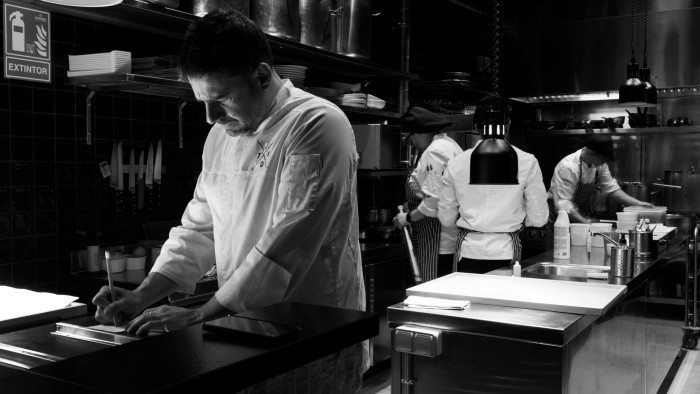
La Tasquería is not an average chichi Spanish eatery, however. It is probably the most original fine-dining restaurant in Madrid, a city that is undergoing a culinary revolution and is increasingly recognised as one of Europe’s top gourmet destinations. At the one-Michelin-star La Tasquería, chef Javi Estévez focuses his entire offering on casquería — offal — to spectacular effect, with various tasting menus for diners to choose from.
“Offal allows us to prepare dishes that are much more fun and attractive, with many more possibilities in terms of textures and flavour,” Estévez says. “In the end, a piece of meat such as a cutlet does not have so many possibilities.”
Diners can choose from either a short or long version of a menu of new dishes, or instead opt for the menu memoria, which celebrates the restaurant’s most emblematic plates since it opened in 2015. There is also the option to enjoy the best of both, as I did on a recent visit, which can be tailored with a range of extras including the restaurant’s signature dish: the whole head of a suckling pig, which has been confit and fried in olive oil. Even the snack courses included many parts of pig, cow and sheep that, as an avowed offal eater, I hadn’t ever discovered, with smoky pig’s snout’s salami, a bonbon of deep-fried lamb brain and a tartlet filled with diced beef testicle, Comté and tomato.
Historically, such an array of offal in a meal was not uncommon in Madrid, with no-frills restaurants or home cooks often serving dishes such as callos (tripe, chickpea and blood sausage stew), gallinejas (fried lamb tripe), and entresijo (a membrane that connects the lamb intestine to the stomach, and is fried). Likewise, in the rest of Spain, tripe, trotters and kidneys are commonly used in slow-cooked stews. But the tradition is in decline. “In the past, perhaps it was our grandmothers or our mothers who stayed at home to cook all these products,” Estévez says. “But in recent years this has changed a lot.”
Estévez is keen to revive the use of humble ingredients by showcasing their belonging in haute cuisine. He fondly recalls eating calf livers and onions (dressed up as veal fillet) most weeks when he was growing up, as well as lamb brains and calf’s testicles on occasion, the former battered and fried, the latter grilled and masked by a heavy dose of garlic and parsley. In the restaurant, Estévez employs similar tricks to drum up enthusiasm, often using salty flavours from seafood to complement an array of land-based ingredients. I particularly enjoyed his focaccia layered with lime mayonnaise, beef tendons, and cockles — a fascinating experience, texturally speaking. Tendons also appear in another dish alongside razor clam — a sea creature that they bear some visual resemblance to — swimming side by side in a beautifully balanced meunière sauce.
“In our case, the sea and mountains, as we say in Spain, have always been present for various reasons,” Estévez says. “For us, this connection has always worked very well and we always rely on it.”
Estévez also introduces zest and tang in the form of acids and spices from further afield, in order to complement and balance the gelatinous and fatty cuts he works with. “We always look to other cultures when we try to come up with new dishes,” he says, citing North African, Peruvian and Mexican cuisines as particular influences.
While dishes are challenging, much of the menu is carefully mantled in approachable presentation. There are courses that are straight up approachable too, like a take on carbonara with salty pieces of cured pig’s head and thin slices of squid in place of spaghetti, as well as a comforting tripe, snout and leg stew — a tribute to callos.
It is the signature dish — the pig’s head — that is the real highlight, however. It is presented table-side, where Estévez pulls apart each edible morsel with surgical precision, leaving cheeks, tongue, brain, snout, and eyeballs on a plate alongside a simple salad. The theatrical presentation encapsulates the chef’s ethos, while the meat is jaw-droppingly gratifying.
“In the old days, also related to the time when we spent more time cooking, even people who had animals at home had a pig, and that was the most sustainable thing in the world,” Estévez says. “From a pig you ate everything, from the snout to the liver, the tripe, to, of course, the loins, the legs, the shoulders, and then you also used everything else to make sausage,” he says. By only purchasing suckling pig heads, duck hearts, rabbit kidneys and pig’s ears, for example, he says the restaurant saves a lot of food that would otherwise be discarded.
Estévez is pleased that his work has influenced other restaurants, with offal re-emerging on menus in recent years. But it’s thrilling the offal-averse that may offer him the most satisfaction. “I think there is nothing nicer than someone who, a priori, is not going to enjoy your restaurant,” he says. “Then [they leave] delighted, having eaten things they had never thought they would eat in their lives.”
Do you have a favourite offal restaurant in Madrid, and what are your favourite Spanish offal-based dishes? Tell us in the comments below. And follow FT Globetrotter on Instagram to find out about our latest stories first
Read the full article here