

Unlock the Editor’s Digest for free
Roula Khalaf, Editor of the FT, selects her favourite stories in this weekly newsletter.
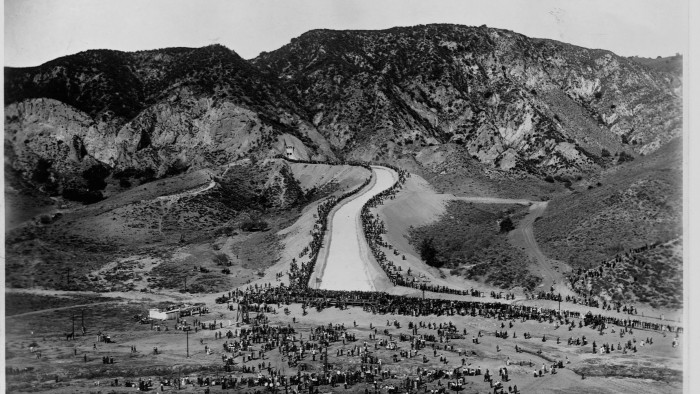
In 1913, William Mulholland completed the Los Angeles Aqueduct, a task so ambitious that only the Romans had previously constructed water diversions on such a scale. Mulholland’s pipe stretched from Owens Lake, a now dry lake on the eastern side of the Sierra Nevada, across barren deserts to the south-western corner of California. This 233-mile journey not only transformed the land’s fertility but also created the city which, from its tiny beginnings, came to dominate 20th-century imagination.
In Aqua, a part memoir, travelogue and investigation, the Italian filmmaker and writer Chiara Barzini tells the story of the founding of Hollywood, the building of the great water systems and confronts the precariousness of both. Her hometown, Rome, and its surrounding areas abound with empty aqueducts and pipes, each representing someone’s dream of turning dry soil into a fertile, lucrative agricultural land.
Barzini opens the book on January 7 2025; Los Angeles is burning. The Santa Ana winds, combined with the recent drought and the inadequate flow from the fire hydrants, result in one of the worst fires of recent years. The Eaton fire, for instance, grew 20-fold in a matter of hours: 12,000 houses, businesses and structures were wiped out and more than 150,000 people lost their homes.
Had the fire hydrants worked better, had water still been flowing freely through the underwater systems that criss-cross the city, the inferno might have been partially mitigated. In Barzini’s view, from the moment that Mullholland emptied Owens Lake into the City of Angels, he set the city on a course of mismanagement, greed and corruption. Today, water is (almost) as precious as gold; farmers in the north sell it to farmers in the south as it’s worth more than any arable crop. Landowners in the south hold auctions for water they’ve stored: the Kern Water Bank in the San Joaquin Valley is owned by one billionaire farming family who have been banking water since the ’90s in tanks and reservoirs. It’s a remarkable paradox that one of Hollywood’s most enduring classics, Chinatown, addresses head on.
Like the industry it created, Los Angeles itself is a dream city, one that could not have happened without Mulholland’s engineering miracle. His aqueduct allowed so much water to flow into LA that early movie directors were able to create spectacular “seas” inside movie lots to stage nautical battles. In Rome in 46BC Julius Caesar used the Aqua Alsietina to stage mock sea battles in specially dug-out basins known as naumachiae.
Barzini decides to follow Mulholland’s journey from Owens Lake to LA after a friend gives her a book entitled Construction of the Los Angeles Aqueduct Final Report. She is in discussion with an unnamed but clearly highly successful director about turning a book of hers into a movie. Things start well, then her calls aren’t returned so often and lunch does not always accompany their meetings. Every movie, she notes, is a gamble, but so was Mullholland’s decision. Los Angeles had no harbour, no railway and no gold. The mountains and deserts shut it off from the rest of the continent.
Mulholland’s own story is fascinating. He was born in Belfast and arrived in LA in 1878. He had no job or training but he met a well digger who needed help. Mulholland was fascinated by water — its life, power and absolute necessity. He studied diagrams of the aqueducts of the Roman empire; their construction stretched over five centuries. In 1904 a drought gripped the city and the LA water department put out a call saying it needed to supplement the water supply for the population of more than 100,000 (it is now 3.8mn). Mulholland, then superintendent of the city’s water system, became what Cadillac Desert author Marc Reisner once described as “a modern Moses”. “Instead of leading his people through the waters to the promised land”, Barzini writes, he “would cleave the desert and lead the promised waters to them.”
It was, like its Roman forebears, too good to last. Now, 112 years later, the water is running out. The Hoover Dam, the other great water engineering project of the western United States, promised everlasting flow. But the dropping of the Colorado river due to overuse and climate change has turned “the age of great expectations”, Barzini writes, referencing Reisner, into an “Era of Limits”.
This timely and excellent book is a modern day parable, vividly demonstrating the lengths that humans have gone to bend the planet to their will, regardless of logic, buoyed by the conviction that mankind can — and will always — solve any physical problem in its path. As Aqua so brilliantly shows, this is no longer the case. Los Angeles is living on borrowed time.
Aqua: A Story of Water and Lost Dreams by Chiara Barzini Canongate £16.99, 304 pages
Join our online book group on Facebook at FT Books Café and follow FT Weekend on Instagram, Bluesky and X
Read the full article here