

Unlock the Editor’s Digest for free
Roula Khalaf, Editor of the FT, selects her favourite stories in this weekly newsletter.
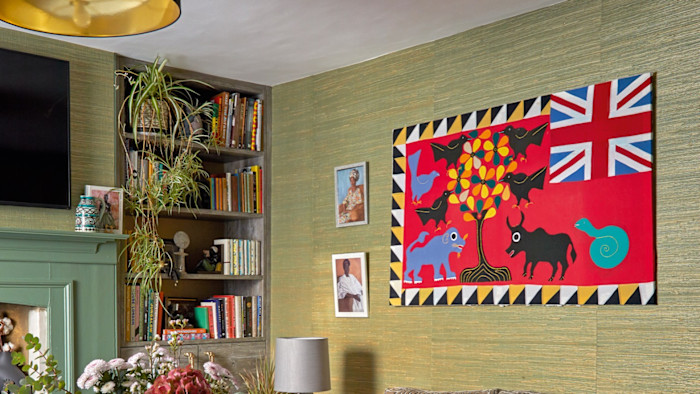
Unpacking the meaning of an Asafo flag, the military banner first created in the coastal villages of Ghana in the 17th century, can feel like playing the cartoon caption game at the back of The New Yorker. You might find a man holding the moon above his head, flanked by two proud black birds against a faded pink and cream wall, or a mustard-coloured dog passing his bone to a chocolate canine under the Union Jack on patchy ink-blue textile, or two men wearing hats, poised to do battle, standing over a bowl, spoon and cup, with a St George’s flag. What do the pictures mean?
The answers lie in the proverbs used by the Akan people, who live along the coast of Guinea, and in the culture of the Fante people of southern Ghana. The name Asafo, meaning “war people”, refers to the military companies established by the Fante people to defend their communities. The flags were made in workshops and co-operatives using dyeing, embroidery and appliqué techniques. Usually measuring 3ft x 5ft, the flags subverted colonial symbolism by referencing proverbs that seemed innocuous to outsiders but were legible to the resistance movement, who used them for covert communication. A hunter facing a tortoise and snail, for instance, draws on the Akan proverb that warns against bringing a gun to hunt harmless prey.
By the time Ghana won independence from Britain in 1957, the flags had captured the imaginations of collectors and are now used in ways that go far beyond their designated purpose. Asafo flags have also become popular as part of a wider embrace of textile arts. Institutional exhibitions and museum acquisitions have reframed perceptions and prices. The flags have been “repositioned from being ethnographic artefacts and presented more as visual statements of satire and political critique”, says Giles Peppiatt, director of modern and contemporary African art at Bonhams.
Kemide Lawson, co-founder of lifestyle store The Cornrow, discovered the flags when she was decorating her family home in north London. “With their bold use of colour combined with their intricate hand-appliquéd motifs, Asafo flags are simply stunning to look at,” she says. “They felt unusual too: even my Ghanaian friends were unfamiliar with them. It made them seem like little-known masterpieces.” The flags appear in the homes of model and activist Adwoa Aboah, who is part-Ghanaian, and French-Moroccan designer Ramdane Touhami, who has several hung in his Paris living room.
“The older flags are the most sought-after collectable pieces because of their rarity,” says Barbara Eyeson, the London-based creative director of Asafo Flags, an educational resource and sales platform. Pre-1957 examples, particularly designs featuring the Union Jack, command premium prices: they are seen as artefacts of Fante culture during a particularly fraught moment in history, in contrast to newer works made with the art and tourist market in mind.
“There is a kind of ‘golden age’ between about 1910 and Ghana’s independence in 1957,” says Duncan Clarke, founder of Adire African Textiles in London. Key markers for this era are the Union Jack, a light patina, hand-stitching and cotton material. In rare cases, older flags may have small stamps or handwritten text stating the name of the maker. A recent Sotheby’s auction in Paris included an undated flag incorporating a Union Jack with an estimate of €2,000 to €3,000. Eyeson currently has a 1940s flag by mid-20th-century master flagmaker Kweku Kakanu on sale for £4,500, which depicts the proverb “fish grow fat for the benefit of the crocodile, who rules the river”.
Interest has clustered around particular makers, including Kakanu, whose work has featured in the collections of the Smithsonian, Saint Louis Art Museum and Royal Ontario Museum. Kakanu worked from a workshop in Ghana’s Saltpond area, experimenting with striking interpretations of proverbs. A brown and purple design from the 1950s, currently for sale at Adire African Textiles (£4,500), features a small figure with blood on his hand and face after touching a pond, a warning not to underestimate the danger beneath a calm appearance. In November, Clarke sold a yellow and red flag by Kakanu depicting the proverb “our enemies are caught like fish in the net” for more than £6,000.
Eyeson stresses the importance of interrogating provenance. “A surge of dealers are labelling the flags as ‘vintage’ to command higher prices even though they were actually produced in the past 10 years,” she says. Auction houses and specialist dealers such as Clarke and Eyeson are all credible options in the UK, while in Ghana there is the Artists Alliance Gallery in Accra (where one of the world’s largest collections of Asafo flags is maintained) and Osabarimba Asafo Gallery in Cape Coast, which collaborates directly with makers.
Late last year, a collaboration between London’s Horniman Museum and contemporary flagmaker Baba Issaka marked the bicentenary of the Abolition of the Transatlantic Slave Trade Act with six new flags that told stories of trade and abolition. As older master flagmakers retire, however, fewer young artists are emerging. Organisations that support new commissions and work with rare contemporary craftsmen are becoming vital in preserving these fast-disappearing skills.
Read the full article here