

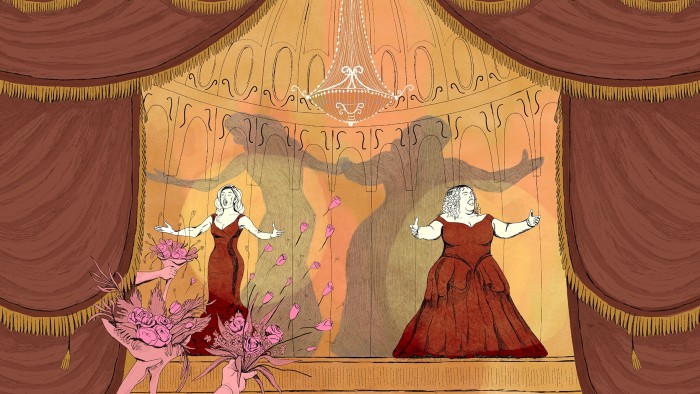
The opera, we’re told, ain’t over till the fat lady sings. We might be waiting a long time these days. In a world dominated by fashion-driven imagery of thin and thinner young things, opera stages, especially in Europe, are falling into line.
“We have to cast a thin soprano,” a director friend once patiently explained, “otherwise nobody will believe that the tenor falls in love with her.” Some of us must have missed the memo.
Despite the “body positivity” of recent years, singers in larger bodies are still passed over for roles and endure endless demands to slim down or sign up for weight loss surgery, sometimes losing their voices in the process. This was confirmed in a series of interviews with performers, pedagogues and institutional directors across three continents.
It is nothing new. Austrian-British impresario Rudolf Bing described Maria Callas in 1951 as “monstrously fat and awkward,” but after she dropped more than a third of her body weight in 1954, he declared her an “astonishing, svelte, striking woman.”
Callas was tall — 173cm — and now clocked in at 54kg, underweight even by the flawed standards of the body mass index. Before, she had endured endless slights and mockery. “Why are you so fat?” demanded vocal audience members when she sang Aida at La Scala in 1950. “All the Milanese saw was this overweight Greek lady,” Franco Zeffirelli would later recall.
Film director Luchino Visconti told Callas she would have to lose 30kg if she wanted to work with him. She lost a reported 40kg. Her secret? Not the rumoured tapeworms. Instead, she found doctors willing to inject her thyroid with iodine, and others who prescribed her amphetamines. She would suffer the terrible impact of these “treatments” for the rest of her life; to what extent they or the resulting weight loss can be blamed for the deterioration of her voice will always be a matter of speculation. Her official cause of death, at the age of 53, was heart failure — a common end for the victims of anorexia nervosa.
While overt public fat-shaming can now generate outrage, it continues unabated behind the scenes. American mezzo-soprano Jamie Barton is a vocal supporter of size diversity on the opera stage. “I think in that era it was more blatant,” she says of the insults that Callas endured. “It’s still absolutely prevalent. There’s no question. But back then it was so normal for men, especially, to comment out loud on the size of women’s bodies that I can only imagine the pressures she must have felt to live up to an ideal that, quite frankly, in my opinion, is meant to keep women weak.”
Barton says she has lost count of the number of times directors, designers, teachers and conductors have pulled her aside to discuss weight loss; her tale is a common one, echoed by other singers interviewed for this article. Comments about weight often begin at conservatoires and persist throughout professional careers.
“I’m 43 years old,” says Barton. “I’ve been through the diet culture thing. I’ve come out on the other side and I’m now at the healthiest place of my life. And that’s not because I’m skinny; it’s because I’m paying attention to my cholesterol and my blood sugar and the numbers that actually do have an impact on my health. I’m also at the top of my career, but these messages continue to come from people who just have, quite honestly, no place trying to dictate how somebody else’s body should look.”
Like Barton, South African soprano Golda Schultz says that she has left dieting behind.
“I’ve had my own struggle with disordered eating,” Schultz says. “I’m not ashamed to admit it. Before Covid I was probably the thinnest I’m ever going to be. And I look back at pictures that look great, but that person was stressed out. That person was worried about good food and bad food. Have I worked out enough to deserve to eat something? How’s the costume going to fit?”
Neither Barton nor Schultz need to fear that their size will have a negative impact on their career options; both are globally recognised as outstanding performers and work at the world’s top houses and festivals. But both worry about younger and less established peers who still suffer from what they see as the industry’s ingrained fatphobia.
I was told of a singer who was passed over for a prize at a major vocal competition because, according to a jury member, “with a body like that, he’s never going to get a job at a major opera house.” (The singer in question is also now enjoying spectacular professional success at top houses.) Schultz responds: “We’re erasing bigger bodies from the story of humanity. And that’s not fair, because we exist in the world. Why am I not allowed to see someone who looks like me, living out a love story, living out a story of vengeance, living out a story of anything?”
To Schultz, issues of representation apply equally to questions of race. “We don’t see enough brown and Black princesses on stage. There are brown and Black girls, little girls everywhere, young women out there who look like me, who don’t see themselves on stage. I have to fight, even if it makes me damn uncomfortable. It makes me so sad and it makes me so angry.”
Irish tenor Paul McNamara, who has specialised in Wagnerian roles and is also artistic leader of the Dutch National Opera Academy, says that it is not only women who face size discrimination. His solution, he says, is simply not to apply to houses where the evident aesthetic does not fit his own profile as a performer.
“There is a tendency today for opera houses to bring in directors from cinema or visual arts [instead of trained opera directors]. But when I go to the dentist, I’m not interested in being treated by somebody who isn’t a dentist. I want somebody who understands dentistry. The important thing, when it comes to opera, is that people understand what makes it so different from other genres. The emphasis on casting from looks, as opposed to casting from what one can sing, is dangerous.”
Body size is not directly correlated to strength of voice; vocal resonance is a complex science, but happens mostly within the chest, trachea, larynx, pharynx, mouth, nose and sinus cavities. And weight loss, McNamara explains, does not have to mean corresponding vocal damage. Nevertheless, opera singing is a whole-body endeavour, and careful training, especially of the supportive abdominal muscles, throughout any process of physical change, is essential. Pregnancy and childbirth, for instance, often result in vocal change.
Opera is, says McNamara, among other things, a visual art form, and casting has always been, at least on some level, about looks. Even so, early illustrations and, later, photographs of opera singers reflect society’s changing beauty standards, just as early ballet dancers once sported soft curves that today’s expectations do not permit. In the baroque era, castrati generated feverish adulation, despite inhabiting bodies that today seem oddly proportioned. What remains constant is the seductive power of music.
“Of course, when you go to the theatre, you want something to be credible,” says McNamara. “But the credibility in opera comes from the music. Why does a particular character express themselves in this rhythm, in this harmony, in this melody, with these particular words at this particular time? A credibility in those terms is, for me, much, much more important.”
“It’s so easy to say it’s the industry’s fault,” cautions Schultz. “But it’s not. We’re all culpable. Because we accept the narrative and we internalise it. We’re also not culpable, because it’s a narrative that we’ve been taught to internalise and accept by our mothers and our grandmothers. But we don’t have to accept it. We can also say: ‘The buck stops with me. I will be the generational rule-breaker.’”
Find out about our latest stories first — follow FT Weekend on Instagram, Bluesky and X, and sign up to receive the FT Weekend newsletter every Saturday morning
Read the full article here