
Playwright Laura Wade on why moving from Jilly Cooper to Somerset Maugham isn’t such a leap

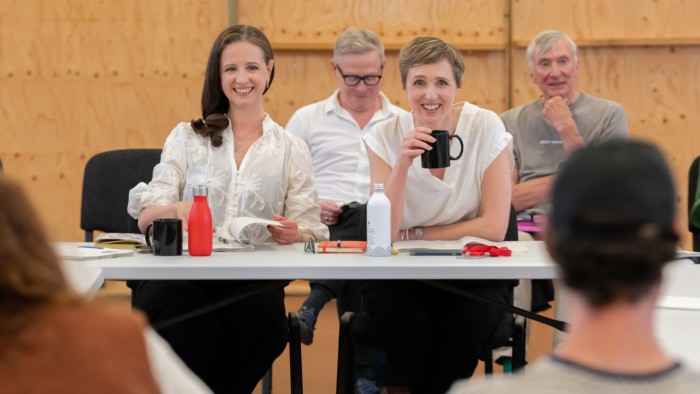
The actors in the Royal Shakespeare Company’s south London rehearsal room are clad in the casual workwear of 2025: jeans, sweatshirts, trainers. But their ramrod posture and clipped accents tell a different story. And as for the telephone — a marvellously ornate, green-and-gold device standing proudly on its own table — well, that makes today’s gadgets look altogether less smart.
This is the world of The Constant Wife, Somerset Maugham’s piquant 1926 comedy about marital dysfunction among a chic London set. Here infidelity and indiscretion come laced with droll repartee about occasional tables and a great deal of elaborate subterfuge over cigarette cases. However, when the eponymous wife, Constance, discovers the truth about her husband’s conduct, her response is both smart and unorthodox.
Though hugely popular in its day, the play is rarely revived and, when it is, people can be a little sniffy, making unflattering comparisons with Shaw (punchier) and Wilde (wittier). In 2005, the New York Times described it as “merely an elaborate comic trifle, all glittering surface shellacking an emotional void”. Ouch.
Playwright Laura Wade, who has revised the original for this new production, rides to the defence. “Well, first of all, I bloody love trifle,” she says. “And this is a trifle in which the ingredients down the bottom are really worth digging for. You’ve got confectionery sprinkles on the top, but it really has some deep emotion underneath.”
For her, Maugham’s comedy is closest to those of Noël Coward, another writer who could smuggle in bitter truths and rich psychological insight underneath pithy dialogue. Maugham offers a shrewd appraisal of the choices facing married women and creates a hugely intelligent, clear-eyed female character.
“His writing of Constance is extraordinarily empathetic,” says Wade. “The key thing for her is to establish her economic independence: that’s what gives her power. That is a remarkably modern and wise thing for her to do . . . I think his work has been unjustly under-represented. But we can sometimes find the plays a little unwieldy for a modern production — which is why it has been so nice to have this opportunity to have a tinker.”
A tinker? “We’ve called it a remix,” says Wade with a smile, explaining that she has done some judicious restructuring and added a few playful touches. “It’s really about distilling the essence of what’s there — it was never a question of modernising it. There are a lot of things in the play that are so surprisingly feminist, people will probably think they are my additions. But they aren’t at all.” (As well as seeking financial independence, Constance proposes that men and women be measured by the same moral standards and has some radically pragmatic views on marriage.)
Wade has a rare skill for interweaving social commentary and comedy in work that often explores Britishness, class and belonging. Her 2010 play Posh portrayed the outrageous exploits of an elite Oxford university drinking club: “I remember people thinking it was a bit far-fetched. And then we watched, over the next few years, everything that was metaphorically contained in it play out.”
Then came the dazzlingly clever Home, I’m Darling, in which a modern couple try to revert to 1950s domesticity, and The Watsons, a scintillating meta-theatrical response to Jane Austen’s unfinished novel. Most recently, she’s been deeply immersed in “Rutshire”, as a writer and executive producer of Disney’s streaming series Rivals, an adaptation of Jilly Cooper’s fabulously raunchy account of Cotswolds coupling and 1980s excess.
Rivals has been quite the ride. The screen version gleefully embraces the eye-watering intemperance of the novel. Opening with Alex Hassell’s gloriously lubricious toff, Rupert Campbell-Black, going at it full throttle with a journalist in the Concorde lavatory, it continues in that vein, scattering innuendos like confetti. “I don’t think I could have done any of it without your incredible equipment,” says a character, coyly, at one point.
How do you write dialogue like that with a straight face, I ask Wade, who, dressed in black and sipping tea, cuts a demure figure. “It’s just going with it,” she replies. “Letting it be itself and not apologising for it. There are times when we’ve fine-tuned the sexual politics, but we don’t sanitise it.”
The first season romped to success, but Wade, now working on season two, suggests that it’s the darker period detail beneath the shoulder pads and swagger that makes it: the frank depiction of sexism, racism and homophobia.
“I think people are coming to a new appreciation of Jilly Cooper’s work,” she says. “The books are so rich, and her characters are so brilliantly drawn — funny, but heartbreaking. Social commentary, class — there’s just so much stuff in her books for you to play with: it’s like Dickens.”
It might feel like a big step from nude tennis to the more decorous conduct in Austen and Maugham. But Wade suggests that, at heart, their concerns are similar: power, class, sexual politics — and money.
“We tend to think Jane Austen is about the romance but it’s always about the money. As with The Constant Wife, if you haven’t got the money, then you haven’t got the freedom to make independent choices.”
Back in the rehearsal room, Rose Leslie, playing Constance, is packing “scandalous beach trousers” into a suitcase. Maugham’s play, for all its surface sparkle, keyed into a significant sociological shift: 1926 was the year British women were given the same property rights as men; two years later, they would get equal franchise.
A hundred years on, it’s important not to take those rights for granted, says Wade: “It’s worth remembering how hard won those things were. And we still live in a world where women are very often at an economic disadvantage, very often in relationships that they can’t afford to leave. Or they’re economically disadvantaged by having taken time off to have children or care for family members. We still live in an unequal place.”
‘The Constant Wife’, Swan Theatre, Stratford-upon-Avon, to August 2, rsc.org.uk
Find out about our latest stories first — follow FT Weekend on Instagram, Bluesky and X, and sign up to receive the FT Weekend newsletter every Saturday morning
Read the full article here