

Unlock the Editor’s Digest for free
Roula Khalaf, Editor of the FT, selects her favourite stories in this weekly newsletter.
The wild banks of Tasmania’s Swan River are home to millions of flowers, thousands of insects and hundreds of birds. White-bellied sea eagles and three species of cormorant are as common as pigeons in a public park, drawn by the abundance of fish in its waters. High on the ridge lines, more cautious than the birds, Bennett’s wallabies send their unmistakable silhouettes bounding through thin woodlands.
Rising on the flanks of Mount St John, the Swan runs for about 45km, meandering south to Moulting Lagoon, where grebes, herons, egrets, ducks and mighty Australian pelicans gather in uncommon abundance. Satisfyingly, it is also home to thousands of black swans. It’s their presence, and annual moulting, that gives both river and lagoon their names.
Finally the lagoon empties into Great Oyster Bay, the now brackish river water mingling with the cold expanse of the Tasman Sea. Having piloted me through the fecund river’s meanders and the lagoon to the sea, Mat Routley cuts our small boat’s engine and drops a fishing line. “What a day!” says the Tasmanian, as though it’s happened by accident. Broad-shouldered and handsome, he looks like he could take a punch without flinching.
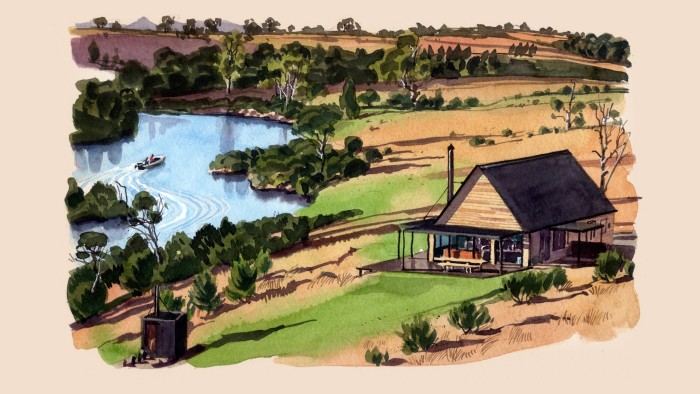
The exploration of these beautiful, bountiful waters is part of Routley’s Tasmanian “safari”, which he leads from the Swan River Sanctuary, his newly opened lodge on the riverbank. The property lies at the edge of his regenerative beef farm and sleeps private groups of up to six, complete with wood-fired sauna and a platform for leaping into the river.
A couple of times a month, Routley takes guests on his safari, an immersive tour of the region. For me that means a morning out on the river, catching half a dozen sand flatheads — a delicious bottom-dwelling fish — then anchoring at Hazards Beach on the east side of Great Oyster Bay for a short hike over to the white sands of Wineglass Bay. Other visitors who’d just completed an arduous trek to reach the same point looked at us with naked envy.
The safari description is no accident. As a younger man, Routley made repeated trips to Africa and took inspiration from its high-end lodges, with some of those ideas making their way back to Tasmania. As well as some of the decor (though there are no zebra prints) and the open fireplace in the lodge’s main lounge, Routley’s rotational approach to his beef farm was in part inspired by watching migrations of animals on the great plains of east Africa.
“This is a culmination of a bunch of experiences, but this farming and tourism model was for sure drawn from those experiences in Africa,” he says. “I loved some of the lodges I stayed in. I was walking around taking photos of how it all looked and worked, while other people were out searching for animals.”
Like many African lodges, Swan River Sanctuary is off-grid, with water coming from rainfall, power from the sun. Routley has resisted temptation to install WiFi, although at just over 100km north-east of Hobart, most mobile phones still work. Routley originally built the lodge as a holiday home for his family but, after a separation, decided to open it to the public.
When it’s not booked, he still brings his daughters here. “Trips down the river, kayaking, a bit of birdwatching — this is how we live on the east coast of Tasmania. Your weekend is basically how I’d be living with my family.”
The branches of both sides of his family tree are Tasmanian. Many men in his position — a white landowner — would ignore the Aboriginal history on the island, but not Routley. During our return boat ride, he bought oysters from the Melshell Oyster Shack, then berthed us in some reeds to read stories of pre-European life on these lands.
After a long, graphic account of a bloody battle that was fought just yards from where we were, he said: “I’ve been influenced over time to realise that it’s just the white history that’s taught, but to me the Aboriginal story feels more authentic and important in this particular place.”
Perhaps this all sounds a bit too good to be true, a bit too earnest. But that afternoon we puttered back up the Swan River accompanied by dozens more birds looking to roost, showing us the way home. Routley and his girlfriend and business partner Alex Hurley then set about cooking our morning’s catch, while I was left to drink a local beer and consider the newly installed sauna as the sun set. I thought about what I’d do differently if I owned this place instead — and failed to come up with much at all.
Find out about our latest stories first — follow FT Weekend on Instagram and X, and sign up to receive the FT Weekend newsletter every Saturday morning
Read the full article here