
Postcard from Val Thorens: huge snowfalls across the Alps start the ski season with a bang

It was dark as our rental car snaked up the mountainside last Friday night, the snow growing heavier the higher we climbed. Above the little French village of Saint-Martin-de-Belleville, the icy flakes shining in the headlights took on a hypnotic quality, perhaps giving the impression we were about to make the jump to hyperspace. Trees glimpsed through fogged windows were weighed down with snow.
But the road ahead, after being quiet for months, was suddenly busy — a procession of red tail-lights stretching into the night. Our destination, at the top of the 30km valley, was Val Thorens, the Alps’ highest ski resort, where the next day the lifts would start turning for “La Grande Première”, the opening weekend of the winter season.
For once, the weather seemed to be perfectly on script: the storm was due to drop 70cm, then clear in the early hours, to leave a sunny Saturday. That news had drawn hundreds of avid skiers from nearby cities — Grenoble, Chambéry, Albertville, Annecy and more. At the side of the road, lay-bys were full with drivers trying to remember how to fit their snow chains, but even the hitchhikers seemed in high spirits, anticipation insulating them from the snow collecting on their shoulders.
Many ski resorts open gradually, starting with a few lifts, perhaps launching for a weekend but then staying closed midweek, and often catering mainly to locals. Val Thorens has developed an alternative approach — trying to open with not just as many lifts as possible, but with as many hotels, restaurants and bars too. “I have to go round all the owners promising them there will be lots of people here,” says Vincent Lalanne, director of the tourist office.
No one would claim this is a year-round resort. Set at 2,300 metres above sea level, high above the tree line and surrounded by rock and scree, even its devotees admit it can be bleak in autumn. Most hospitality businesses here shut down in the off-season, so announcing the resort is back and full of life is crucial.
And this year Lalanne was in luck. Saturday morning dawned as bright and cold as forecast — a deep blue sky and -10C in the resort. We rented skis and joined the eager rush on to perfect pistes, tracing a zig-zagging clockwise route around the bowl that surrounds the resort, then dropping down to the sunny slopes of Orelle in the next valley.
We took the new Face Nord gondola, rising to just over 3,000 metres (which, given the altitude and aspect, some hope will allow the resort to extend its season even further), and later the Cime Caron cable car, now back in action with two new cabins after an accident left it closed for all of last winter. In total, 18 of the resort’s 31 lifts were running — the links over the ridge to Méribel, and the rest of the Trois Vallées (600km of pistes in all) aren’t due to open until December 6 — and 14,334 people were skiing, 30 per cent up on the previous year.
But “Val Tho” isn’t alone in getting a flying start. The mid-mountain weather station at Engelberg, Switzerland, recorded 195cm of fresh snow in the week to November 26; Avoriaz got 130cm at the top of its slopes in a single day on Monday, saying it hadn’t seen such quantities in November since 2012. Val d’Isère, Les Deux Alpes, Crans-Montana, Wengen and many others are due to open this weekend with excellent conditions. Skiers in the western US must be looking on with envious eyes: big-hitters including Jackson Hole, Park City and Telluride have all had to postpone their openings due to warm temperatures and lack of snow.
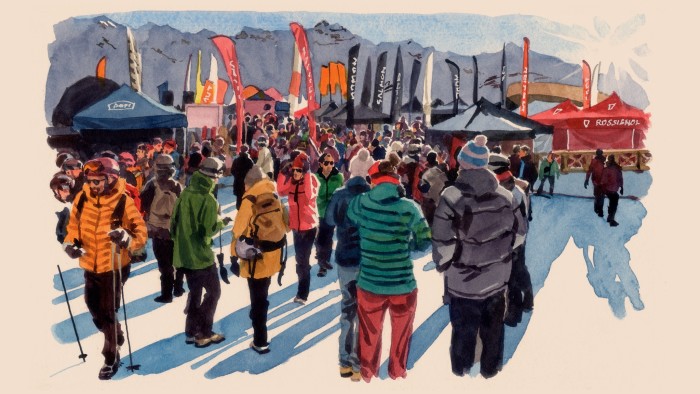
Back in Val Thorens, we stopped for lunch then called in at the makeshift village of brightly coloured tents, banners flying above them like a medieval joust, where 50 brands were offering their latest skis and snowboards for testing, for free. By the time I returned to hand back my pair of Salomon Addikt Pro 76s, a DJ was playing — the booth housed in a vintage caravan, the dance floor compacted snow — and vin chaud and cakes were being handed out. Two local breweries had set up stalls; in the cinema a free programme of ski movies was just getting under way.
The resort has always prided itself on being unconventional, its few founding families acting, in Lalanne’s words, like “wild west pioneers”, to create a resort at unprecedented altitude and in the face of widespread scepticism. St Moritz had already celebrated its centenary as a winter resort by the time Val Thorens got its first few draglifts in 1971, but the upstart grew quickly in the ’80s and ’90s, becoming known as a young destination for serious skiing — and with a party reputation to match. Once a place of rabbit-hutch apartments, it has seen a push upmarket: until 2012 there were no five-star hotels but then four opened in as many years.
Another is currently being built, along with a four-star Mama Shelter, due to open in 2027. But the party-seekers are still more than welcome. Opening day for many ended in “la rue de la soif” (thirsty road), a street filled with bars and clubs, including the Danish Café Snesko and The Frog, a British pub that claims to be the highest in Europe.
But if the bars, and the slopes, were packed to bursting on Saturday, by Sunday afternoon — with the skies darkening and another big storm rolling in — the pistes were emptying. By Monday morning, they were all but silent. I skied from the top of the Péclet gondola back to town, a little more than 3km, without passing another person. Then it was back into the car, back down the winding road, as the snow started to fall once again.
Find out about our latest stories first — follow FT Weekend on Instagram, Bluesky and X, and sign up to receive the FT Weekend newsletter every Saturday morning
Read the full article here