

Unlock the Editor’s Digest for free
Roula Khalaf, Editor of the FT, selects her favourite stories in this weekly newsletter.
Balcony scenes have become a thing for director Jamie Lloyd. A year ago he staged Romeo & Juliet without one; now he’s taken the show-stopping mega-moment in Evita out of the theatre altogether, with Rachel Zegler’s Eva Perón delivering “Don’t Cry for Me Argentina” to crowds outside the London Palladium from a theatre balcony (see below). Audiences inside watch the scene live-streamed on a giant screen.
The move has made headlines — PR stunt or genuine attempt to share art with the masses? — thus animating afresh the questions that course through Andrew Lloyd Webber’s musical about Argentina’s controversial 1940s first lady. It’s a brilliant idea. It’s also superbly executed.
Zegler had her breakthrough in Steven Spielberg’s 2021 West Side Story remake, before starring in this year’s Snow White misfire. Here she is slight, fragile, hovering high above the crowd in a glittering white ballgown, her voice first sweetly low, then soaring and yearning as she pleads for the trust of the rapt onlookers. She has us all captive at that point — those on the ground gazing up, smartphones raised; those in the auditorium watching close-ups of her glistening eyes. Far from being short-changed, you feel part of something bigger.
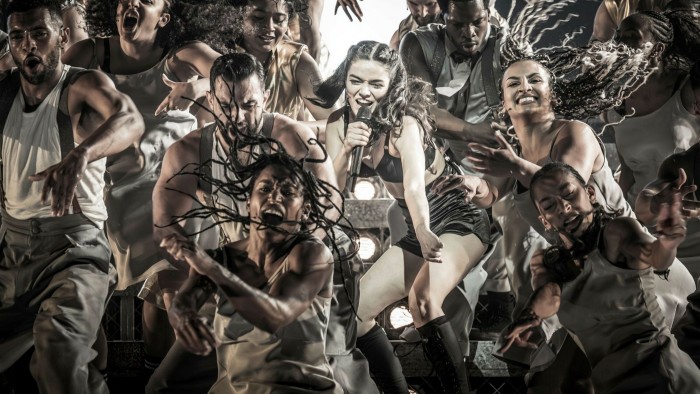
It’s stunning: the apex of a show that, like Lloyd’s Sunset Boulevard, boldly reframes a much-loved musical for today. Together with designer Soutra Gilmour and choreographer Fabian Aloise, Lloyd rips away period detail to stage a pulsating, contemporary spectacle — smoke, streamers, dazzling lights, bodies gleaming with sweat — on a flight of steps that rise, symbolically, to the giant letters EVITA.
A superb ensemble of dancers surge up and down them, playing mourners, soldiers or the Argentine elite, executing Aloise’s dazzling, athletic choreography. Musical director Alan Williams brings raw emotion and sharp definition to the score. The whole thing is perched queasily between superstar arena concert and populist political rally.
It’s youthful, angry, hopeful. But the exhilaration segues into something more sinister. The blue and white ticker tape raining down as Perón is elected feels almost oppressive; that same tape spills from white balloons as they are popped each time a dissenter is silenced. Spectacle splices with violence; the atmosphere feels electric, loaded.
There is a price to pay for this approach: the intense volume can feel relentless, you lose too many of Tim Rice’s sharp, witty lyrics and, with them, some narrative clarity. But it viscerally expresses the heady nature of populism and the tip into authoritarianism, and smartly frames the tension between the public and private Eva: the impoverished young woman who defies the establishment and champions the poor, but is dogged by accusations of corruption and still divides opinion decades after her death.
Zegler’s riveting Eva sustains this ambivalence. On stage she cuts a very different figure from that shimmering princess on the balcony. In a black performance bra and shorts, her chin tilted defiantly, she’s part rock diva, part streetwise hustler. She dares to outplay the snobs and sexists, edging seductively closer to James Olivas’s coolly ambitious Juan Perón to convince him she’ll “be good for him”, and watching impassively as his former mistress — played beautifully by Bella Brown — departs.
She and Diego Andres Rodriguez’s excellent, sardonic Che, who acts as the play’s narrator, critic and conscience, battle for control of a handheld mic and, with it, the story. But there is too an electric charge between them: two humans carrying the hopes of thousands in a volatile time. And coursing underneath all of Eva’s ambition, Zegler suggests vulnerability and a deep desire for validation. Her reprise of that signature anthem is tremendous: this time there’s no ballgown, no crowd, just one final plea to believe her.
★★★★★
To September 6, evitathemusical.com
Read the full article here